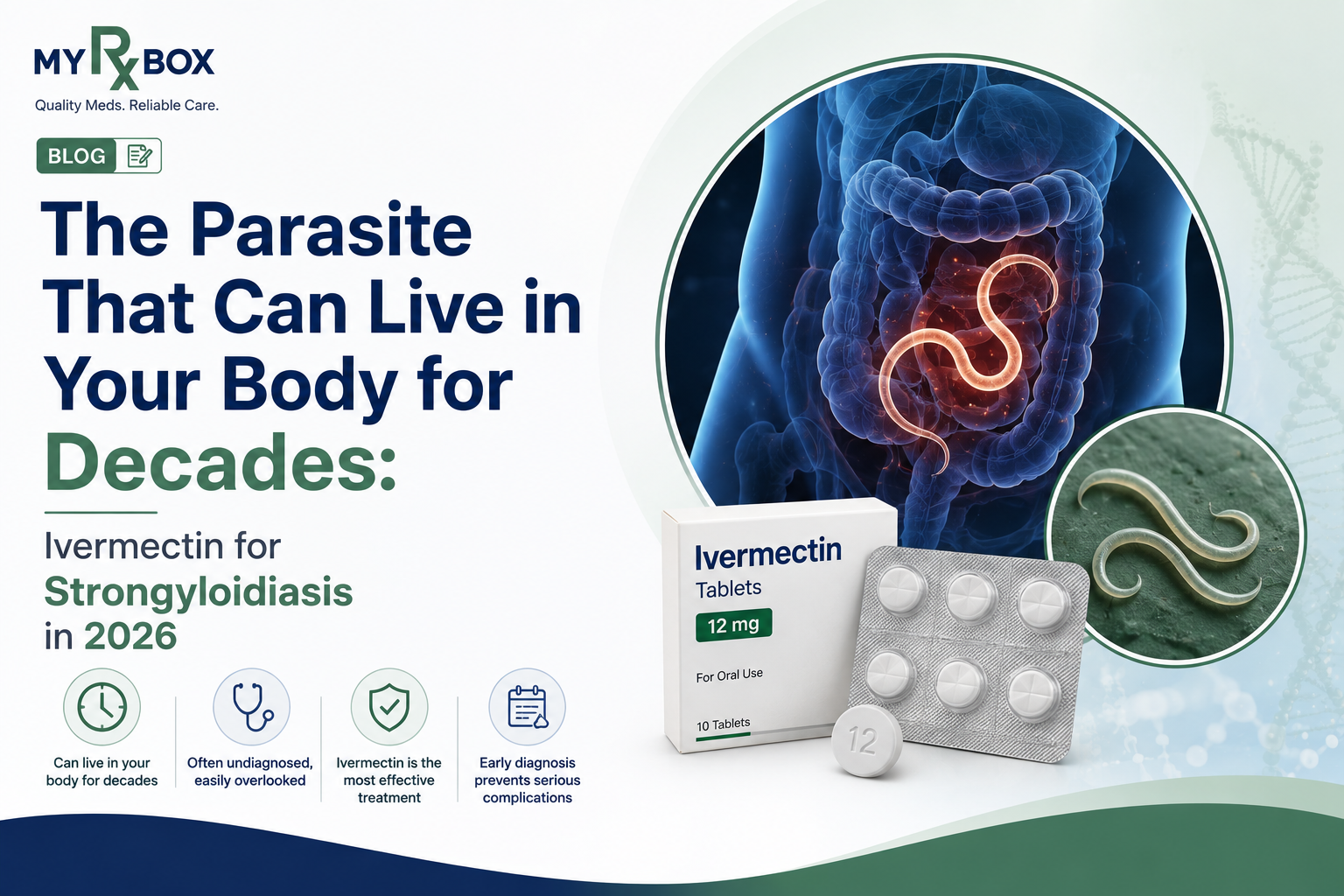
Imagine picking up a parasite during travel, childhood or years spent in a tropical region—and carrying it without realizing it for decades.
That is possible with Strongyloides stercoralis.
Unlike many intestinal worms, Strongyloides has a remarkable ability to reproduce within the human host through a process called autoinfection.
That means an untreated infection can persist for years or potentially for life.
For many people, it causes few or no obvious symptoms.
But under certain circumstances—particularly after immune suppression—the infection can become dramatically more dangerous.
CDC updated its clinical overview in February 2026 and warns that hyperinfection syndrome and disseminated strongyloidiasis can have case-fatality rates approaching 90%.
That is one reason ivermectin has such an important established medical role.
For readers unfamiliar with the drug itself, the MyRxBox ivermectin guide explains the medicine and its different formulations.
What Is Strongyloidiasis?
Strongyloidiasis is a parasitic infection caused primarily by the roundworm Strongyloides stercoralis.
The infection is particularly associated with tropical and subtropical regions.
WHO estimates that approximately 300 million to 600 million people worldwide are infected.
The parasite is found across parts of:
- South and Southeast Asia
- Africa
- Central America
- South America
- The Caribbean
- Pacific regions
- Other tropical and subtropical areas
People can become infected when larvae in contaminated soil penetrate the skin.
This is one reason exposure involving bare feet and contaminated soil has historically been associated with infection.
Once inside the body, the larvae migrate and eventually reach the intestine.
But Strongyloides has one feature that makes it unusual among intestinal parasites.
It can reinfect its own host.
Why Strongyloides Can Stay in the Body for Decades
Most intestinal worms eventually leave the body unless a person becomes infected again.
Strongyloides can behave differently.
Its autoinfection cycle allows new larvae to develop inside the infected person and reinvade the body.
CDC notes that this process means Strongyloides infection can persist for decades or even lifelong when untreated.
For migrants and travelers, this creates an important medical issue.
Someone may have left an endemic region many years ago and still carry an infection.
CDC’s immigrant and refugee guidance notes that if Strongyloides is not detected around arrival in the United States, the average time before diagnosis can be more than five years.
The infection does not necessarily disappear simply because the exposure happened long ago.
For broader information about intestinal worm treatment, MyRxBox also has a deworming tablets for adults guide.
The Symptoms Can Be Surprisingly Easy to Miss
Strongyloidiasis can be difficult to recognize because chronic infections may produce very mild symptoms—or none at all.
Possible symptoms include:
- Abdominal discomfort
- Diarrhea
- Constipation
- Nausea
- Reduced appetite
- Cough
- Itchy skin
- Recurrent rash
CDC says some people with chronic infection have mild eosinophilia, meaning elevated levels of a type of white blood cell called an eosinophil.
But symptoms alone cannot reliably diagnose Strongyloides.
A person with abdominal discomfort after travel does not automatically have a parasitic infection, and self-treating based only on symptoms can delay the correct diagnosis.
Why Doctors Worry About Strongyloides Before Steroid Treatment
This is the part of the story that gives Strongyloides unusual clinical importance.
A chronic infection that has remained almost silent for years can potentially become severe when the immune system is suppressed.
High-dose corticosteroids are one of the best-known triggers.
CDC says hyperinfection syndrome and disseminated strongyloidiasis are most frequently associated with previously subclinical infection in patients receiving high-dose corticosteroids, including treatment for conditions such as asthma or COPD exacerbations.
WHO has separately warned healthcare professionals about the risk of corticosteroids triggering potentially fatal Strongyloides hyperinfection.
The danger is not that steroids “create” the parasite.
The infection may already be present.
Immune suppression can allow the parasite’s autoinfection cycle to accelerate dramatically.
What Is Strongyloides Hyperinfection?
Hyperinfection occurs when the parasite’s normal reproductive and migration cycle accelerates, producing a much larger burden of larvae.
Disseminated disease is even more serious because larvae can spread beyond the gastrointestinal tract and lungs into other organs.
CDC says untreated hyperinfection and disseminated strongyloidiasis can have mortality rates approaching 90%.
WHO has likewise reported case-fatality rates above 60% in disseminated disease.
This is why screening can matter before some patients start significant immunosuppressive therapy.
Someone with a history of living in or extensive travel to an endemic region should tell their healthcare professional about that exposure—particularly if they are about to receive corticosteroids or other immune-suppressing treatment.
Is Ivermectin Actually Approved for Strongyloidiasis?
Yes.
This is one of the important distinctions between Strongyloides and many controversial ivermectin claims found online.
Human oral ivermectin has an established, labeled medical role in treating intestinal strongyloidiasis.
Current U.S. DailyMed labeling for prescription ivermectin tablets specifically includes strongyloidiasis under dosage and administration.
Current 2026 U.S. labels also continue to list human prescription ivermectin tablets in 3 mg strength.
Readers comparing oral formulations can review the MyRxBox ivermectin tablets guide.
The important point is that this is not an experimental internet use.
Strongyloidiasis is one of ivermectin’s established antiparasitic indications.
How Is Ivermectin Used for Strongyloidiasis?
Treatment should be determined by a healthcare professional after evaluating the patient and infection.
CDC identifies ivermectin as the first-line treatment for acute and chronic strongyloidiasis.
Current U.S. prescription labeling uses weight-based dosing for strongyloidiasis.
Because treatment is calculated according to body weight and because special situations can change management, people should not simply select a tablet strength and calculate a treatment course for themselves.
Current prescription labeling also recommends follow-up testing to verify eradication of infection.
That matters because feeling better does not necessarily prove that Strongyloides has been eliminated.
Anyone researching how ivermectin strengths differ can read the MyRxBox ivermectin dosage guide, but an individual Strongyloides treatment plan should still come from an appropriately qualified clinician.
Why Are Ivermectin Tablets Commonly 3 mg in U.S. Drug Labels?
Current U.S. prescription labels provide an interesting detail.
DailyMed listings updated in 2026 continue to show human ivermectin tablets supplied in 3 mg units.
For example, an Ajanta Pharma USA label revised in April 2026 lists ivermectin tablets USP 3 mg as a human prescription product.
Another Zydus product became marketed in February 2026 and is also listed as ivermectin tablets USP 3 mg and Rx only.
The tablet count needed for an approved indication may therefore depend on body weight rather than choosing a single high-strength tablet.
That is one reason consumers should distinguish between:
tablet strength and prescribed total dose.
They are not the same thing.
If cost is part of the decision after a prescription has been issued, MyRxBox’s ivermectin price guide can help explain how formulations and prices differ.
Do Not Assume 6 mg, 12 mg or 40 mg Is Automatically “Better”
Online medicine listings often emphasize tablet strength.
That can create the impression that a higher number means a stronger or more effective treatment.
For weight-based antiparasitic therapy, that is the wrong way to think about it.
The appropriate total amount depends on the indication and patient.
A 12 mg tablet is not automatically “better” than a 3 mg tablet.
Likewise, choosing the highest ivermectin strength available online does not make treatment safer or more effective.
The MyRxBox ivermectin category contains multiple formulations and strengths, which makes checking the exact drug form and prescription particularly important.
Strongyloidiasis Is Different From Scabies
Another frequent source of confusion is that ivermectin is used in discussions involving several parasitic conditions.
Strongyloidiasis is an intestinal nematode infection caused by Strongyloides stercoralis.
Scabies is a skin infestation caused by the Sarcoptes scabiei mite.
They are completely different organisms and conditions.
The treatment approach is therefore not interchangeable.
Readers specifically researching scabies should use the dedicated ivermectin for scabies guide rather than applying scabies information to Strongyloides infection.
Strongyloidiasis Is Also Different From Routine Deworming
People sometimes use “worms” or “deworming” as if every intestinal parasite were treated in the same way.
That is not correct.
Different parasites respond to different medicines.
For example, ivermectin, albendazole, mebendazole and praziquantel each have different roles depending on the parasite involved.
WHO identifies ivermectin as the drug of choice for Strongyloides and considers albendazole less effective for this particular infection.
This makes diagnosis important.
Rather than simply choosing a general “deworming tablet,” patients should know which parasite is actually being treated whenever possible.
The MyRxBox anti-worm medicines section provides a broader overview of antiparasitic medicine categories.
Who Should Be Considered for Strongyloides Screening?
CDC advises healthcare professionals to be particularly alert to Strongyloides in people who:
- Are receiving or about to receive corticosteroids or other immunosuppressive therapy
- Have unexplained persistent eosinophilia
- Have a history of living in or traveling to endemic areas
- Have compatible gastrointestinal or skin symptoms
- Are being evaluated for organ transplantation
- Have certain conditions associated with increased risk of severe infection
Exposure history matters.
A patient should mention previous residence or long-term travel in tropical or subtropical regions even if the trip happened many years ago.
Strongyloides can persist long after the original exposure.
How Is Strongyloidiasis Diagnosed?
Diagnosis can involve stool examination, serologic blood testing and other specialized tests.
CDC identifies serial stool examination as an important diagnostic method because a single stool sample can sometimes miss infection.
Strongyloides larvae may not be shed consistently.
Serologic testing can therefore also be useful in appropriate clinical situations.
The correct test depends on factors such as symptoms, exposure history and immune status.
This is another reason buying ivermectin before confirming the problem may not be the best first step.
A positive diagnosis helps determine what needs to be treated and whether follow-up testing is required.
What Happens After Ivermectin Treatment?
Follow-up can be important.
CDC recommends follow-up stool examination 2–4 weeks after treatment in patients with positive stool examination and persistent symptoms to confirm that the infection has cleared.
If larvae are still found, retreatment may be needed.
Current U.S. ivermectin labeling similarly advises follow-up stool examinations to verify eradication.
So a completed tablet course should not always be interpreted as the end of the process.
For an infection capable of persisting through autoinfection, confirming successful treatment matters.
Hyperinfection Requires Different Medical Management
Routine chronic Strongyloides infection and severe hyperinfection are not managed in exactly the same way.
CDC’s treatment guidance for hyperinfection/disseminated strongyloidiasis calls for daily ivermectin treatment under medical supervision until stool and/or sputum examinations remain negative for two weeks.
That is very different from someone independently following a standard outpatient treatment schedule.
Hyperinfection is a medical emergency.
Patients who are seriously ill, immunosuppressed or suspected of disseminated Strongyloides require clinician-directed care rather than an online medication protocol.
A Special Warning for People With Possible Loa loa Exposure
Ivermectin is not risk-free in every parasitic setting.
CDC specifically warns that patients with high levels of Loa loa microfilariae can develop serious neurologic reactions after ivermectin.
Loa loa is endemic in parts of West and Central Africa.
CDC’s refugee-health guidance therefore recommends additional caution and appropriate evaluation before presumptive ivermectin treatment in people with relevant exposure to Loa loa-endemic regions.
This is an important example of why travel history matters before taking an antiparasitic drug.
“I was in Africa” is not enough information.
The specific country and region may influence treatment decisions.
Why WHO Made Strongyloidiasis a Bigger Public-Health Priority
Strongyloidiasis historically received far less attention than several other tropical parasitic diseases.
That is beginning to change.
In 2024, WHO published its first guideline on public-health control of strongyloidiasis.
WHO estimates 300–600 million infections globally and highlights the parasite’s ability to create lifelong infection through autoinfection.
The guideline conditionally recommends ivermectin-based mass drug administration in qualifying endemic communities with sufficient Strongyloides prevalence.
That public-health policy is different from individual treatment purchased through a pharmacy, but it reinforces ivermectin’s established role against this particular parasite.
Can Travelers Get Strongyloides?
Yes.
Long-term residents of endemic regions are not the only people who can be exposed.
Travelers can potentially acquire infection through contact with contaminated soil.
The risk depends on location, sanitation conditions, activities and exposure.
Someone who develops unexplained gastrointestinal symptoms, recurrent rash or eosinophilia after relevant travel should discuss the exposure with a healthcare professional rather than assuming it is routine “traveler’s stomach.”
The especially surprising point is that symptoms do not have to appear immediately.
Because Strongyloides can persist, the medical relevance of travel may remain years later.
What Should You Check Before Obtaining Ivermectin Tablets?
If a healthcare professional has prescribed ivermectin, verify that you are purchasing human oral ivermectin from an appropriate source.
Check:
- The active ingredient
- Tablet strength
- Manufacturer
- Expiration date
- Packaging integrity
- Prescription directions
- Pharmacy or dispensing source
In the United States, current human ivermectin tablet labels remain prescription-only.
Do not replace human prescription ivermectin with veterinary ivermectin.
And do not assume that an ivermectin cream or lotion can substitute for oral tablets used for an intestinal parasite.
If you are comparing legitimate medicine costs after receiving a prescription, see the MyRxBox ivermectin price guide and Medicine Price Index.
For broader purchasing-safety information, read the MyRxBox online pharmacy guide.
The Biggest Mistake: Treating Ivermectin as One Universal Product
The name “ivermectin” appears on many products.
That does not mean they do the same thing.
There are:
- Oral prescription tablets
- Topical rosacea cream
- Head-lice lotion
- Veterinary products
- Different strengths and manufacturers
Strongyloidiasis involves oral human ivermectin prescribed for an intestinal parasitic infection.
A cream intended for rosacea cannot treat intestinal Strongyloides.
A head-lice lotion cannot treat intestinal Strongyloides.
Veterinary ivermectin should not be substituted for human medicine.
Understanding the formulation is just as important as recognizing the drug name.
The Bottom Line
Strongyloides is one of the strangest parasites affecting humans.
It can enter through the skin.
It can reproduce within its host.
It can remain for decades.
And an infection that caused almost no symptoms can become life-threatening when immune suppression changes the balance between parasite and host.
That is why Strongyloides deserves more attention—and why ivermectin has an important legitimate role in medicine beyond the controversies that have surrounded the drug online.
CDC identifies ivermectin as first-line therapy for uncomplicated strongyloidiasis, while current U.S. prescription labeling specifically includes strongyloidiasis as an indication for ivermectin tablets.
But the right sequence matters:
Recognize the risk. Get evaluated. Confirm the diagnosis when appropriate. Use human ivermectin under proper medical guidance. Complete follow-up when recommended.
If you’re researching the medication itself, visit the MyRxBox ivermectin guide, compare oral formulations in the ivermectin tablets guide, or review the broader ivermectin medicine category.
Frequently Asked Questions
Is ivermectin used to treat Strongyloides?
Yes. CDC identifies ivermectin as first-line treatment for acute and chronic strongyloidiasis, and current U.S. prescription ivermectin labeling includes intestinal strongyloidiasis as an approved indication.
Can Strongyloides really remain in the body for decades?
Yes. Strongyloides can maintain an autoinfection cycle inside a human host, allowing untreated infection to persist for decades and potentially lifelong.
Why are steroids dangerous for someone with Strongyloides?
Corticosteroid-related immune suppression can allow Strongyloides replication and migration to accelerate, potentially producing hyperinfection or disseminated disease.
How dangerous is Strongyloides hyperinfection?
CDC’s February 2026 clinical overview states that hyperinfection syndrome and disseminated strongyloidiasis can have case-fatality rates approaching 90%.
Is ivermectin an FDA-recognized treatment for strongyloidiasis?
Yes. Current U.S. prescription ivermectin tablet labeling specifically contains dosing instructions for intestinal strongyloidiasis.
Are ivermectin tablets over the counter in the United States?
Current U.S. human ivermectin tablet labels list them as prescription medicines.
Is 12 mg ivermectin better than 3 mg for Strongyloides?
A higher tablet strength is not automatically better. Treatment is based on the prescribed total dose, often calculated by body weight, rather than choosing the highest-strength tablet available.
Should I take ivermectin before starting steroids?
Do not self-start ivermectin solely because you are taking steroids. People with relevant Strongyloides exposure risk should discuss screening and treatment with a clinician before significant immunosuppressive therapy.
Can ivermectin cream treat Strongyloides?
No. Topical ivermectin cream is a different formulation used for conditions such as inflammatory rosacea lesions. Intestinal strongyloidiasis requires systemic treatment directed by a healthcare professional.
How do doctors confirm the infection is gone?
CDC recommends appropriate follow-up testing in selected patients, including repeat stool examinations after treatment when indicated.
Medical Disclaimer: This article is for general educational information and does not replace diagnosis or treatment by a qualified healthcare professional. Strongyloidiasis can become life-threatening in immunosuppressed patients. Oral ivermectin is a prescription medicine in the United States, and treatment should be selected according to the patient’s diagnosis, body weight, exposure history, medical conditions and other relevant clinical factors.