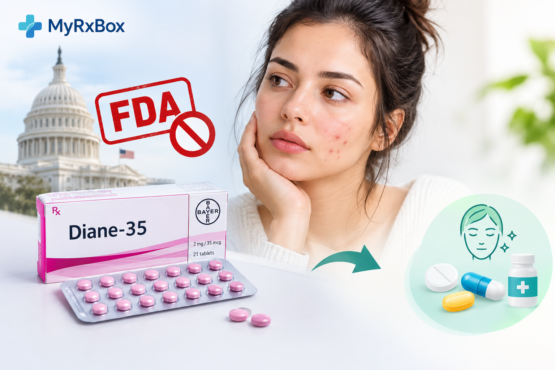
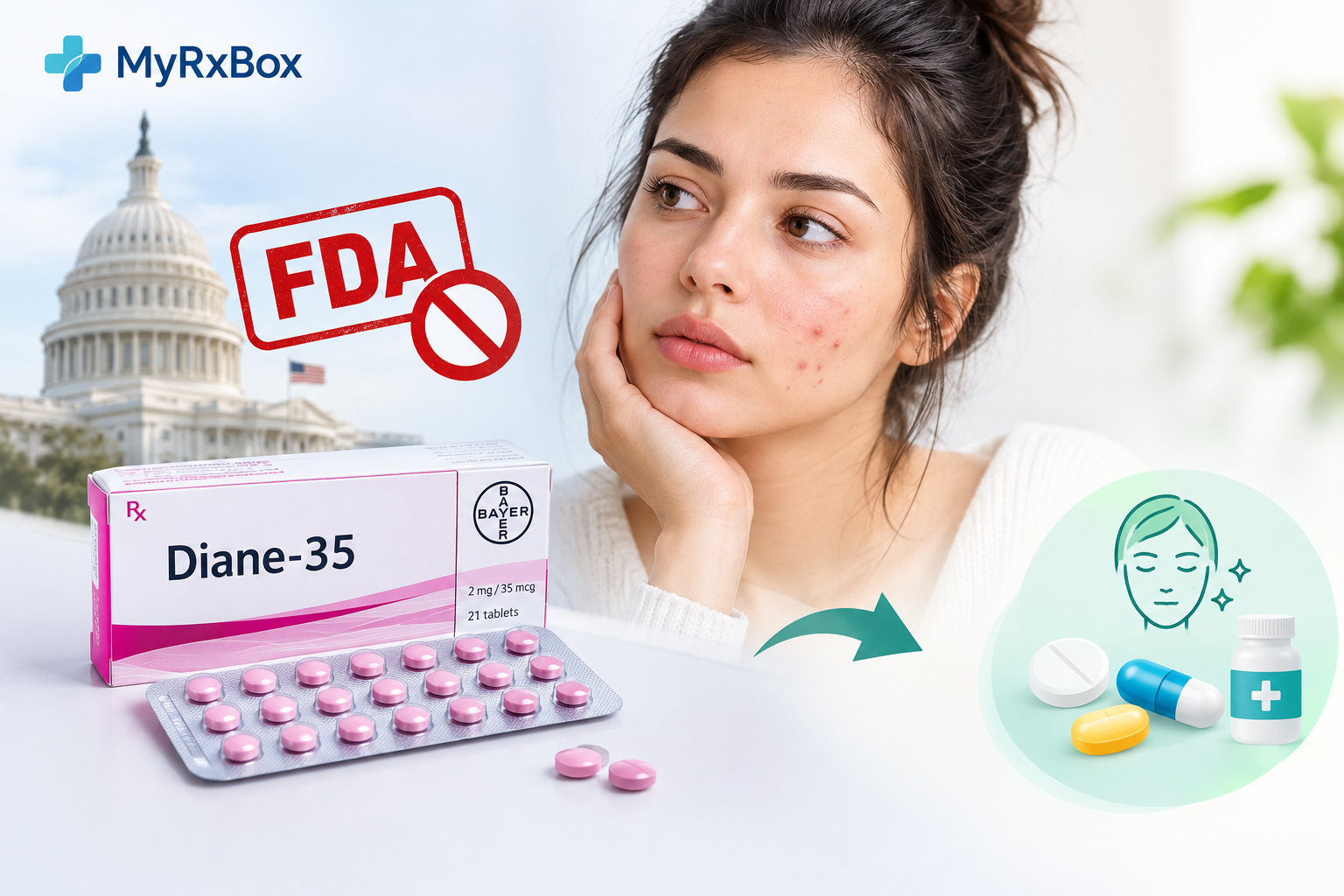
Diane-35 has become a much-discussed treatment for hormonal acne, especially among women searching for relief from persistent breakouts, oily skin, and unwanted facial hair. But there’s a surprising catch: although the medication is prescribed in several countries, it has never received FDA approval in the United States.
So why do people keep searching for “Diane 35 USA”? Does it really work better than other acne treatments? Was it banned because of blood clots? And what can American patients use instead?
The answers are more nuanced than social-media claims about a miracle acne pill.
This evidence-based MyRxBox guide examines the medication’s active ingredients, approved uses abroad, clinical research, blood-clot concerns, FDA status, and treatment alternatives available in the United States.
Diane-35 in the USA: The Quick Answer
Diane-35 is not FDA-approved in the United States. Its active ingredients are cyproterone acetate 2 mg and ethinylestradiol 35 micrograms. The combination is prescribed in several countries for particular androgen-related skin conditions, especially moderate to severe acne and excessive hair growth in women.
However, several important facts matter:
- FDA status: Diane-35 is not an FDA-approved medication and is not an authorized U.S. prescription product.
- Primary medical purpose abroad: Treatment of androgen-sensitive acne or hirsutism under specific restrictions.
- Contraceptive effect: Diane-35 suppresses ovulation, but European regulators do not recommend prescribing it solely for contraception.
- Major safety concern: Its risk of venous blood clots is approximately 1.5–2 times that associated with combined pills containing levonorgestrel.
- U.S. alternatives: FDA-approved acne treatments include certain combined oral contraceptives, topical retinoids, and clascoterone cream. Spironolactone is also used off-label under medical supervision.
Bottom line: Diane-35 can be effective for selected patients, but it is not automatically the best or safest treatment for hormonal acne. U.S. patients have several established alternatives.
Sources: European Medicines Agency and American Academy of Dermatology.
1. What Is Diane-35?
Diane-35 is a prescription hormonal medication that combines an anti-androgen with an estrogen. It has been used internationally to manage certain skin and hair conditions associated with androgen activity.
| Feature | Diane-35 details |
|---|---|
| Brand name | Diane-35 |
| Active ingredient 1 | Cyproterone acetate 2 mg |
| Active ingredient 2 | Ethinylestradiol 35 micrograms |
| Drug class | Anti-androgen and estrogen combination |
| Main use | Androgen-sensitive acne and hirsutism |
| Contraceptive activity | Yes |
| FDA approval | No |
| U.S. prescription availability | Not an FDA-approved U.S. product |
| Prescription status internationally | Prescription medicine |
Diane-35 is also associated with the name Dianette in the United Kingdom, while other markets have generic formulations of the same hormonal combination.
A frequent misunderstanding concerns the number 35. It refers to 35 micrograms of ethinylestradiol, not 35 mg of cyproterone acetate.
This distinction is important because taking medications with incorrectly understood strengths can cause serious problems.
2. How Does Diane-35 Work for Hormonal Acne?
To understand the appeal of Diane-35, it helps to understand the role hormones play in acne.
Androgens, including testosterone, influence the skin’s oil-producing sebaceous glands. Increased androgen activity can contribute to excessive sebum production, clogged pores, and inflammatory acne lesions.
Diane-35 targets this pathway through two ingredients.
Cyproterone acetate: blocking androgen effects
Cyproterone acetate has anti-androgen properties. It interferes with androgen signaling, helping reduce some of the hormonal stimulation responsible for oily skin and acne.
Ethinylestradiol: modifying hormone activity
Ethinylestradiol supports changes in hormonal regulation, including an increase in sex hormone-binding globulin (SHBG). This can reduce the amount of free testosterone circulating in the bloodstream.
Together, these effects can improve androgen-related skin symptoms.
However, not every acne breakout is caused by excessive androgen activity. Genetics, follicular blockage, inflammation, and other biological processes also contribute.
This is why a dermatologist may recommend topical medications before considering systemic hormonal therapy.
For a closer look at commonly used topical treatments, read our Salicylic Acid vs Benzoyl Peroxide comparison.
3. Is Diane-35 FDA-Approved in the United States?
No. Diane-35 has not received FDA approval for acne, birth control, PCOS, or any other indication.
Cyproterone acetate itself is not an FDA-approved, commercially available U.S. medication.
This is a regulatory distinction, not proof that the FDA has formally banned Diane-35 following a product-specific safety decision.
FDA approval requires a manufacturer to submit an application supported by appropriate evidence of safety, effectiveness, quality, and manufacturing standards.
Without U.S. marketing approval, Diane-35 cannot be marketed as an FDA-approved prescription medicine in the United States.
Was Diane-35 banned in the USA?
Calling Diane-35 “banned in America” is misleading.
The important distinction is:
Not FDA-approved is not the same as FDA-approved and later withdrawn.
There is no basis to claim that Diane-35 was withdrawn from the U.S. market after a proven nationwide safety scandal. It was not approved for the U.S. market in the first place.
European regulators reviewed its safety in 2013 and allowed continued use under stricter conditions.
Can Americans legally order Diane-35 from another country?
The FDA states that importing unapproved foreign medications for personal use is generally illegal. Limited enforcement-discretion situations may exist, but they are not blanket permission to import any prescription drug.
A medication being approved in Canada, Europe, or elsewhere does not automatically make it approved for U.S. consumers.
Before obtaining medication from an international source, review the FDA’s personal importation guidance and speak with a qualified U.S. clinician.
For broader online medication safety, see the MyRxBox guide: Before You Buy Medicine Online: 7 Checks That Can Save You Trouble.
4. What Conditions Is Diane-35 Used to Treat?
In countries where it is authorized, Diane-35 is primarily associated with androgen-related conditions.
Moderate to severe acne
European prescribing guidance restricts its use to moderate to severe acne associated with androgen sensitivity.
For acne, treatment is generally reserved for patients who have not responded adequately to topical therapies or systemic antibiotics.
Hirsutism
Hirsutism refers to excessive growth of coarse, dark hair in androgen-sensitive areas, such as the face, chest, or abdomen.
By blocking androgen effects, the medication may help reduce this unwanted hair growth over time.
Oily skin
Diane-35 may improve excessive oil production when it is associated with androgen activity, including in patients treated for qualifying acne.
Polycystic ovary syndrome (PCOS)
Some people with PCOS experience acne, unwanted facial hair, or irregular periods.
Diane-35 may address certain androgen-related symptoms in countries where clinicians prescribe it appropriately, but it is not a cure for PCOS and should not be described as an FDA-approved PCOS treatment.
The international PCOS guideline also notes that acne alone is a relatively weak indicator of biochemical androgen excess.
If acne occurs alongside irregular menstrual cycles, increasing facial hair, or scalp hair thinning, a clinician may assess whether PCOS or another hormonal condition is contributing.
Source: 2023 International Evidence-Based PCOS Guideline.
5. Does Diane-35 Really Work for Acne? What Clinical Evidence Says
There is evidence that hormonal contraceptive combinations, including those containing cyproterone acetate, can improve acne.
But the quality and interpretation of that evidence matter.
A major Cochrane systematic review included 31 clinical trials involving 12,579 women.
The review found that combined oral contraceptives reduced facial acne compared with placebo. Some comparisons suggested better acne outcomes with cyproterone-containing combinations than with certain other pills.
However, the reviewers also reported that consistent differences between pill types were limited.
That means we should not confidently claim that Diane-35 is universally more effective than Yaz, all other birth control pills, or modern topical therapies.
What the evidence supports: Diane-35 can help androgen-sensitive acne in appropriately selected patients.
What it does not prove: Diane-35 is the single best acne treatment for every woman.
Read the original research: Cochrane — Effect of Birth Control Pills on Acne in Women.
6. Diane-35 Results: How Long Before Acne Improves?
One common disappointment with hormonal acne treatment is expecting visible results within days.
The official UK Dianette prescribing information states that symptom improvement takes at least three months.
A realistic way to understand treatment progress is:
| Treatment period | What to expect |
|---|---|
| First few weeks | Visible improvement may be limited |
| Around 2–3 months | A reasonable period for an initial response assessment |
| After 3 months | Clinician reviews response, side effects, and whether treatment should continue |
| Longer-term treatment | Ongoing reassessment is necessary; treatment should not continue automatically |
These are general review points, not a guarantee that every patient improves within a specific timeframe.
Excessive facial hair may respond more slowly than acne because the hair-growth cycle is different from the development of acne lesions.
Avoid changing hormonal medicines repeatedly or increasing doses without medical advice.
For readers considering nonhormonal options, our Tazarotene vs Tretinoin guide explains how two prescription topical retinoids compare.
7. The Biggest Diane-35 Safety Concern: Blood Clots
Diane-35’s blood-clot risk is one of the most important issues identified by medicine regulators.
A blood clot that develops in a deep vein is called deep vein thrombosis (DVT). If a clot travels to the lungs, it may cause a pulmonary embolism (PE), a potentially life-threatening emergency.
In 2013, the European Medicines Agency reviewed Diane-35 and similar cyproterone-containing combinations.
It concluded that their benefits could outweigh the risks for certain patients, but only with restrictions designed to reduce thromboembolic complications.
How much higher is the risk?
The EMA reported that venous thromboembolism risk with Diane-35 is approximately 1.5 to 2 times higher than with levonorgestrel-containing combined contraceptive pills.
This is a relative-risk comparison, not a statement that 1.5% or 2% of users will develop a clot.
Understanding the actual numbers
For context, European regulators published the following approximate annual clot rates for several combined hormonal contraceptives.
| Group | Estimated blood clots per 10,000 women per year |
|---|---|
| Non-pregnant women not using combined hormonal contraception | 2 |
| Levonorgestrel-containing combined pills | 5–7 |
| Norgestimate- or norethisterone-containing combined pills | 5–7 |
| Drospirenone-, desogestrel-, or gestodene-containing combined pills | 9–12 |
Important: These are general combined-contraceptive estimates from the EMA, not directly measured Diane-35-specific rates. Diane-35 was reviewed separately, and its risk varies with patient characteristics.
The comparison shows why a relative increase matters even when blood clots remain uncommon.
Sources: EMA Diane-35 Safety Review and EMA Combined Hormonal Contraceptives.
Who may face a higher risk?
Risk assessment becomes particularly important for patients with:
- A personal history of deep vein thrombosis or pulmonary embolism
- Inherited clotting disorders or a significant family history
- Migraine with aura
- Smoking, particularly at age 35 or older
- Major surgery or prolonged immobility
- Severe hypertension or certain cardiovascular conditions
- Obesity or multiple additional clot-risk factors
The medication’s official contraindications also include pregnancy, certain liver diseases, breast cancer, and a history of meningioma.
Symptoms that require emergency medical attention
Seek emergency medical care if you develop sudden or unexplained symptoms such as:
- Pain or swelling in one leg
- Sudden shortness of breath
- Sharp chest pain, especially with breathing
- Sudden vision loss or changes
- A severe, unusual headache
- Sudden weakness, facial drooping, or trouble speaking
Do not wait for symptoms to resolve if a blood clot or stroke is suspected.
For the full safety information, consult the official Dianette prescribing information.
8. Diane-35 and the Meningioma Question: What the 2020 Review Found
Some headlines connect cyproterone acetate with meningioma, a tumor arising from the membranes surrounding the brain and spinal cord.
The concern is real, but dose matters significantly.
In 2020, the European Medicines Agency reviewed meningioma risk associated with cyproterone-containing medications.
The review identified the greatest concern with prolonged exposure to higher doses, particularly 25 mg daily or more.
Diane-35 contains 2 mg of cyproterone acetate per active tablet.
The EMA reported that the available evidence did not indicate a meningioma risk for low-dose combination products containing 1–2 mg of cyproterone acetate.
However, this does not prove that every possible risk has been excluded.
As a precaution, low-dose cyproterone-containing products should not be used in people who currently have or have previously had a meningioma.
The correct message is not “Diane-35 causes brain tumors” or “Diane-35 has zero brain-tumor risk.” The available regulatory evidence distinguishes higher-dose cyproterone exposure from lower-dose combination medicines.
Source: European Medicines Agency — Cyproterone and Meningioma Safety Review.
9. Diane-35 Side Effects Beyond Blood Clots
Blood clots are not the only consideration.
According to the official UK prescribing information, commonly reported adverse effects include:
- Nausea or abdominal discomfort
- Headaches
- Breast tenderness or pain
- Weight changes
- Altered or depressed mood
- Changes in menstrual bleeding
Some patients may also experience fluid retention, migraine, reduced libido, or other reactions.
Mood changes deserve particular attention. Depression can be serious, and patients should report new or worsening depressive symptoms promptly.
Anyone considering Diane-35 should have a professional assessment of their medical history, blood pressure, current medicines, and relevant risk factors.
10. Diane-35 vs Yaz: Which Is Better for Hormonal Acne?
This is one of the most useful comparisons for American readers.
Although both are hormonal combinations that may improve acne, they are not the same medicine.
| Feature | Diane-35 | Yaz |
|---|---|---|
| Hormonal components | Cyproterone acetate + ethinylestradiol | Drospirenone + ethinyl estradiol |
| U.S. FDA-approved | No | Yes |
| Acne use | Authorized under restrictions in several countries | FDA-approved for moderate acne under specific conditions |
| Contraceptive action | Yes | Yes |
| Blood-clot concerns | Yes | Yes |
| Main U.S. advantage | No approved U.S. formulation | U.S.-approved prescribing information and regulated distribution |
Yaz is FDA-approved for moderate acne in females at least 14 years old who have begun menstruating, are appropriate candidates for combined oral contraception, and want an oral contraceptive for birth control.
That does not mean Yaz is safe for every patient. It also carries important blood-clot and cardiovascular warnings.
And although some evidence suggests differences in acne outcomes between cyproterone-containing and drospirenone-containing pills, the available research does not establish a universal winner.
A clinician should consider acne severity, whether contraception is desired, medical history, and medication-specific risks.
Source: Official U.S. Yaz Prescribing Information.
11. Best U.S. Alternatives to Diane-35 for Acne
American patients do not need to rely on a non-FDA-approved foreign hormone combination to explore evidence-based acne treatment.
The American Academy of Dermatology recommends several topical and systemic options depending on the patient’s clinical needs.
FDA-approved hormonal options
| Treatment | U.S. status | Main consideration |
|---|---|---|
| Yaz (drospirenone/ethinyl estradiol) | FDA-approved for moderate acne in qualifying patients aged 14+ | Patient must also desire oral contraception |
| Tri-Estarylla (norgestimate/ethinyl estradiol) | FDA-approved for moderate acne in qualifying patients aged 15+ | Appropriate combined-pill candidate who desires contraception |
| Tilia Fe (norethindrone acetate/ethinyl estradiol) | FDA-approved for moderate acne under specified conditions in patients aged 15+ | Intended for patients who desire contraception and whose acne has not responded to topical treatment |
Each has its own eligibility criteria, adverse effects, and contraindications.
Sources: Yaz label, Tri-Estarylla label, Tilia Fe label.
Spironolactone for hormonal acne
Spironolactone is a prescription medicine originally used for conditions such as hypertension and fluid retention.
It also has anti-androgen activity and is used off-label for acne in selected women.
The American Academy of Dermatology gives spironolactone a conditional recommendation for acne treatment.
However, it is not FDA-approved specifically for acne.
Spironolactone also requires pregnancy-related precautions and assessment of potassium-related risks, particularly in patients with kidney disease or interacting medications.
Before any combination treatment, patients should review their complete medication list with a pharmacist. Our Drug Interaction Checker can be used as a preliminary screening aid, but does not replace a professional medication review.
Winlevi (clascoterone 1% cream)
Winlevi is a topical androgen-receptor inhibitor approved by the FDA for acne in patients aged 12 years and older.
Unlike Diane-35, Winlevi is applied to the skin rather than taken as a systemic hormonal pill.
It may appeal to patients who need a prescription topical option, although it has its own safety warnings, including possible local irritation and hypothalamic-pituitary-adrenal axis suppression.
Source: Official Winlevi Prescribing Information.
Prescription topical retinoids
Topical retinoids help prevent blocked pores and are foundational medications for many forms of acne.
Common examples include tretinoin, adapalene, and tazarotene, depending on formulation and prescription requirements.
MyRxBox readers can explore educational product information on Retino-A 0.025% Cream and Retino-A 0.05% Cream.
Important: A product listed on an international pharmacy website is not automatically an FDA-approved U.S. formulation. Patients should obtain prescription medicines through legally authorized channels and follow their prescriber’s instructions.
Topical retinoids can cause irritation and require particular precautions during pregnancy or when planning pregnancy.
Other evidence-based acne treatments
Depending on severity, clinicians may also recommend:
- Benzoyl peroxide
- Azelaic acid
- Topical antibiotics in appropriate combinations
- Oral doxycycline for selected inflammatory acne cases
- Isotretinoin for severe, treatment-resistant, or scarring acne under strict medical supervision
A treatment plan does not have to begin with hormonal medication.
Source: American Academy of Dermatology — Acne Clinical Guideline.
12. What About Hormonal Acne Without Birth Control?
Not everyone wants or can safely use a combined hormonal contraceptive.
Some patients are trying to conceive, have medical contraindications, or simply prefer non-contraceptive treatment.
Depending on the circumstances, a clinician may consider topical retinoids, benzoyl peroxide, azelaic acid, clascoterone, or other medications.
Spironolactone may be an option for some adult women, but it is not appropriate during pregnancy and requires individualized risk assessment.
The safest option depends on more than whether acne appears around the jawline or worsens before a menstrual period.
A dermatologist can help determine whether hormonal therapy is necessary at all.
13. Six Diane-35 Myths That Deserve a Fact Check
Myth 1: Diane-35 is banned worldwide.
Fact: It remains authorized under specific restrictions in several countries. Its absence from the U.S. market reflects a lack of FDA approval.
Myth 2: Diane-35 is the strongest acne pill available.
Fact: Clinical evidence supports acne improvement, but it does not prove that Diane-35 is universally more effective than other appropriate treatments.
Myth 3: Diane-35 is completely safe because many women take it.
Fact: Wide use does not eliminate blood-clot risk, contraindications, or adverse effects.
Myth 4: Taking Diane-35 together with another birth control pill improves results.
Fact: European regulators specifically advise against combining it with another hormonal contraceptive because additional hormone exposure can increase risks.
Myth 5: Diane-35 cures PCOS.
Fact: It can address certain androgen-related symptoms but does not eliminate the underlying condition.
Myth 6: The 2020 meningioma warning means every Diane-35 user will develop a brain tumor.
Fact: The EMA’s findings were primarily associated with higher cyproterone doses and prolonged exposure. Low-dose products have different evidence, although relevant precautions remain.
14. How to Discuss the Right Acne Treatment With Your Doctor
Instead of choosing a medication based on popularity, it helps to start with the clinical problem.
| Your main concern | Options to discuss with a clinician |
|---|---|
| Blackheads or clogged pores | Topical retinoids or other comedone-targeting therapies |
| Red, inflammatory acne | Benzoyl peroxide, appropriate prescription combinations, or oral treatment |
| Acne that fluctuates with menstrual cycles | Hormonal assessment and potential hormonal or topical treatment |
| Acne plus a desire for contraception | An appropriate FDA-approved combined oral contraceptive |
| Adult female acne without a desire for contraception | Topical treatments, clascoterone, or selected off-label options |
| Deep nodules or scarring | Dermatology referral and assessment for isotretinoin or other specialist treatment |
| Acne plus irregular periods and increased facial hair | Evaluation for PCOS or other endocrine causes |
This is a discussion framework, not a self-prescribing tool.
When visiting a dermatologist, consider asking:
- Is my acne actually androgen-sensitive, or could another treatment work better?
- Do I need testing for PCOS or another hormonal condition?
- Am I at increased risk of blood clots?
- Would an FDA-approved treatment be more appropriate?
- How will we measure treatment response and decide when to change the plan?
15. Frequently Asked Questions About Diane-35
Is Diane-35 available in the USA in 2026?
Diane-35 is not FDA-approved in the United States and is not an authorized U.S. prescription medicine. Patients should discuss approved alternatives with their clinicians.
Why is Diane-35 not FDA-approved?
No FDA approval exists for this combination. It would be inaccurate to claim a particular FDA rejection reason without evidence of such a decision.
Can Diane-35 clear hormonal acne permanently?
Diane-35 can improve androgen-related acne while it is being used, but it does not guarantee permanent clearance. Acne may recur when hormonal treatment is discontinued.
Is Diane-35 a birth control pill?
It suppresses ovulation and has contraceptive effects. However, European prescribing guidance does not recommend using it solely as a contraceptive, and it should not be combined with another hormonal contraceptive.
Is Diane-35 better than Yaz?
Neither medicine is demonstrably best for every patient. Diane-35 is not FDA-approved in the U.S., whereas Yaz has an FDA-approved acne indication for qualifying patients.
Does Diane-35 cause weight gain?
Weight increase is listed among the possible adverse effects in the UK product information. Not every patient experiences weight changes, and individual weight changes cannot automatically be attributed to the drug.
Can Diane-35 help PCOS-related acne?
It may improve androgen-related acne in some patients, but it is not a cure for PCOS and is not FDA-approved for PCOS treatment.
How long does Diane-35 take to work?
Official UK product information states that symptom relief takes at least three months. Individual responses vary, and continued treatment should be reviewed regularly.
Does Diane-35 cause blood clots?
Diane-35 increases venous blood-clot risk compared with no hormonal contraceptive use. European regulators estimate its risk at approximately 1.5–2 times that of levonorgestrel-containing combined pills.
Can Diane-35 be used during pregnancy?
No. Pregnancy is a contraindication. Patients who become pregnant or suspect pregnancy while taking it should seek prompt medical advice.
Can I take Diane-35 with spironolactone?
Do not combine prescription hormonal treatments independently. The appropriateness of any combination depends on medical history, pregnancy considerations, potassium-related risks, and clinician assessment.
What should I do if I miss a Diane-35 tablet?
Follow the instructions for the exact product and country-specific patient leaflet, and ask a pharmacist promptly. Advice can depend on how many tablets were missed, the timing in the pack, and whether pregnancy prevention is needed. Emergency contraception advice may be necessary in some circumstances.
Is Diane-35 the same as Ginette-35?
Both names are associated with formulations containing cyproterone acetate 2 mg and ethinylestradiol 35 micrograms. However, brand names do not guarantee identical regulatory approval, manufacturing standards, packaging, or availability in every country.
Is it legal to buy Diane-35 online for delivery to the United States?
FDA guidance says importing unapproved medications is generally illegal, subject to limited enforcement discretion. Patients should not interpret an overseas seller’s willingness to ship as confirmation that importing the product is lawful or safe.
16. The Final Verdict: Should Americans Choose Diane-35 for Acne?
Diane-35 is neither the miracle cure suggested by some online discussions nor a medicine that must be described as universally unsafe.
Clinical evidence supports its ability to improve certain androgen-sensitive skin conditions. Regulators in multiple countries have retained it for restricted uses.
But the decision has important limitations.
Its lack of FDA approval, blood-clot risk, other contraindications, and availability of U.S.-approved alternatives make self-directed use particularly concerning for American patients.
For a U.S. reader, the sensible first step is to identify the type and severity of acne, assess any underlying hormonal condition, and discuss FDA-approved options with a qualified clinician.
For readers continuing their research, explore MyRxBox’s acne treatment ingredient comparison, retinoid comparison guide, and online pharmacy safety checklist.
The goal is not simply to find a popular acne pill. It is to find a treatment with a reasonable chance of working and a safety profile appropriate for you.
Medical References and Authentic Sources
The following sources support the key clinical and regulatory information in this guide.
- European Medicines Agency (2013). Diane-35 and generic medicines: benefits, risks, and prescribing restrictions. Read the EMA decision.
- Bayer plc / UK Electronic Medicines Compendium. Dianette Summary of Product Characteristics, including indications, dosing, contraindications, and side effects. Official prescribing information.
- European Medicines Agency (2020). Restrictions in the use of cyproterone due to meningioma risk. Read the regulatory review.
- U.S. Food and Drug Administration. Personal importation rules for medicines. FDA guidance.
- American Academy of Dermatology (2024). Clinical guidelines for the management of acne vulgaris. AAD guidelines.
- Cochrane Database of Systematic Reviews (2022 edition). Combined oral contraceptive pills for treatment of acne; 31 clinical trials and 12,579 participants. Cochrane review.
- European Medicines Agency. Combined hormonal contraceptives and comparative risk of venous thromboembolism. EMA safety overview.
- U.S. National Library of Medicine / DailyMed. Official labeling for Yaz, Tri-Estarylla, and Winlevi.
- Centers for Disease Control and Prevention (2024). U.S. Medical Eligibility Criteria for Contraceptive Use. CDC clinical recommendations.
- International PCOS Guideline (2023). Evidence-based recommendations for assessment and management of polycystic ovary syndrome. Peer-reviewed publication.
Medical disclaimer: This article is for general education and does not replace individualized advice from a qualified healthcare professional. Do not start, stop, combine, or change prescription medicines based only on online information. Medication approval and import rules differ by country.