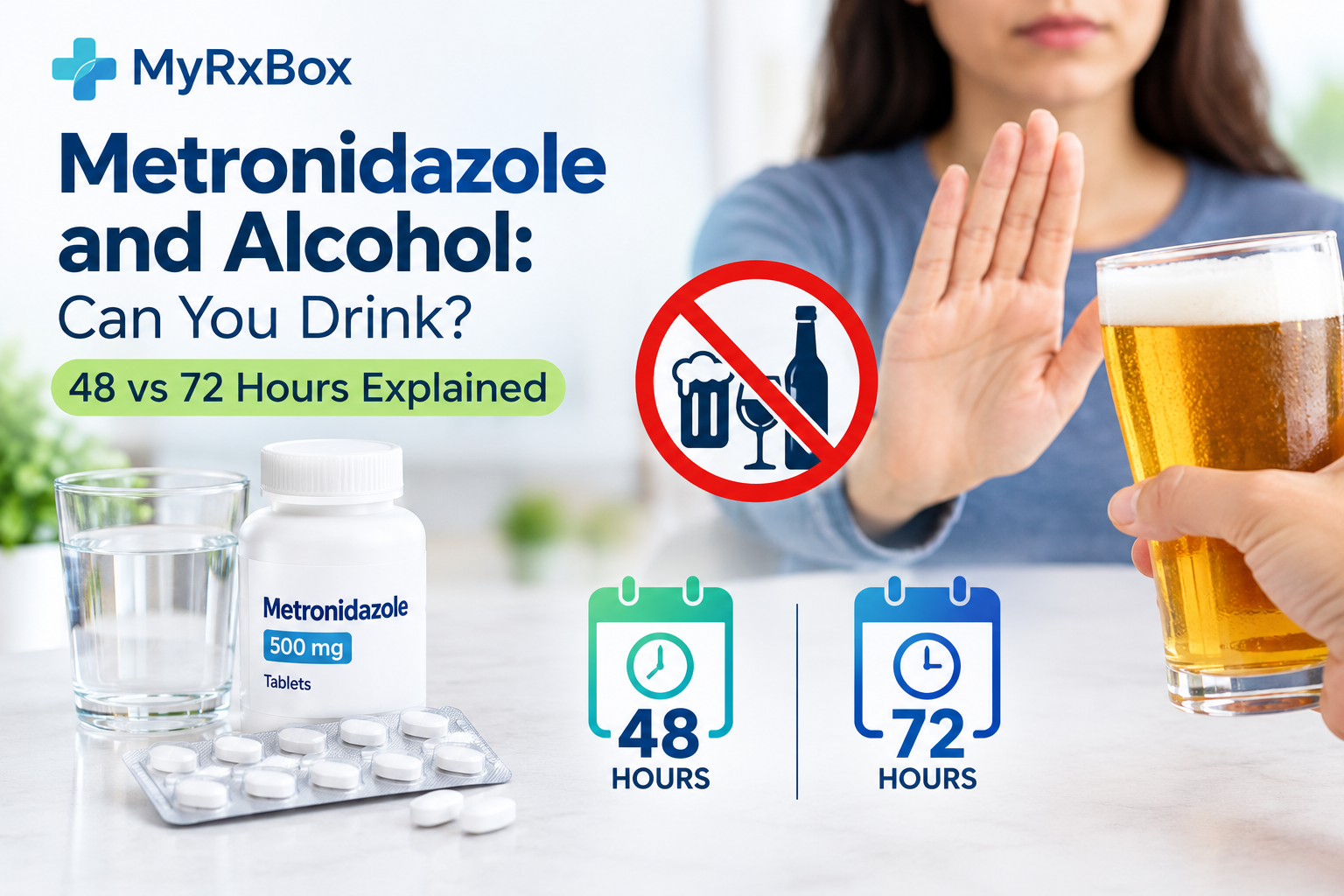
Can you drink alcohol while taking metronidazole? The answer is more complicated than a simple yes or no.
Metronidazole and alcohol have traditionally been considered an unsafe combination because of possible nausea, vomiting, flushing, headaches and stomach cramps. However, scientific research has questioned whether the commonly described reaction happens as reliably as drug warnings suggest.
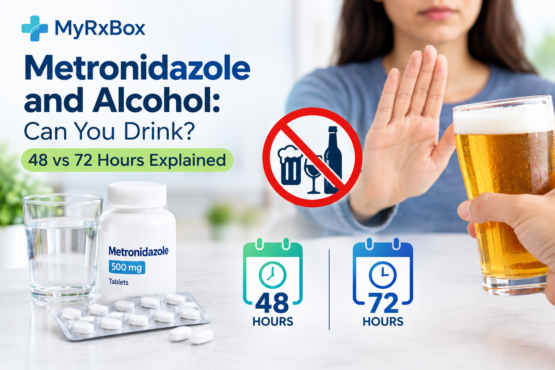
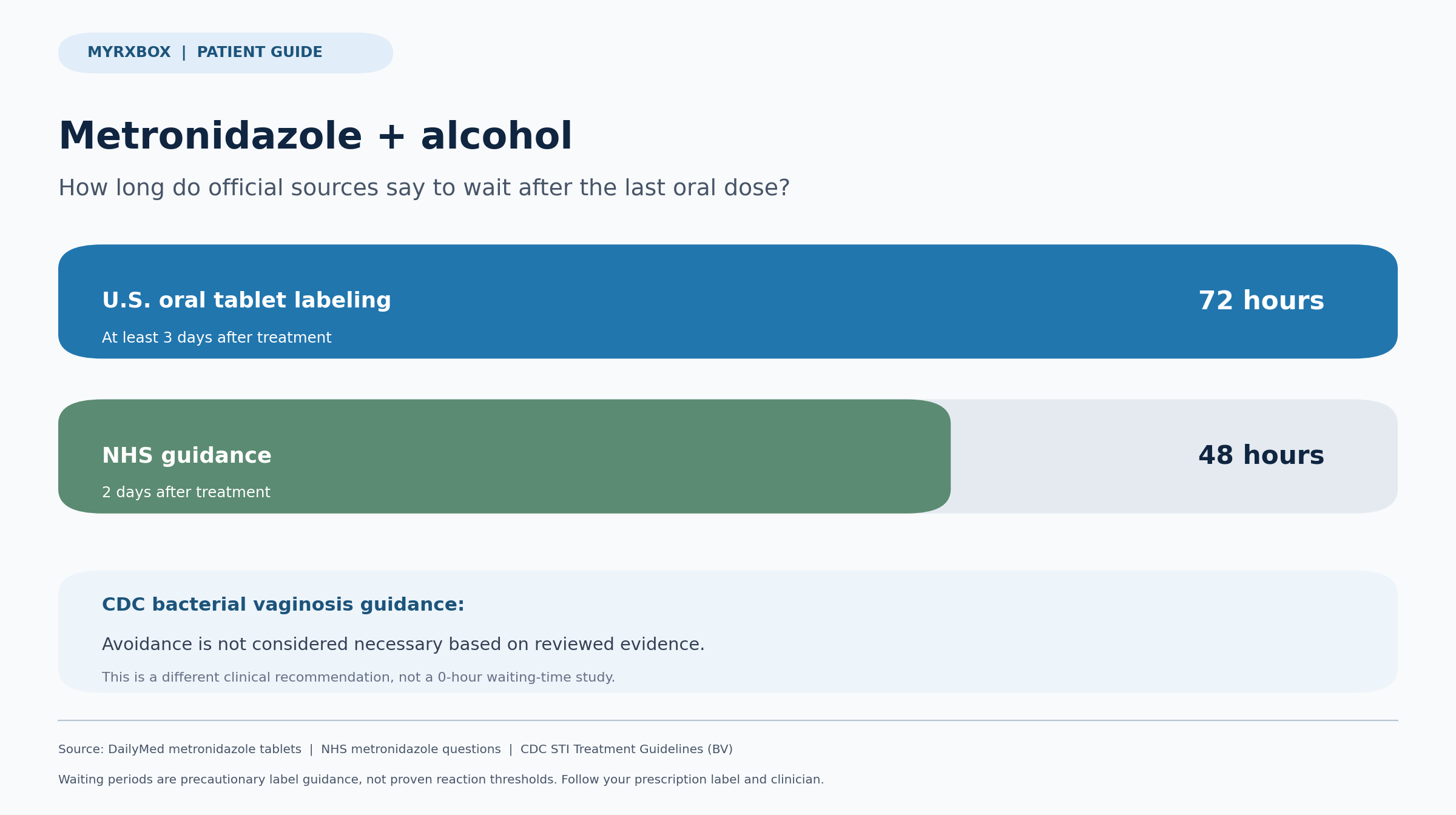
There is also an important difference between official recommendations. Some UK guidance advises waiting 48 hours after treatment, while US oral metronidazole labeling recommends at least 72 hours.
This guide explains those differences, what to do if you accidentally drink alcohol, whether the rules apply to metronidazole 500 mg and vaginal gel, and when you should seek medical advice.
Can You Drink Alcohol While Taking Metronidazole?
The safest practical approach is to avoid alcohol throughout your prescribed metronidazole treatment and follow the waiting period on your medication label.
Three major medical sources provide different perspectives:
| Medical source | What it says | Practical interpretation |
|---|---|---|
| US metronidazole tablet labeling | Avoid alcohol during treatment and for at least 3 days afterward | Wait at least 72 hours after your final dose |
| UK National Health Service (NHS) | Avoid alcohol during treatment and for 2 days afterward | Wait 48 hours after treatment |
| US Centers for Disease Control and Prevention (CDC) | Its bacterial vaginosis guidelines say avoiding alcohol with metronidazole is unnecessary | The evidence for the traditional reaction is disputed |
The CDC recommendation reflects research evidence, while US product labeling continues to take a precautionary approach.
This distinction matters. Scientific uncertainty about a drug interaction does not automatically mean mixing alcohol and metronidazole is risk-free.
You can also explore our metronidazole medication overview for information about its uses, safety warnings and possible adverse effects.
How Long After Metronidazole Can You Drink Alcohol?
The commonly cited waiting period is 48 to 72 hours after your final dose, depending on which product information and national guidance apply to you.
Why does the US recommend 72 hours?
The US prescribing information for metronidazole tablets on DailyMed recommends avoiding alcohol and products containing propylene glycol during treatment and for at least three days after completing therapy.
The label warns about symptoms such as flushing, abdominal cramps, vomiting and headaches.
Why does the NHS recommend 48 hours?
The NHS guidance on metronidazole advises avoiding alcohol while taking oral metronidazole or using suppositories, and for two days afterward.
These waiting periods are intended to allow the medication to clear from the body. They should not be interpreted as experimentally proven times at which an alcohol reaction becomes impossible.
Metronidazole and alcohol waiting-time chart
| Final metronidazole dose | After 48 hours (NHS) | After 72 hours (US oral label) |
|---|---|---|
| Monday, 8 PM | Wednesday, 8 PM | Thursday, 8 PM |
| Wednesday, 9 AM | Friday, 9 AM | Saturday, 9 AM |
| Friday, 8 PM | Sunday, 8 PM | Monday, 8 PM |
| Sunday, 10 AM | Tuesday, 10 AM | Wednesday, 10 AM |
Important: Calculate the interval from your final prescribed dose, not from the first tablet or the day your symptoms disappear.
For example, if your final oral dose is Friday at 8 PM, the US label’s three-day interval runs until Monday at 8 PM.
Do not skip antibiotic doses or shorten your treatment simply to drink alcohol earlier.
What Happens if You Drink Alcohol With Metronidazole?
Warnings about metronidazole and alcohol describe a possible disulfiram-like reaction.
Disulfiram is a medication used in alcohol-use-disorder treatment. It interferes with alcohol metabolism, allowing acetaldehyde to accumulate in the body and causing unpleasant symptoms.
Metronidazole was historically believed to produce a similar reaction. However, researchers have not convincingly established that it works through the same mechanism.
Possible symptoms associated with the combination include:
- Flushing or an unusually warm face
- Nausea and vomiting
- Headache
- Abdominal cramps
- Dizziness or lightheadedness
- A racing or pounding heartbeat
These symptoms are not specific to a metronidazole–alcohol interaction. Alcohol or metronidazole alone can cause several of them.
What does the CDC say about the interaction?
The CDC’s Sexually Transmitted Infections Treatment Guidelines, published in 2021, reviewed the available evidence in its bacterial vaginosis section.
The CDC concluded that the evidence did not convincingly establish the traditional disulfiram-like interaction and stated that abstaining from alcohol during treatment with metronidazole or tinidazole was unnecessary.
However, the absence of convincing evidence is not proof that adverse effects can never occur.
The practical takeaway: The clinical literature questions the mechanism behind the warning, but US prescribing information still advises avoidance. Follow your specific medication label and seek individual guidance from your prescriber.
I Accidentally Drank Alcohol While Taking Metronidazole. What Should I Do?
If you have already consumed alcohol during treatment, the first step is to assess how you feel.
One accidental drink does not guarantee that you will experience a serious reaction, and there is no reason to assume an emergency solely because alcohol was consumed.
If you have no symptoms
Stop drinking alcohol for the remainder of the treatment and follow the post-treatment precautions provided with your medication.
Do not automatically skip or discontinue your antibiotic. Contact your pharmacist or prescriber if you are concerned about the amount consumed, timing or possible interactions.
If you feel nauseated or dizzy
Avoid further alcohol, rest in a safe location and sip water if you can keep fluids down.
Seek medical advice if symptoms persist, worsen or interfere with taking your prescribed medication.
If you develop severe symptoms
Seek urgent medical assistance for chest pain, fainting, difficulty breathing, marked confusion, a seizure, or severe and persistent vomiting.
Tell the healthcare team which medication you took, when you took it and approximately how much alcohol you consumed.
Do not try to make yourself vomit or take additional medication to counteract the combination.
Does the Type of Metronidazole Matter?
Yes. Metronidazole is available in several formulations, and the amount absorbed into the bloodstream varies.
That is why advice for tablets may not apply identically to skin creams or vaginal gels.
| Metronidazole formulation | Alcohol considerations |
|---|---|
| Oral tablets, including 250 mg and 500 mg | Follow the prescribed product’s alcohol warning and post-treatment waiting period |
| Oral liquid | Systemic exposure occurs; the usual oral-treatment precautions apply |
| Rectal suppositories | NHS advises avoiding alcohol during treatment and for 48 hours afterward |
| Vaginal gel | Systemic absorption is lower than with oral treatment, but alcohol-related effects remain a consideration |
| Skin cream or gel | Very little is generally absorbed systemically; alcohol-related reactions are less likely |
Metronidazole 500 mg and alcohol
A 500 mg tablet is not exempt from the alcohol warning, and there is no established safe amount of alcohol based on tablet strength alone.
The waiting period is generally linked to completing the prescribed treatment rather than whether a tablet contains 250 mg, 400 mg or 500 mg.
Metronidazole vaginal gel and alcohol
Vaginal metronidazole produces lower systemic drug exposure than oral tablets, but this does not guarantee that an interaction is impossible.
The NHS notes that people using vaginal gel can sometimes experience alcohol-associated symptoms.
Because individual vaginal gel products can have different instructions, check the specific package insert rather than automatically applying the oral tablet schedule.
Metronidazole skin gel or cream and alcohol
Topical metronidazole used for conditions such as rosacea generally produces much lower bloodstream exposure than oral medication.
As a result, an alcohol-related reaction is less likely.
However, alcohol itself may aggravate facial flushing in some people with rosacea. Any change in facial redness after drinking is not necessarily caused by an interaction with the topical medication.
Hidden Sources of Alcohol: What Should You Check?
Avoiding alcoholic drinks may not be the only issue during treatment.
Some products contain ethanol or propylene glycol, which is specifically mentioned in US oral metronidazole labeling.
Potential examples include certain liquid cough medicines, oral tinctures, herbal preparations and medicinal liquids.
Check the ingredients rather than assuming every liquid medication is alcohol-free.
What about everyday foods and drinks?
Alcohol-free beer: Products labeled alcohol-free are not necessarily identical to products labeled 0.0% alcohol. Check the actual alcohol content and ask a pharmacist about any uncertainty.
Kombucha and fermented drinks: Alcohol content can vary. They may not be the best option when you are following strict alcohol-avoidance instructions.
Food prepared with alcohol: The amount of alcohol remaining depends on the recipe and cooking process. There is no established threshold for an interaction with metronidazole, so ask a pharmacist if a particular food concerns you.
Mouthwash: A mouthwash used correctly and spat out is not equivalent to drinking an alcoholic beverage. Choosing an alcohol-free version can nevertheless simplify your routine.
Ordinary skincare products: The presence of propylene glycol in a product applied to the skin should not automatically be treated as equivalent to swallowing it. Ask about specific products if needed.
Can Alcohol Make Metronidazole Less Effective?
There is no convincing clinical evidence that an occasional alcoholic drink directly neutralizes metronidazole’s antimicrobial action.
The primary labeling concern is a possible adverse reaction, not a proven loss of antibiotic potency.
Nevertheless, drinking while ill can complicate recovery.
For example, nausea and vomiting may make it difficult to keep medication down, dizziness may interfere with normal activities, and alcohol consumption may lead someone to forget or skip a scheduled dose.
These concerns matter even if a true disulfiram-like reaction does not occur.
What if you vomit after taking metronidazole?
Do not automatically take another tablet.
Whether a replacement dose is appropriate depends on the formulation, how soon vomiting occurred and the prescribed schedule.
Contact your pharmacist or prescriber for instructions. Taking an additional dose without guidance may result in taking too much medication.
Other Metronidazole Drug Interactions You Should Know About
Alcohol is not the only substance worth checking.
US oral metronidazole labeling identifies several clinically important interactions.
Disulfiram: Metronidazole should not be given to patients who have taken disulfiram within the previous two weeks because psychotic reactions have been reported with the combination.
Warfarin: Metronidazole can increase the anticoagulant effect of warfarin. Additional INR monitoring may be necessary.
Lithium: Metronidazole may increase lithium levels, potentially creating toxicity risks.
Busulfan: Combining these medicines can increase busulfan exposure and requires specialist consideration.
Before starting treatment, share your current prescription medicines, over-the-counter products and supplements with your healthcare professional.
You can also use the MyRxBox Drug Interaction Checker as an initial screening aid. It covers selected interactions and cannot replace a pharmacist’s comprehensive medication review.
When Is Extra Caution Necessary?
Certain patients need more individualized medical guidance.
People with liver disease
Metronidazole is metabolized by the liver. Severe hepatic impairment can increase medication exposure and may require dose adjustments.
Do not use a standard waiting-period calculation as a substitute for your prescriber’s advice if you have significant liver disease.
People who regularly consume large amounts of alcohol
Heavy alcohol consumption creates additional risks, independent of whether metronidazole causes a disulfiram-like reaction.
If you are physically dependent on alcohol, suddenly stopping can cause dangerous withdrawal symptoms. Speak with a healthcare professional about safe treatment planning rather than attempting unsupervised withdrawal.
Pregnant or breastfeeding patients
Pregnancy and breastfeeding require individual consideration of the infection, formulation, treatment regimen and medical history.
Ask your clinician for advice about metronidazole treatment. Alcohol is not recommended during pregnancy.
People experiencing significant medication side effects
Persistent vomiting, severe dizziness, confusion, tingling or numbness, or a new widespread rash should not be dismissed as a simple alcohol reaction.
Seek prompt medical evaluation if these occur.
Metronidazole vs. Tinidazole: Are the Alcohol Rules the Same?
Metronidazole and tinidazole belong to the nitroimidazole family of antimicrobial medicines.
Both have traditionally carried alcohol-related warnings, although their formulations, treatment schedules and pharmacokinetic characteristics differ.
US tinidazole labeling also advises avoiding alcohol during treatment and for three days afterward.
Tinidazole is not automatically interchangeable with metronidazole. Your clinician chooses treatment based on the infection, applicable guidelines and individual medical considerations.
For more information, see our tinidazole medicine overview.
Frequently Asked Questions About Metronidazole and Alcohol
Can I drink alcohol 24 hours after metronidazole?
Twenty-four hours is shorter than the 48-hour NHS recommendation and the 72-hour interval in US oral metronidazole labeling. Follow the instructions on your particular medication.
Can I drink alcohol 48 hours after taking metronidazole?
The NHS advises waiting 48 hours after treatment. However, US oral product labeling specifies at least 72 hours. Follow your prescribed product’s instructions.
What if I had one beer while taking metronidazole?
One beer does not guarantee a reaction. Stop further alcohol consumption, monitor for symptoms and contact a pharmacist if you have concerns. Seek urgent care for severe symptoms.
Can I drink wine while taking metronidazole 500 mg?
Wine contains alcohol and is included in the precautions for oral metronidazole. The 500 mg strength does not create a special exception.
Is it safe to drink alcohol between metronidazole doses?
Do not treat the time between scheduled doses as an alcohol-free-treatment window. The precaution applies throughout the treatment course and for the applicable interval after the final dose.
Can I skip one metronidazole tablet to drink alcohol?
No. Skipping a dose does not remove the medication already present in your body and could compromise treatment. Do not change your antibiotic schedule to accommodate drinking.
Is the metronidazole and alcohol interaction a myth?
The traditional disulfiram-like mechanism has not been convincingly demonstrated in clinical research. However, that does not establish that every individual can safely combine the two. Drug labeling continues to warn against the combination.
Does Flagyl have the same alcohol warning?
Flagyl is a brand of metronidazole. Its alcohol-related precautions should be checked on the specific formulation and prescribing information.
Can I drink alcohol after a single dose of metronidazole?
A single-dose regimen does not automatically eliminate the post-treatment waiting recommendation. Refer to your product label and prescriber.
What is the safest drink while taking metronidazole?
Water and clearly nonalcoholic beverages are practical options. If you are unsure whether a beverage or medicinal liquid contains alcohol, check its ingredients before consuming it.
Final Takeaway: Should You Mix Metronidazole and Alcohol?
The evidence surrounding metronidazole and alcohol is more nuanced than older explanations suggest.
The CDC’s bacterial vaginosis guidance questions the need for alcohol abstinence based on the available scientific evidence. Meanwhile, US oral metronidazole prescribing information and NHS guidance continue to recommend avoidance, with different post-treatment intervals.
For patients who want a straightforward precautionary approach, the answer remains simple: avoid alcohol during treatment, complete the prescribed course, and follow your medication’s specific waiting-period instructions.
If you accidentally drink alcohol, do not assume a serious reaction is inevitable. Monitor how you feel, avoid additional alcohol and obtain medical assistance if significant symptoms develop.
Medical disclaimer: This article provides general educational information and does not replace medical advice, diagnosis or treatment. Follow the instructions supplied with your prescribed medication and consult a qualified healthcare professional about individual concerns.
Medical sources: US metronidazole prescribing information (DailyMed); NHS metronidazole guidance (reviewed December 2025); CDC Sexually Transmitted Infections Treatment Guidelines (2021). All three are linked within this article.