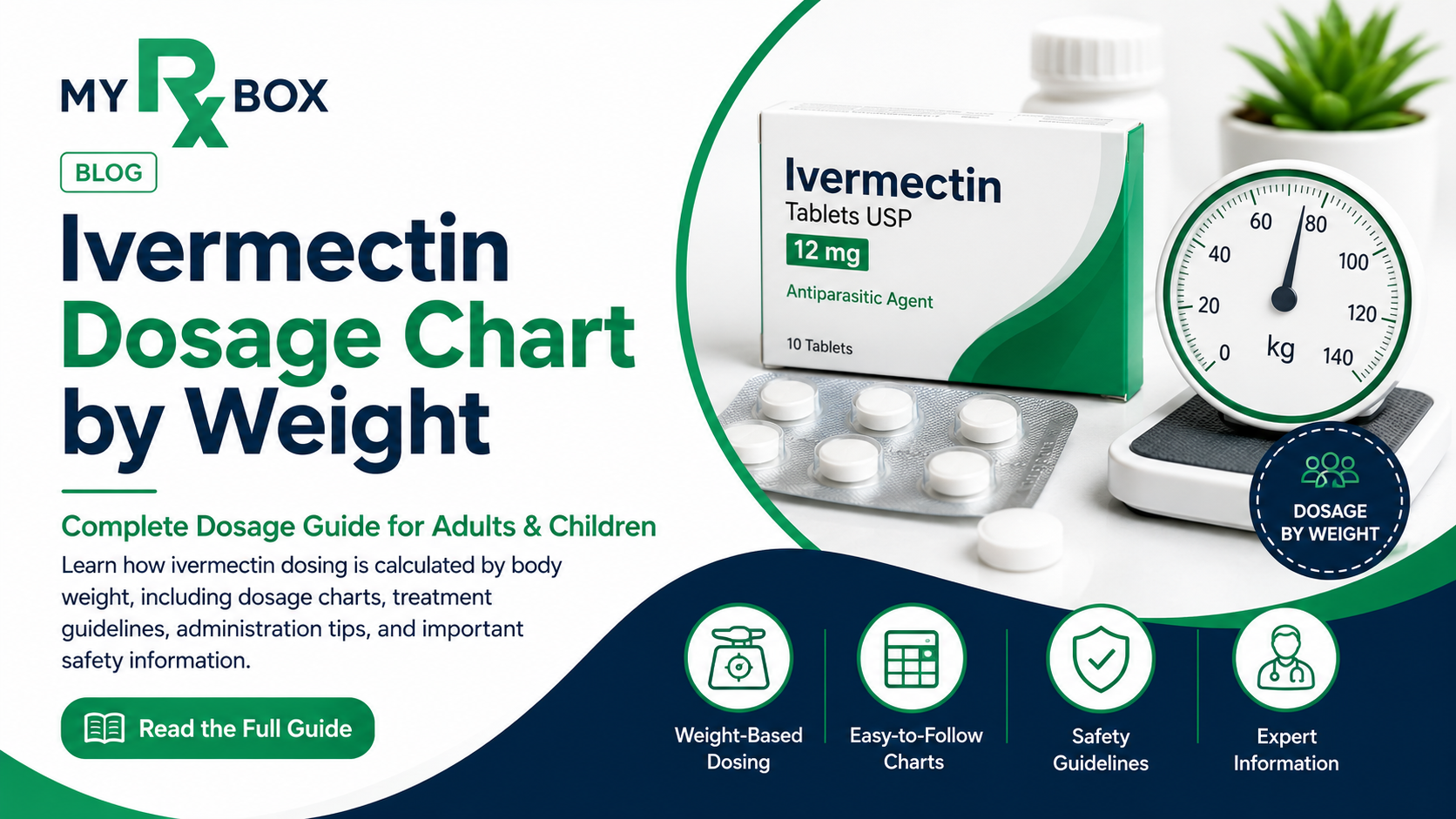
The most common question people have when considering ivermectin — whether for an approved antiparasitic use or as part of an off-label protocol — is simply: how much do I take? The answer depends entirely on your body weight, the condition being treated, and the formulation available. Getting the dose right matters both for effectiveness and for safety.
This guide provides a comprehensive ivermectin dosage chart by weight for all major approved indications, an explanation of how the weight-based dosing system works, a comparison of tablet vs liquid formulations, and a review of the dose ranges discussed in research for off-label uses. This is intended as an educational reference — ivermectin is a prescription drug in many countries, and any use should be discussed with a physician.
⚠️ Important Ivermectin is a prescription medication in the United States, UK, Australia, Canada, and most of Europe. Dosing information here is educational. Ivermectin overdose — particularly from veterinary formulations — is dangerous. Never use livestock ivermectin products at human doses without verified milligram-accurate measurement.
How Ivermectin Dosing Works: The Weight-Based System
Ivermectin is dosed in micrograms (mcg) per kilogram of body weight — typically written as mcg/kg. The standard approved dose for most conditions is 200 mcg/kg (0.2 mg/kg). This means a heavier person receives more total milligrams than a lighter person. Standard human ivermectin tablets are 3mg each, which makes calculating doses for different body weights straightforward.
The key formula is: Dose (mg) = Body Weight (kg) × 0.2 mg/kg
Converting Weight: Pounds to Kilograms
Since many users in the United States measure weight in pounds: divide your weight in pounds by 2.2 to get kilograms. For example, 176 lbs ÷ 2.2 = 80 kg.
Ivermectin Dosage Chart by Weight — Standard Dose (200 mcg/kg)
The following chart gives the standard 200 mcg/kg dose, the number of 3mg tablets required, and the next safe rounding for tablet-based dosing:
| Body Weight | Weight (kg) | Exact Dose (mg) | 3mg Tablets | Practical Dose |
|---|---|---|---|---|
| 88 lbs / 40 kg | 40 kg | 8 mg | 2.67 tablets | 2–3 tablets (6–9mg) |
| 110 lbs / 50 kg | 50 kg | 10 mg | 3.33 tablets | 3 tablets (9mg) |
| 132 lbs / 60 kg | 60 kg | 12 mg | 4 tablets | 4 tablets (12mg) ✓ |
| 154 lbs / 70 kg | 70 kg | 14 mg | 4.67 tablets | 4–5 tablets (12–15mg) |
| 176 lbs / 80 kg | 80 kg | 16 mg | 5.33 tablets | 5 tablets (15mg) |
| 198 lbs / 90 kg | 90 kg | 18 mg | 6 tablets | 6 tablets (18mg) ✓ |
| 220 lbs / 100 kg | 100 kg | 20 mg | 6.67 tablets | 6–7 tablets (18–21mg) |
| 242 lbs / 110 kg | 110 kg | 22 mg | 7.33 tablets | 7 tablets (21mg) |
| 264 lbs / 120 kg | 120 kg | 24 mg | 8 tablets | 8 tablets (24mg) ✓ |
Dosage by Condition: Approved Uses of Ivermectin
The dose and schedule differ significantly depending on what ivermectin is being used to treat. Here is a condition-by-condition breakdown:
Onchocerciasis (River Blindness)
Standard dose: 150 mcg/kg as a single oral dose, repeated every 6–12 months. This is one of the longest-established ivermectin indications and the one that contributed to the Nobel Prize in Physiology or Medicine being awarded to Satoshi Ōmura and William Campbell in 2015 for their work on avermectins.
Strongyloidiasis (Threadworm)
Standard dose: 200 mcg/kg once daily for 2 days (immunocompetent patients). For hyperinfection syndrome or disseminated strongyloidiasis (seen in immunocompromised patients), 200 mcg/kg once daily for a minimum of 2 weeks and until stool/sputum exams are negative for two consecutive weeks — this is a medical emergency and requires hospital-level care.
Scabies (Sarcoptes scabiei)
Standard dose for classic scabies: 200 mcg/kg as a single dose, repeated in 7–14 days. For crusted (Norwegian) scabies — a severe, highly contagious form found in immunocompromised individuals — higher doses and longer courses are required, often 200 mcg/kg on days 1, 2, 8, 9, and 15, sometimes with topical permethrin between oral doses.
| Condition | Dose | Frequency | Duration | Notes |
|---|---|---|---|---|
| Onchocerciasis | 150 mcg/kg | Single dose | Repeat every 6–12 months | Does not kill adult worms; kills microfilariae |
| Strongyloidiasis | 200 mcg/kg | Once daily | 2 days | Extend significantly in immunocompromised patients |
| Scabies (classic) | 200 mcg/kg | Single dose | Repeat at 14 days | All close contacts should be treated simultaneously |
| Crusted scabies | 200 mcg/kg | Days 1,2,8,9,15 | 15+ days | Combine with topical permethrin; highly infectious |
| Lymphatic filariasis | 200–400 mcg/kg | Single dose annually | Years (endemic areas) | Often combined with albendazole or DEC |
| Head lice (off-label) | 200–400 mcg/kg | Single dose | Repeat at 10 days | Alternative when topical treatments fail |
Higher-Dose Protocols: What the Research Discusses
In off-label contexts, researchers and clinicians have explored doses significantly higher than the standard 200 mcg/kg. It is important to understand the evidence and the risks associated with higher dosing:
400 mcg/kg (2× Standard)
This dose has been studied for crusted scabies, tropical strongyloidiasis, and in some antiviral research contexts. It is within the range used in WHO-approved mass drug administration programs in some countries. At this dose in healthy adults, the side effect profile remains relatively mild — primarily dizziness, nausea, and the Mazzotti reaction (a transient inflammatory response as parasites are killed).
600 mcg/kg (3× Standard)
Doses up to 600 mcg/kg have been evaluated in clinical settings, primarily for hyperinfection strongyloidiasis. At this level, side effects become more pronounced, particularly neurological effects (dizziness, ataxia, somnolence). This dose range requires medical supervision.
The BIRD Group and FLCCC Protocols (COVID-19 Off-Label Context)
During 2020–2022, groups including the FLCCC Alliance (Front Line COVID-19 Critical Care Alliance) published protocols using ivermectin doses of 200–400 mcg/kg for COVID-19 prevention and treatment. The scientific controversy around these uses is extensive and still unresolved — large randomized controlled trials (TOGETHER, PRINCIPLE, ACTIV-6) found no significant benefit for COVID-19 outcomes, while some meta-analyses of smaller studies found signals of benefit. This remains an area of active scientific dispute. These doses are included here for informational completeness; their use for COVID-19 is not endorsed by FDA, WHO, or EMA.
Formulations: Tablets vs Liquid vs Topical
Ivermectin is available in several formulations, each with different considerations:
| Formulation | Common Strengths | Best For | Bioavailability | Key Note |
|---|---|---|---|---|
| Oral tablets (human) | 3mg (Stromectol / generics) | Systemic parasites, off-label use | ~50–70% (enhanced by fatty food) | Gold standard for human dosing |
| Oral solution (human) | Varies by country | Pediatric or precise dosing | Similar to tablets | Less commonly available in US |
| Topical cream 1% (Soolantra) | 10mg/gram | Rosacea (approved use) | Minimal systemic absorption | For skin conditions only — not for systemic parasites |
| Topical lotion 0.5% (Sklice) | 5mg/gram | Head lice (approved) | Minimal systemic absorption | Single application treatment |
| Veterinary paste (1.87%) | 187mg per gram of paste | Horses, livestock — NOT for humans | Variable; NOT validated in humans | ⚠️ DANGEROUS for human use — dosing is imprecise |
🚨 Critical Warning: Veterinary IvermectinHorse and cattle ivermectin products (1.87% paste, pour-on solutions) are formulated for large animals and should NEVER be used by humans. The concentration is vastly different from human tablets, making accurate human dosing effectively impossible. Ivermectin toxicity — including serious neurological effects — has been reported from veterinary product misuse. Use only pharmaceutical-grade human tablets.
How to Take Ivermectin: Practical Guidance
- Take on an empty stomach: The standard recommendation for antiparasitic use is to take ivermectin with water on an empty stomach (1–2 hours before a meal). This is somewhat counterintuitive compared to some other drugs.
- However — for off-label use where systemic levels matter: Some research suggests taking ivermectin with a high-fat meal substantially increases bioavailability (by as much as 2.5× compared to fasted state). This is discussed in some off-label protocols.
- Do not crush tablets: Swallow whole with a full glass of water
- Timing of meals after dosing: Wait at least 1 hour after taking before eating, if dosing fasted
- Avoid grapefruit: Grapefruit inhibits CYP3A4, which metabolizes ivermectin — this can increase blood levels unpredictably
Frequently Asked Questions
How many 3mg ivermectin tablets should I take for my weight?
Use the formula: weight in kg × 0.2 = dose in mg, then divide by 3 to get the number of tablets. For example: 70 kg × 0.2 = 14mg ÷ 3 = approximately 4–5 tablets (12–15mg). Always round to the nearest whole tablet and err on the side of the dose closest to your calculated target.
Is it safe to take ivermectin every day?
Daily ivermectin use is not approved for any indication and is not standard practice. Some off-label protocols use ivermectin every week or on a cycling schedule, not daily. Prolonged daily dosing has not been adequately studied for safety in humans. If someone has recommended daily ivermectin to you, seek a second medical opinion.
Can I take ivermectin if I am taking other medications?
Ivermectin is metabolized by CYP3A4 and P-glycoprotein. Drugs that inhibit or induce these pathways (certain antibiotics, antifungals, HIV medications, seizure medications) can significantly alter ivermectin blood levels. Additionally, ivermectin potentiates the effects of warfarin — if you are on blood thinners, close INR monitoring is essential. Always disclose all medications to your prescribing physician.
Ivermectin 3mg Tablets — Pharmaceutical Grade
myRxbox offers verified ivermectin tablets in quantities from single-course packs to bulk orders. Worldwide shipping.