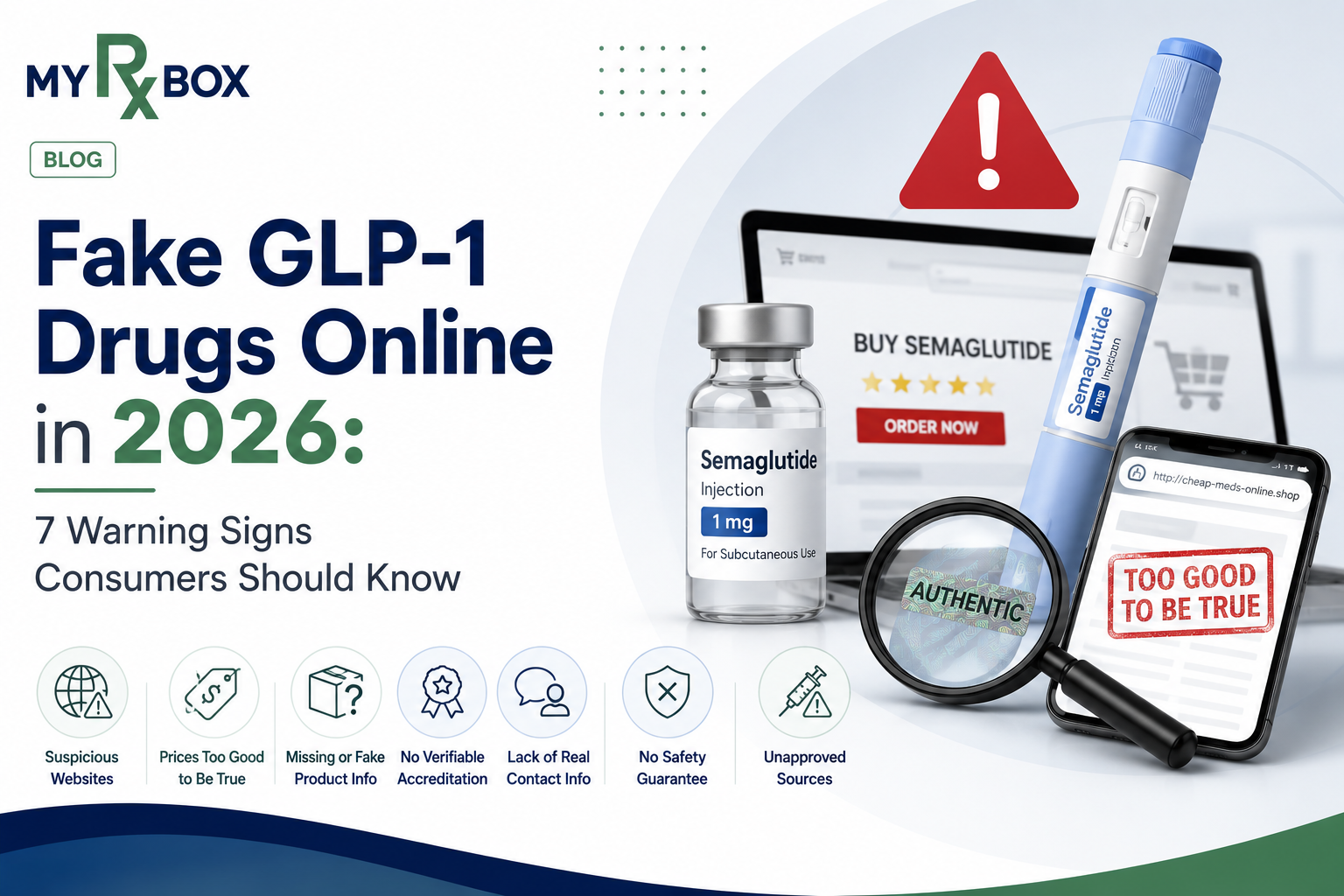
GLP-1 medicines have become some of the most discussed prescription drugs in the world.
But the extraordinary interest surrounding semaglutide, tirzepatide and other GLP-1 medicines has created a second market that consumers need to understand: counterfeit products, fraudulent compounded medicines, illegally marketed drugs and websites making misleading claims about what they sell.
The issue is still developing in 2026.
On March 3, 2026, the U.S. Food and Drug Administration announced 30 warning letters to telehealth companies over false or misleading claims involving compounded GLP-1 products. FDA said some marketing implied compounded drugs were equivalent to FDA-approved products or obscured where the medicines were actually compounded.
FDA has also reported adverse events involving compounded versions of these medicines. As of May 31, 2026, the agency said it had received 990 adverse-event reports associated with compounded semaglutide and more than 730 associated with compounded tirzepatide. FDA also emphasizes that an adverse-event report does not necessarily establish that the medicine caused the event.
That makes one question increasingly important:
How can consumers tell when an online GLP-1 offer deserves a closer look?
Here are seven warning signs.
First, Understand One Important Difference
Before discussing fake medicines, it is important not to place every non-brand product into the same category.
There are meaningful differences between FDA-approved drugs, compounded drugs, fraudulent products and counterfeit medicines.
FDA-approved medicines undergo FDA review for safety, effectiveness and quality for their approved uses.
Compounded drugs are different. They can serve legitimate medical needs in appropriate circumstances, but they are not FDA-approved, meaning FDA does not review each compounded product for safety, effectiveness and quality before it reaches patients. FDA states that compounded drugs should generally be used when a patient’s medical needs cannot be met by an available FDA-approved medicine.
Counterfeit products are another category entirely. They falsely claim to be authentic medicines.
FDA says counterfeit medicines may contain the wrong ingredients, too much or too little active ingredient, no active ingredient or other potentially harmful substances.
If you are unfamiliar with the drug itself, start with MyRxBox’s Semaglutide Glossary Guide or the more detailed Oral Semaglutide Guide.
Why This Story Matters in 2026
Counterfeit GLP-1 medicines are no longer only a theoretical internet risk.
In December 2025, FDA announced that it had seized dozens of counterfeit Ozempic injection units that had been distributed outside the manufacturer’s authorized supply chain. The counterfeit products even carried a lot number that was also used on authentic medicine, demonstrating why simply seeing a familiar-looking number or package may not be enough to prove authenticity.
FDA had also reported another seizure involving several hundred counterfeit units earlier in 2025.
And the problem extends beyond the United States.
The World Health Organization previously issued an alert involving falsified Ozempic detected in the United States, United Kingdom and Brazil. WHO has reported increased notifications of falsified semaglutide products through its global monitoring system.
That doesn’t mean people should assume every medicine bought online is fake.
It means verification matters more than ever.
For a broader look at online medicine trends, see Top 10 Medicines People Buy Online in 2026.
Warning Sign #1: No Valid Prescription Is Required
One of the clearest warning signs is a website offering prescription medication without requiring an appropriate prescription.
FDA’s BeSafeRx program tells consumers to be cautious of online pharmacies that allow prescription medicines to be purchased without a doctor’s prescription.
A safer online pharmacy should require a prescription from an appropriately licensed healthcare professional, provide identifiable contact information, have pharmacist support and hold the required pharmacy licensing.
This matters because prescription drugs aren’t ordinary consumer products.
A healthcare professional may need to evaluate medical history, interactions with other medications, contraindications, existing conditions and whether a specific drug is appropriate for a particular patient.
If you regularly purchase medicines online, MyRxBox also has an educational overview on online pharmacies and prescription medicines.
Warning Sign #2: The Website Claims Its Compounded Drug Is “FDA-Approved”
This is particularly relevant in 2026.
FDA’s recent enforcement actions repeatedly focused on marketing that could make consumers believe a compounded GLP-1 drug had FDA approval or was effectively identical to an FDA-approved product.
FDA explicitly states:
Compounded drugs are not FDA-approved drugs.
In March 2026, FDA announced warning letters to 30 telehealth companies over misleading compounded GLP-1 promotions. More warning letters involving semaglutide and tirzepatide marketing were issued during 2026.
Be cautious when a website uses phrases such as:
- “FDA-approved compounded semaglutide”
- “Exactly the same as Ozempic”
- “FDA-licensed compounded drug”
- “Guaranteed equivalent”
- “Same medicine for a fraction of the cost”
The precise wording matters.
A compounded medicine and an FDA-approved drug should not automatically be treated as interchangeable.
For definitions of unfamiliar medication terminology, use the MyRxBox Medicine Glossary.
Warning Sign #3: Nobody Clearly Identifies Who Made the Medicine
The label should not create a mystery.
FDA said in 2026 that it was aware of fraudulent compounded semaglutide and tirzepatide products containing false information on their labels.
In some cases, FDA said the compounding pharmacy listed on a label did not exist. In others, a real licensed pharmacy’s name appeared on medicine that FDA said the pharmacy had not compounded.
That makes source verification especially important.
Consumers should be able to determine who prescribed the medicine, who dispensed or compounded it when applicable, how the pharmacy can be contacted and whether the pharmacy’s licensing can be verified.
A professional-looking label by itself isn’t proof.
If you’re unsure how prescription information should be presented, read How to Read Your Prescription Label: A Complete Guide.
Warning Sign #4: Packaging, Lot Information or the Medicine Looks Different
Counterfeit medicines can sometimes be surprisingly convincing.
FDA recommends watching for medicines or packaging that look different from what you normally receive.
Possible warning signs include damaged packaging, unusual print quality, inconsistent labeling, missing expiration information, unexpected language, unexplained changes in the device or tablets, or packaging that simply doesn’t match what you previously received.
The December 2025 counterfeit Ozempic alert illustrates just how subtle these differences can become.
FDA described counterfeit products carrying an authentic lot number but having differences in where the EXP/LOT information appeared on the pen label.
Consumers should not attempt to become counterfeit-drug investigators on their own.
If something looks unusual, contact the dispensing pharmacy or a healthcare professional before using it.
MyRxBox has previously covered similar counterfeit-drug concerns in its Fake Viagra Warning Signs article.
Warning Sign #5: The Price Is Almost Impossible to Believe
Saving money on prescription medicine is a legitimate concern.
But enormous discounts can also be used to lure consumers toward unsafe websites.
FDA specifically identifies deep discounts or prices that appear too good to be true as a warning sign of a potentially unsafe online pharmacy.
That doesn’t mean an inexpensive medicine is automatically counterfeit.
Instead, price should be evaluated alongside the seller’s licensing, prescription requirements, product source and ability to provide pharmacist support.
Before judging a deal purely by its advertised discount, consumers can compare broader medication costs through the MyRxBox Medicine Price Index.
You can also review the site’s GoodRx Alternative Guide for general price-comparison context.
Warning Sign #6: Dosing or Concentration Information Is Confusing
This warning sign is particularly important with compounded injectable products.
FDA has reported dosing errors involving compounded injectable semaglutide. Some reports involved patients measuring an incorrect amount, while others involved healthcare providers miscalculating a dose.
FDA has noted that compounded semaglutide may be supplied in different concentrations and containers, and confusion between milligrams, milliliters and syringe “units” can contribute to errors. Some reported adverse events required medical attention or hospitalization.
This is not a reason to calculate or alter a prescription yourself.
It is the opposite.
If the concentration, syringe markings, administration instructions or prescribed amount are unclear, consumers should contact the prescribing healthcare professional or dispensing pharmacist rather than guessing.
For additional medicine education, browse the MyRxBox Medicines section.
Warning Sign #7: Social Media Hype Replaces Medical Information
GLP-1 medicines are highly visible on TikTok, Instagram, YouTube, Facebook, Reddit and other platforms.
That visibility also gives questionable sellers an easy way to reach large audiences.
Be cautious when an advertisement relies primarily on before-and-after imagery, celebrity-style testimonials, countdown timers, phrases such as “secret formula,” claims of guaranteed results or pressure to purchase immediately.
FDA has been increasing scrutiny of misleading direct-to-consumer claims around compounded GLP-1 drugs, including marketing that obscures important differences between compounded and FDA-approved medicines.
FDA also warns more generally that fraudulent weight-loss products can be promoted online and through social media, sometimes with positive reviews or “natural” marketing language.
Popularity is not proof of authenticity.
A viral post can’t confirm a pharmacy license, product identity, manufacturing quality or whether a prescription drug is appropriate for you.
For more trending health topics, visit the MyRxBox Viral Health Concern section.
How to Check an Online Pharmacy Before Ordering
FDA’s BeSafeRx guidance gives consumers a practical framework.
A safer U.S. online pharmacy should require an appropriate prescription, provide a physical address and telephone number, have a licensed pharmacist available and be licensed by the relevant state board of pharmacy.
There is another statistic worth paying attention to.
FDA’s current BeSafeRx FAQ says there are roughly 35,000 active online pharmacies at any given time, and—citing National Association of Boards of Pharmacy information—says approximately 5% comply with U.S. pharmacy laws and practice standards.
That figure helps explain why simply finding a polished website through search or social media isn’t sufficient verification.
FDA provides online-pharmacy safety tools through its BeSafeRx campaign.
FDA BeSafeRx Online Pharmacy Safety Resources
What Should You Do If You Suspect a GLP-1 Medicine Is Fake?
Do not use questionable medicine simply to “see if it works.”
Instead, keep the packaging and product available for identification, contact the dispensing pharmacy or healthcare professional, and ask whether the product can be verified.
If you are in the United States, suspected counterfeit medicines or illegal online sales can also be reported to FDA. Unexpected adverse effects can be reported through FDA’s MedWatch system.
FDA’s counterfeit-medicine information is available here:
FDA Counterfeit Medicine Guidance
Are All Compounded GLP-1 Medicines Fake?
No.
This distinction is essential.
A legitimately compounded drug is not automatically counterfeit.
Compounded medications can have a legitimate role when a patient’s medical needs cannot be met by an available FDA-approved product. However, compounded drugs do not undergo FDA’s premarket review for safety, effectiveness and quality in the way FDA-approved products do.
A counterfeit drug falsely claims to be an authentic medicine.
A fraudulent compounded product may falsely identify where or by whom it was compounded.
An unapproved drug sold illegally online may create another category of risk.
Consumers should therefore avoid assuming that “compounded,” “generic,” “counterfeit” and “FDA-approved” all mean the same thing.
They don’t.
For basic medicine definitions and explanations, bookmark the MyRxBox A–Z Medicine Glossary.
Why Counterfeit GLP-1 Medicines Can Be Dangerous
The biggest problem with a counterfeit medicine is uncertainty.
You may not actually know what is inside it.
WHO warns that falsified semaglutide products can create risks because of incorrect dosage, contamination, unknown ingredients or substituted ingredients.
FDA similarly warns that counterfeit or illegally marketed products could contain incorrect amounts of active ingredient, no active ingredient, the wrong ingredient or harmful ingredients.
With injectable drugs, contamination and sterility can create additional concerns because the product bypasses many of the body’s normal protective barriers.
That is why pharmacy and product verification should happen before, not after, a medicine is used.
The Bottom Line
The GLP-1 boom has changed the prescription-drug market.
It has also created opportunities for counterfeiters, misleading marketers and unsafe online sellers.
Consumers don’t need to panic.
They do need to verify.
Before using prescription medicine purchased online, check the prescription requirement, pharmacy licensing, pharmacist access, product source, packaging, label information and whether the seller is making claims that sound dramatically stronger than those made by regulators or legitimate medical sources.
Most importantly, don’t let price or social-media urgency replace professional medical guidance.
Check the prescription. Check the pharmacy. Check the source. Check the package.
If something does not look right, ask a qualified healthcare professional before using the medicine.
For more medicine and online-pharmacy education, visit the MyRxBox Blog.
Frequently Asked Questions
Can fake semaglutide look like the real medicine?
Yes. Counterfeit products may imitate authentic packaging, labels or identifying information. FDA’s 2025 counterfeit Ozempic alert described counterfeit units carrying a lot number that was also associated with authentic products. Consumers should obtain prescription drugs from appropriately licensed pharmacies and investigate unexpected differences in packaging or medicine appearance.
Is compounded semaglutide the same as counterfeit semaglutide?
No. A legitimately compounded medicine is not automatically counterfeit. However, compounded drugs are not FDA-approved, and FDA has also identified fraudulent products falsely presented as compounded semaglutide or tirzepatide.
How can I tell whether an online pharmacy is safer?
FDA recommends checking that the pharmacy requires a prescription, has a physical address and phone number, provides access to a licensed pharmacist and is properly licensed with the relevant state board of pharmacy.
Is a very cheap GLP-1 medicine automatically fake?
No. Price alone cannot determine whether a medicine is genuine. However, FDA lists extreme discounts or prices that seem too good to be true among the warning signs of potentially unsafe online pharmacies.
What should I do if the medicine or package looks suspicious?
Do not rely on visual appearance alone or use questionable medicine just to test it. Contact the dispensing pharmacy or healthcare professional. In the United States, suspected counterfeit products and unexpected adverse events can also be reported to FDA.
Does FDA approve compounded GLP-1 drugs?
No. FDA states that compounded drugs are not FDA-approved and therefore are not reviewed by FDA for safety, effectiveness and quality before marketing in the same way approved products are.
External Authority Links
FDA — Concerns With Unapproved GLP-1 Drugs Used for Weight Loss
Read the FDA GLP-1 safety guidance
FDA — Counterfeit Ozempic Alert
Read the FDA counterfeit Ozempic alert
FDA — Online Pharmacy Safety
Read FDA’s online pharmacy guidance
FDA — Counterfeit Medicine
Read FDA counterfeit medicine guidance
World Health Organization — Falsified Semaglutide Alert
Read the WHO medical product alert