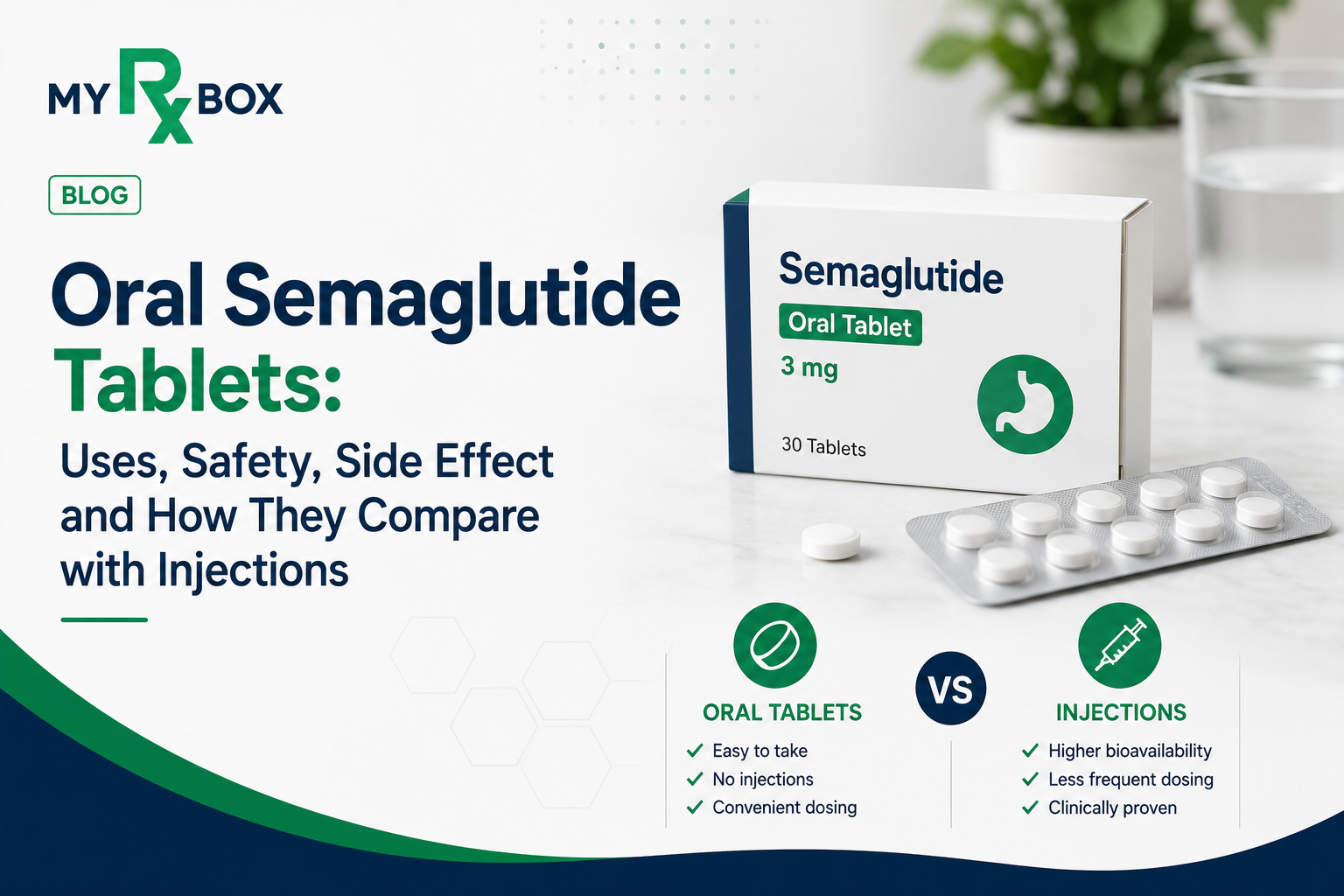
Oral semaglutide is a prescription GLP-1 receptor agonist supplied as a tablet.
In the United States, Rybelsus is approved for adults with type 2 diabetes. It is used with diet and physical activity to improve blood glucose control. Current US prescribing information also includes reducing the risk of major cardiovascular events in adults with type 2 diabetes who are at high risk for those events.
Rybelsus is not simply an oral version of every injectable semaglutide product. Different products can have different approved uses, strengths, dose schedules and administration instructions.
Rybelsus should generally be taken on an empty stomach with a small amount of plain water. Patients must wait before eating, drinking or taking other oral medicines. The exact instructions on the prescription label should be followed.
Common adverse effects include nausea, abdominal pain, diarrhea, reduced appetite, vomiting and constipation.
Semaglutide carries important warnings involving thyroid C-cell tumors, pancreatitis, gallbladder disease, dehydration-related kidney injury, diabetic retinopathy complications and severe gastrointestinal reactions.
Rybelsus should not be promoted as an approved weight-loss tablet in the United States. Some patients lose weight during diabetes treatment, but Rybelsus has historically been authorized for type 2 diabetes rather than as a general weight-management medicine.
Unapproved or improperly marketed compounded GLP-1 products are not the same as FDA-approved products. The FDA has taken action against misleading claims involving compounded semaglutide.
What Is Oral Semaglutide?
Semaglutide belongs to a group of medicines called glucagon-like peptide-1 receptor agonists, usually shortened to GLP-1 receptor agonists.
GLP-1 is a hormone involved in blood glucose regulation, insulin release, appetite and digestion. Semaglutide acts on the same receptor as naturally produced GLP-1, but its effects last much longer.
Most people first became familiar with semaglutide as a weekly injection. Oral semaglutide was developed so that semaglutide could also be delivered as a tablet.
Peptide medicines are normally broken down in the digestive system before enough active medicine can reach the bloodstream. The oral formulation contains an absorption-supporting ingredient that helps semaglutide cross the stomach lining.
Even with that ingredient, absorption is sensitive to how the medicine is taken. Food, beverages and other tablets can reduce or alter the amount absorbed. This is why oral semaglutide has unusually strict administration instructions compared with many daily tablets.
Rybelsus is the best-known branded oral semaglutide medicine. Its approved strengths, formulation and instructions can vary by country and may change as regulators approve updated formulations. Patients should rely on the current label supplied with their own medicine rather than instructions copied from an older website or another market.
What Is Rybelsus Used For?
In the United States, Rybelsus is prescribed for adults with type 2 diabetes.
It may be used with diet and physical activity to improve blood glucose. Current prescribing information also states that it may reduce the risk of major cardiovascular events, such as cardiovascular death, nonfatal heart attack or nonfatal stroke, in adults with type 2 diabetes who are at high cardiovascular risk.
Rybelsus is not insulin. It does not replace insulin in people who require insulin therapy.
It is not intended for the treatment of type 1 diabetes. Type 1 diabetes results from little or no insulin production and requires a different treatment plan.
Rybelsus is also not a treatment for diabetic ketoacidosis, which is a medical emergency.
The US product information states that safety and effectiveness in children have not been established.
A clinician may consider oral semaglutide when a patient:
- Has type 2 diabetes that is not adequately controlled
- Would benefit from a GLP-1 receptor agonist
- Prefers a tablet to an injection
- Can follow the strict morning administration routine
- Does not have a contraindication
- Can tolerate possible gastrointestinal effects
- Has had their other medicines and health conditions reviewed
The decision should not be based only on expected weight change. Blood glucose goals, cardiovascular risk, kidney function, eye health, cost, adherence and adverse-effect history can all influence the choice.
Is Oral Semaglutide Approved for Weight Loss?
Rybelsus should not be described as an approved weight-loss tablet in US patient content.
Some people taking Rybelsus for type 2 diabetes lose weight during treatment. Clinical studies have reported average weight reductions, but individual outcomes differ and some patients may lose little or no weight. The manufacturer states that Rybelsus is not a weight-loss medicine, despite weight reduction being seen in some study participants.
This distinction matters because “contains semaglutide” does not mean that every semaglutide product has the same regulatory approval.
Semaglutide products may differ in:
- Approved medical use
- Tablet or injectable form
- Strength
- Dose-escalation schedule
- Administration frequency
- Clinical study evidence
- Patient population
- Product label
- Prescribing restrictions
A clinician might prescribe an approved medicine outside its labeled use in some circumstances. This is called off-label prescribing. An off-label prescription does not mean that the medicine has gained formal approval for that use.
Commercial pages should not blur these categories. Claims such as “approved weight-loss pill,” “oral Ozempic for weight loss” or “guaranteed GLP-1 weight reduction” may mislead patients.
How Does Oral Semaglutide Work?
Oral semaglutide acts at GLP-1 receptors.
Its glucose-lowering actions include increasing insulin release when blood glucose is elevated and reducing inappropriate glucagon secretion. Glucagon is a hormone that signals the liver to release stored glucose.
Semaglutide also slows gastric emptying, especially during earlier treatment. This means food may move from the stomach into the small intestine more slowly.
These effects can support lower blood glucose after meals and may reduce appetite in some people.
Because insulin release is glucose-dependent, semaglutide used alone has a lower risk of severe hypoglycemia than medicines that stimulate insulin regardless of blood glucose. The risk can rise when semaglutide is combined with insulin or a sulfonylurea.
Patients receiving those combinations may need closer glucose monitoring and a clinician-directed change to the insulin or sulfonylurea dose.
Semaglutide has a long half-life. Its effects do not disappear immediately when a dose is missed or treatment is stopped. Adverse effects can also take time to settle.
How Should Oral Semaglutide Tablets Be Taken?
The administration routine is central to oral semaglutide treatment.
Patients should follow the current instructions that come with their particular formulation. Traditional Rybelsus instructions generally require the tablet to be taken:
- After waking
- On an empty stomach
- With a small amount of plain water
- Before food
- Before drinks other than plain water
- Before other oral medicines
- With a waiting period before eating, drinking or taking another tablet
The tablet should usually be swallowed whole. It should not be split, crushed or chewed unless the official product information for that exact formulation states otherwise.
Taking the tablet with coffee, juice, milk or a full glass of water can affect absorption. Eating too soon can also reduce exposure to the medicine.
This routine can be difficult for patients who:
- Must take another morning medicine immediately
- Work irregular shifts
- Need food upon waking
- Have morning nausea
- Depend on a carer for medicines
- Have swallowing difficulty
- Find daily fasting instructions hard to remember
A prescriber should be told about these barriers. A medicine that works well in clinical trials may work poorly in practice when the administration routine cannot be followed consistently.
Patients should not take two tablets at once to make up for a forgotten dose. The missed-dose directions in the current medication guide should be followed.
Why Does the Starting Dose Change Over Time?
GLP-1 receptor agonists are usually started at a low dose and increased in stages.
The early dose helps the body become accustomed to the medicine. It is not necessarily intended to provide the full glucose-lowering effect.
Gradual dose escalation may reduce nausea, vomiting and other gastrointestinal symptoms. It does not remove the possibility of adverse effects.
Patients should not increase the dose early because they have not noticed a change in appetite, weight or blood glucose.
Likewise, a patient should not remain on a starting dose indefinitely without checking the treatment plan. The correct next step depends on the formulation, response, tolerability and clinician’s instructions.
The current US label should be checked because oral semaglutide formulations and tablet strengths have changed over time. Online articles that list only older strengths may no longer describe every approved formulation.
Oral Semaglutide Versus Injectable Semaglutide
Oral and injectable semaglutide contain the same active molecule, but they are not interchangeable dose for dose.
Administration
Oral semaglutide is taken daily under specific fasting conditions.
Injectable semaglutide is generally given under the skin on a weekly schedule, depending on the product.
Absorption
Only a small and variable proportion of oral semaglutide reaches the bloodstream. Correct administration is important.
An injection bypasses the digestive system, so food and water do not affect absorption in the same way.
Approved uses
The approved use depends on the branded product and country.
Rybelsus has been approved for type 2 diabetes. Other semaglutide products have approvals involving type 2 diabetes, chronic weight management, cardiovascular risk reduction or other indications.
Patients should not assume that a condition named on one semaglutide label also appears on every other semaglutide label.
Dosing
Milligram figures cannot be directly compared between oral and injectable products.
A 7 mg or 14 mg oral tablet does not correspond to a 7 mg or 14 mg injection. Most of the oral dose does not enter systemic circulation.
Convenience
Some patients prefer a daily tablet because they dislike injections.
Others prefer a weekly injection because a daily fasting routine is inconvenient.
Switching
Switching requires clinician direction. Timing, the existing dose, treatment response and the new product’s starting instructions all matter.
A patient should never substitute a tablet for an injection based on an online conversion chart.
Is Rybelsus the Same as Ozempic?
Rybelsus and Ozempic have both contained semaglutide, but they have traditionally been supplied in different forms.
Rybelsus is associated with oral tablets. Ozempic has historically been known as a weekly injection for type 2 diabetes.
Product names and formulations can change. In January 2026, the FDA issued labeling documentation involving the names of oral semaglutide formulations, including tablet naming changes. This makes it particularly important to check the package and current prescribing information rather than relying on older comparisons.
Patients should check:
- The full brand name
- Whether it is a tablet or injection
- The strength
- The approved use
- The prescription directions
- The manufacturer
- The country where it was supplied
A statement such as “oral Ozempic” can be confusing because it may describe a newly named product, an informal comparison or an unapproved seller’s claim.
Clear product identification is essential before any dose is taken.
Common Side Effects of Oral Semaglutide
The most common adverse effects are gastrointestinal.
They include:
- Nausea
- Abdominal pain
- Diarrhea
- Reduced appetite
- Vomiting
- Constipation
These effects often occur when treatment begins or after the dose rises.
Some people have mild symptoms that improve over time. Others may experience symptoms severe enough to interfere with eating, drinking or daily activities.
Patients should contact their prescriber when symptoms are persistent, worsening or difficult to manage.
Repeated vomiting or diarrhea can cause dehydration. Dehydration can lead to weakness, dizziness, low blood pressure and kidney problems.
A patient who cannot keep fluids down, urinates very little or feels faint should seek prompt medical advice.
Treatment should not be continued through severe symptoms without assessment simply because nausea is described as common.
Serious Risks and Warnings
Thyroid C-cell tumor warning
Semaglutide prescribing information contains a boxed warning about thyroid C-cell tumors.
Semaglutide caused thyroid C-cell tumors in rodents. It is not known whether it causes medullary thyroid carcinoma in humans.
Oral semaglutide is contraindicated in people with a personal or family history of medullary thyroid carcinoma and in people with multiple endocrine neoplasia syndrome type 2.
Possible warning symptoms include:
- A neck lump
- Persistent hoarseness
- Trouble swallowing
- Shortness of breath
These symptoms can have many causes, but they require medical assessment.
Pancreatitis
Acute pancreatitis has been reported in patients using GLP-1 receptor agonists.
Severe, persistent abdominal pain may be a warning sign. The pain may extend to the back and may occur with or without vomiting.
A patient with suspected pancreatitis should seek urgent medical care. The medicine should not simply be restarted without clinician advice.
Gallbladder problems
Rapid weight change and GLP-1 treatment may be associated with gallstones or gallbladder inflammation.
Symptoms can include:
- Upper abdominal pain
- Fever
- Yellowing of the skin or eyes
- Pale stools
- Dark urine
- Nausea or vomiting
These symptoms should be assessed promptly.
Kidney injury related to dehydration
Semaglutide is not directly toxic to the kidneys in the same way as certain other medicines, but severe vomiting or diarrhea can lead to dehydration and kidney injury.
People with existing kidney disease may be more vulnerable to fluid loss.
Diabetic retinopathy complications
Rapid improvement in blood glucose may temporarily worsen diabetic retinopathy in some patients.
People with a history of diabetic eye disease should tell the prescriber and remain up to date with eye examinations.
Urgent eye assessment is needed for sudden vision loss, new floaters, flashes, a curtain-like shadow or major visual change.
Severe gastrointestinal disease
Semaglutide slows stomach emptying and may cause substantial gastrointestinal symptoms.
Patients with severe gastroparesis or another significant digestive disorder need individual medical review.
Persistent vomiting, abdominal swelling, inability to eat, severe constipation or intense pain should not be dismissed as an expected treatment effect.
Hypoglycemia
Oral semaglutide used alone does not commonly cause severe low blood glucose. Risk increases with insulin or a sulfonylurea.
Symptoms of low blood glucose may include:
- Sweating
- Trembling
- Hunger
- Confusion
- Weakness
- Rapid heartbeat
- Irritability
- Blurred vision
Severe hypoglycemia can lead to seizure or unconsciousness.
Patients at risk should have a clinician-approved glucose monitoring and treatment plan.
Who Should Not Take Oral Semaglutide?
Oral semaglutide may be unsuitable for people with:
- A personal history of medullary thyroid carcinoma
- A family history of medullary thyroid carcinoma
- Multiple endocrine neoplasia syndrome type 2
- A serious allergy to semaglutide or a product ingredient
Added review may be needed for people with:
- Previous pancreatitis
- Gallstones or gallbladder disease
- Diabetic retinopathy
- Severe gastrointestinal disease
- Kidney disease
- Frequent dehydration
- A planned procedure involving anesthesia or deep sedation
- Pregnancy
- Plans to become pregnant
- Breastfeeding
- Use of insulin or sulfonylureas
- Several oral medicines taken in the morning
This is not a complete screening list.
A prescriber needs access to the patient’s full health history and medication list.
Oral Semaglutide and Pregnancy
Semaglutide is not a routine medicine for use during pregnancy.
Weight loss offers no benefit during pregnancy and may harm fetal growth. Diabetes treatment also requires careful planning because uncontrolled blood glucose carries risks for both the pregnant person and fetus.
Semaglutide remains in the body for an extended period. Patients planning pregnancy may need to stop it well before conception according to current prescribing guidance.
Anyone who becomes pregnant during treatment should contact the prescriber promptly. Treatment should not be changed without a plan for managing blood glucose.
Breastfeeding advice may depend on the formulation, available human data and the patient’s situation. A clinician should weigh the possible risks and benefits.
Medicine Interactions
Semaglutide delays gastric emptying and may affect the absorption timing of oral medicines.
This does not mean that it has a dangerous interaction with every tablet. It means that medicines requiring precise or rapid absorption may need added attention.
Patients should disclose:
- Insulin
- Sulfonylureas
- Thyroid medicines
- Blood thinners
- Seizure medicines
- Transplant medicines
- Other diabetes medicines
- Weight-management medicines
- Herbal products
- Vitamins and supplements
The strict fasting routine may also conflict with medicines that must be taken with food or immediately after waking.
Patients should not rearrange several prescription medicines without pharmacist or prescriber guidance.
Combining oral semaglutide with another GLP-1 receptor agonist is generally not appropriate unless a specialist has given specific instructions during a switch.
Taking two semaglutide products together can expose the patient to excessive dosing and serious adverse effects.
Semaglutide Before Surgery or Sedation
GLP-1 medicines delay stomach emptying.
This has raised concern that food or liquid may remain in the stomach during anesthesia or deep sedation, increasing aspiration risk.
Advice has changed as more evidence has become available. Recommendations may depend on:
- The procedure
- The type of anesthesia
- Current gastrointestinal symptoms
- Whether the dose is being increased
- The medicine and dosing schedule
- The patient’s aspiration risk
- The medical team’s local protocol
Patients should tell the surgeon, anesthetist, dentist or procedure team that they take semaglutide.
They should not independently stop diabetes treatment before a procedure unless instructed. Stopping may also affect glucose control.
What Happens if a Dose Is Missed?
The missed-dose instructions depend on the product.
For a daily oral tablet, patients are generally advised to skip a missed dose and return to the usual schedule the following day rather than taking extra tablets.
Taking two doses together may increase nausea, vomiting and other adverse effects.
Patients who have missed several doses or stopped treatment for a long period should contact the prescriber before restarting. Returning immediately to a higher dose may cause substantial gastrointestinal symptoms.
What Happens if Too Much Is Taken?
Semaglutide overdose can cause severe nausea, vomiting, dehydration and hypoglycemia, especially when other glucose-lowering medicines are involved.
Because semaglutide remains in the body for a long time, monitoring and treatment may be needed for an extended period.
A person who takes too much should contact emergency medical services or a poison centre.
Do not attempt to cause vomiting.
The medicine package, tablet strength, number of tablets and approximate time taken should be available for the medical team.
Can Oral Semaglutide Be Purchased Online?
A valid online prescription service may assess a patient remotely and arrange dispensing through a licensed pharmacy where local law permits.
The online setting does not remove the need for medical screening.
A legitimate service should ask about:
- Type of diabetes
- Current blood glucose treatment
- Thyroid cancer history
- Pancreatitis
- Gallbladder disease
- Kidney disease
- Eye disease
- Pregnancy
- Other medicines
- Allergies
- Recent laboratory results
- Adverse effects from earlier GLP-1 medicines
Warning signs include:
- No prescription requirement
- No health questionnaire
- Guaranteed weight loss
- Claims that the medicine is safe for everyone
- No licensed prescriber or pharmacist details
- Unlabelled tablets
- Loose tablets without original packaging
- No manufacturer information
- A strength that does not match an approved product
- Claims that a compounded item is identical to an approved medicine
- Payment methods that make disputes difficult
- No address or customer support process
Patients should not buy prescription semaglutide through social media messages, private chat groups or sellers who cannot identify the dispensing pharmacy.
Approved Semaglutide Versus Compounded Semaglutide
FDA-approved products have been assessed for identity, strength, quality, safety and effectiveness for their authorized uses.
Compounded medicines are not FDA-approved.
Compounding can have a valid role when a patient has a specific medical need that cannot be met by a commercially available approved product and legal conditions are met. It should not be presented as automatically equivalent to an approved medicine.
The FDA has warned about:
- Dosing errors
- Fraudulent labels
- Misleading claims
- Products marketed as generic versions
- Claims that compounded products are the same as FDA-approved products
- Use of salt forms that differ from the active ingredient in approved products
A low price does not prove that a compounded product is appropriate, lawfully supplied or accurately labeled.
Can Oral Semaglutide Be Split or Crushed?
Rybelsus tablets should generally be swallowed whole.
Splitting, crushing or chewing may interfere with the delivery system and alter absorption.
Patients with swallowing difficulty should speak with the prescriber rather than modifying the tablet.
Switching to another formulation may be considered, but the products cannot be exchanged dose for dose.
Does Oral Semaglutide Cause Hair Loss?
Hair loss is not usually listed among the most common Rybelsus adverse effects.
However, rapid weight loss, reduced calorie intake, illness, nutrient deficiency, hormonal changes and physical stress can trigger temporary hair shedding.
A patient experiencing hair loss should not assume that semaglutide is the only possible cause.
Medical review may include diet, iron levels, thyroid function, recent illness, weight change and other medicines.
Does Oral Semaglutide Cause Muscle Loss?
Weight loss can include both fat mass and lean tissue.
The amount varies according to age, diet, activity, total weight loss, illness and other factors.
Patients using a GLP-1 medicine should discuss suitable protein intake and resistance exercise with a qualified professional, particularly if they are older, frail or losing weight rapidly.
Weakness, repeated falls or major loss of function should prompt medical review.
Does Weight Return After Semaglutide Is Stopped?
Semaglutide’s effects on appetite and digestion reduce after treatment ends.
Some patients regain weight after discontinuation, particularly when the medicine was contributing strongly to appetite control.
Type 2 diabetes can also become less controlled after an effective glucose-lowering medicine is stopped.
Patients should not stop solely because a target weight or glucose reading has been reached. A long-term plan should be discussed with the prescriber.
How Long Does Oral Semaglutide Take to Work?
Blood glucose changes may begin during early treatment, but the full effect cannot be judged immediately.
The starting dose is often intended mainly for tolerability. A patient may need dose escalation and several weeks at a maintenance dose before the response can be assessed.
HbA1c reflects average blood glucose over roughly two to three months, so repeat testing is usually more informative than a few isolated readings.
Weight change, when it occurs, also varies over time.
A patient should not take more than prescribed because results appear slow.
When to Seek Urgent Care
Urgent medical care is needed for:
- Severe and persistent abdominal pain
- Repeated vomiting with inability to keep fluids down
- Signs of severe dehydration
- Fainting
- Severe hypoglycemia
- Swelling of the face, lips, tongue or throat
- Difficulty breathing
- Sudden major visual change
- Severe abdominal swelling
- Signs of gallbladder disease
- Confusion or loss of consciousness
- Suspected overdose
Call emergency services when symptoms are severe or rapidly worsening.
Questions to Ask Before Starting Oral Semaglutide
Patients may ask their clinician:
- What condition is this medicine treating?
- Is this product approved for that use?
- Which tablet formulation and strength am I receiving?
- How should I take it with my other morning medicines?
- What should I do if nausea becomes severe?
- Do I have a thyroid cancer contraindication?
- Does my pancreatitis or gallbladder history matter?
- Do I need an eye examination?
- Should my insulin or sulfonylurea dose change?
- What glucose readings should prompt a call?
- What should I do before surgery or sedation?
- What is the plan if I want to become pregnant?
- How will we judge whether the medicine is working?
- Is the dispensing pharmacy licensed?
- When should my treatment be reviewed?
Frequently Asked Questions
Is oral semaglutide a GLP-1 medicine?
Yes. Semaglutide is a GLP-1 receptor agonist.
Is Rybelsus insulin?
No. It is not insulin and does not replace insulin when insulin is medically required.
Can Rybelsus treat type 1 diabetes?
It is not approved as a treatment for type 1 diabetes.
Is Rybelsus approved for weight loss?
Rybelsus has been approved for adults with type 2 diabetes. Some patients lose weight, but it should not be marketed as an approved general weight-loss tablet based on that effect alone.
Can I take Rybelsus after breakfast?
The traditional administration directions require it to be taken on an empty stomach before food, other drinks and oral medicines. Follow the exact instructions supplied with the current formulation.
Can I drink coffee with the tablet?
The medicine is generally taken with plain water only. Coffee should wait until the required fasting interval has passed.
Can Rybelsus and Ozempic be taken together?
Patients should not take two semaglutide products together unless a specialist has given explicit instructions during a medically supervised transition.
Is a higher oral dose always better?
No. Higher doses may cause more adverse effects and are not suitable for every patient.
Can I buy oral semaglutide without a prescription?
Semaglutide is a prescription medicine. A seller offering it without appropriate medical review and lawful dispensing should be treated with caution.
Is compounded semaglutide a generic form of Rybelsus?
A compounded product is not an FDA-approved generic equivalent. The FDA has warned sellers not to describe non-approved compounded GLP-1 products as the same as approved drugs.
Can I stop once my blood glucose improves?
Do not stop without discussing the diabetes treatment plan. Blood glucose may rise again after treatment ends.
Final Word
Oral semaglutide gives some adults with type 2 diabetes a tablet-based GLP-1 treatment option.
Its daily tablet form does not make it a simple medicine. Absorption depends on a strict morning routine, dose changes need clinical supervision, and serious warnings must be considered.
Rybelsus has approved roles in type 2 diabetes and cardiovascular risk reduction for certain adults in the United States. It should not be described as a universally approved weight-loss tablet.
Oral and injectable semaglutide products are not interchangeable. Their strengths, schedules, approved uses and instructions differ.
Patients should use only the exact product prescribed to them, obtain it through a licensed pharmacy and report persistent gastrointestinal symptoms, severe abdominal pain, dehydration or visual changes.
Before publication, this page should be checked against the current label in the country being targeted. It should also include a named medical reviewer, review date, editorial policy and transparent source list.