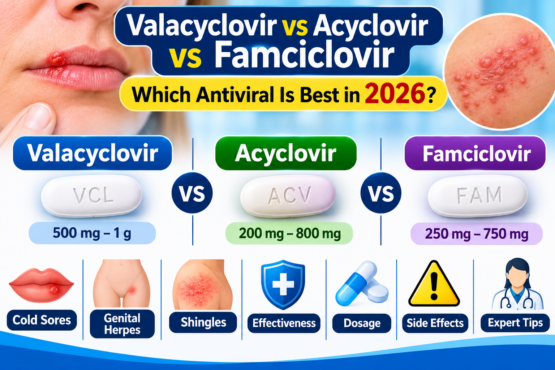
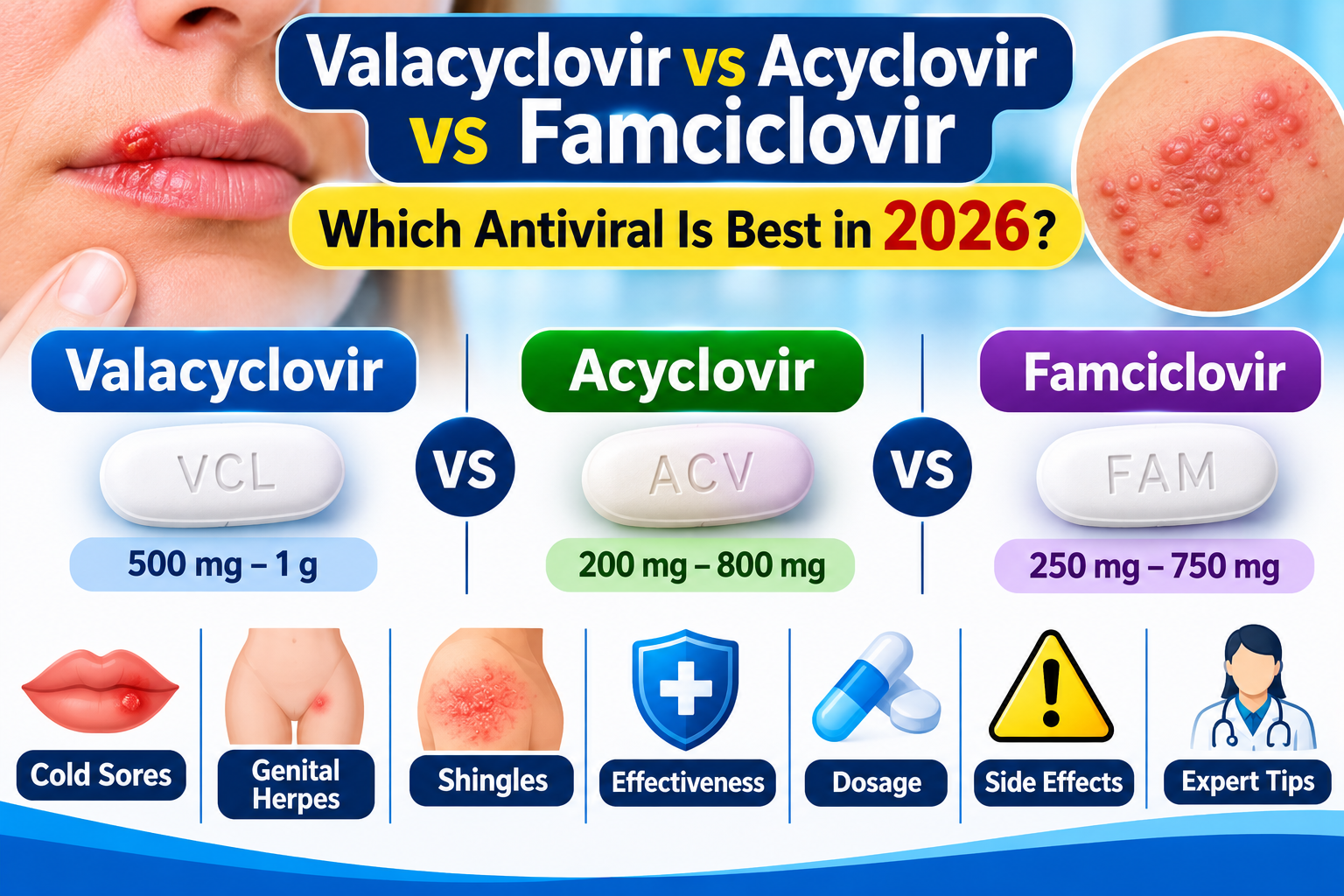
Cold sores, genital herpes, and shingles are caused by viruses belonging to the herpesvirus family. Although these conditions are different, several prescription antiviral medications can help manage them.
Three of the most widely used treatments are valacyclovir, acyclovir, and famciclovir.
They work by interfering with viral replication, but they differ in absorption, dosing frequency, approved uses, and the evidence supporting particular treatment plans.
For someone comparing valacyclovir vs acyclovir vs famciclovir, the most important question is not simply which medication is strongest. It is which medication is appropriate for the diagnosed infection, how quickly treatment begins, and whether the person has health conditions that affect medication safety.
This 2026 guide compares all three antiviral medications using CDC guidance, prescribing information, and clinical research. It also explains common prescription strengths and the difference between brand-name and generic products.
Quick Answer: Valacyclovir vs Acyclovir vs Famciclovir
Valacyclovir is often chosen when a less frequent oral dosing schedule is desirable. Acyclovir is an established treatment with extensive clinical experience, while famciclovir offers another effective option with short-course regimens for certain recurrent herpes infections.
All three have recognized roles in herpes treatment.
For recurrent genital herpes, the Centers for Disease Control and Prevention (CDC) states that the three medicines appear similarly effective when used for episodic treatment.
For shingles, all three are recognized antiviral treatment options. Starting medication early matters.
However, not every antiviral has the same FDA-approved uses, and there is no single medication that is best for every person.
Antiviral Medication Comparison Chart
| Feature | Valacyclovir | Acyclovir | Famciclovir |
|---|---|---|---|
| Well-known brand | Valtrex | Zovirax | Famvir |
| Active ingredient | Valacyclovir | Acyclovir | Famciclovir |
| Converted into | Acyclovir | Already active | Penciclovir |
| Cold sores | Yes | Certain oral or topical regimens | Yes |
| Genital herpes | Yes | Yes | Yes |
| Shingles | Yes | Yes | Yes |
| Daily suppression of recurrent genital herpes | Yes | Yes | Yes |
| Oral dosing frequency | Often less frequent than acyclovir | Often more frequent | Depends on indication |
| Kidney dose adjustments | May be required | May be required | May be required |
| Cure for herpes? | No | No | No |
Important: This table compares medicine ingredients, not interchangeable doses. FDA-approved indications and formulations differ. Acyclovir tablets, acyclovir cream, and acyclovir ointment are not used in exactly the same way.
What Are Valacyclovir, Acyclovir and Famciclovir?
These medications belong to a group known as nucleoside analogue antivirals.
They interfere with the ability of certain herpesviruses to reproduce inside infected cells.
1. Valacyclovir: A Common Oral Antiviral Option
Valacyclovir is the generic ingredient in Valtrex.
After oral administration, the body converts valacyclovir into acyclovir, the active antiviral compound.
Valacyclovir was developed to provide better oral absorption than acyclovir. This allows less frequent dosing for several indications.
Doctors prescribe valacyclovir for conditions that include:
- Recurrent cold sores, also called herpes labialis.
- Initial and recurrent genital herpes.
- Daily suppressive treatment for certain patients with genital herpes.
- Shingles, also known as herpes zoster.
Valacyclovir may reduce the duration or severity of an outbreak when started at the appropriate time. In certain patients with symptomatic HSV-2 genital herpes, daily suppressive treatment can also lower the likelihood of transmission to a sexual partner.
Available MyRxBox product information:
These pages show the listed strengths, manufacturers, and packaging. The correct prescription strength depends on the diagnosis and individual treatment plan.
2. Acyclovir: An Established Herpes Antiviral
Acyclovir has been used for decades to manage herpesvirus infections.
Unlike valacyclovir, acyclovir does not need to be converted from a prodrug before acting as an antiviral.
It is available in several formulations, including oral tablets, oral suspension, topical preparations, and intravenous medication.
Acyclovir can be used to treat genital herpes and shingles, among other herpesvirus infections.
One difference is its oral dosing schedule.
Some acyclovir treatment plans require multiple doses throughout the day. This can make it less convenient for people who find frequent medication schedules difficult to follow.
Nevertheless, acyclovir remains an important and effective treatment option.
It also has a substantial history of clinical use, including in situations requiring specialist treatment.
3. Famciclovir: An Alternative With Short-Course Regimens
Famciclovir is the generic ingredient in Famvir.
The body converts famciclovir into penciclovir, which interferes with herpesvirus replication.
Famciclovir is FDA-approved for several uses in adults, including recurrent cold sores, recurrent genital herpes, suppression of recurrent genital herpes, and shingles.
One notable feature is that some recurrent herpes episodes can be treated with short oral regimens prescribed by a healthcare professional.
However, this does not mean famciclovir is automatically more effective than valacyclovir or acyclovir.
For daily suppression of genital HSV-2, the CDC notes that famciclovir appears somewhat less effective at suppressing viral shedding than some alternatives.
MyRxBox product:
Famciclovir 500mg (Famcimac) Tablets
The 500mg tablet strength should not be confused with the total amount prescribed for a particular infection.
Which Antiviral Is Best for Cold Sores?
Cold sores, also called fever blisters or herpes labialis, usually develop around the lips.
They are commonly caused by herpes simplex virus type 1 (HSV-1), although HSV-2 can also cause oral infection.
Typical symptoms include:
- Tingling, itching, or burning near the lips.
- Small, fluid-filled blisters.
- Painful lesions that eventually crust and heal.
- Occasional recurrent outbreaks.
Valacyclovir and famciclovir both have FDA-labeled oral treatment regimens for recurrent cold sores.
Valacyclovir for Cold Sores
Valacyclovir can shorten cold sore episodes when treatment begins early enough.
The FDA label recommends starting treatment at the earliest symptom, such as tingling or burning, before or as the lesion develops.
The labeled adult regimen for recurrent cold sores is 2 grams taken twice, 12 hours apart, for one day in patients with normal kidney function.
This is a reference to approved prescribing information, not a recommendation to begin or change medication without a clinician.
Famciclovir for Cold Sores
Famciclovir is another oral treatment option for recurrent cold sores in adults.
Its FDA-labeled regimen includes a single 1,500mg dose for immunocompetent adults with normal renal function.
The medication should be started when the earliest symptoms appear.
A healthcare professional must determine whether this regimen is appropriate, particularly for people with kidney impairment or other medical conditions.
What About Acyclovir?
Acyclovir can also treat herpes simplex infections.
Oral or topical regimens may be selected depending on the clinical situation, although the FDA-approved uses differ across formulations.
For recurrent cold sores, convenience, timing, medical history, and clinician guidance can influence the choice.
Cold Sores vs Canker Sores
Not every mouth sore is caused by herpes.
Cold sores usually appear as grouped blisters around the lips and are contagious.
Canker sores are typically round or oval ulcers inside the mouth and are not caused by herpes simplex virus.
Antiviral herpes medication is not the standard treatment for ordinary canker sores.
The National Institute of Dental and Craniofacial Research explains these differences in detail.
Valacyclovir vs Acyclovir vs Famciclovir for Genital Herpes
Genital herpes can be caused by HSV-1 or HSV-2.
The infection can cause painful blisters or ulcers, but some people experience mild symptoms or no recognized symptoms at all.
A person can transmit genital herpes even without a visible outbreak.
Antiviral treatment can help manage genital herpes in two main ways.
Episodic Treatment: Taking Medication During an Outbreak
Episodic treatment means using antiviral medication when an outbreak begins.
According to the CDC, acyclovir, valacyclovir, and famciclovir appear similarly effective for treating recurrent genital herpes episodes.
Treatment generally works best when started during early warning symptoms or within the first day of lesion development.
This is one reason clinicians may prescribe medication in advance for people with a confirmed diagnosis and recurring symptoms.
The best regimen depends on the patient’s medical history, the type of herpes infection, kidney function, and other relevant factors.
Suppressive Therapy: Daily Treatment for Recurrent Herpes
People who experience frequent genital herpes outbreaks may be prescribed daily suppressive antiviral treatment.
The goal is to reduce the frequency of symptomatic recurrences and, in some circumstances, lower the risk of transmission.
The CDC reports that daily suppressive treatment can reduce recurrent genital herpes outbreaks by approximately 70% to 80% among patients who experience frequent recurrences.
However, a reduction in outbreaks does not mean the virus has been eliminated.
The CDC lists acyclovir, valacyclovir, and famciclovir among the recommended suppression options.
For certain people, once-daily valacyclovir offers a convenient treatment schedule.
Clinical evidence also supports daily valacyclovir 500mg for reducing HSV-2 transmission in specific heterosexual couples where one partner has symptomatic genital HSV-2 and the other does not.
Medication does not eliminate transmission risk. Condoms, avoiding sexual contact during outbreaks, and discussing testing with partners remain important.
For a complete review of recommended regimens, see the CDC’s genital herpes treatment guidelines.
Which Antiviral Is Best for Shingles?
Shingles is caused by reactivation of the varicella-zoster virus, the same virus responsible for chickenpox.
Unlike ordinary cold sores, shingles often produces a painful rash affecting one side of the body or face.
Some people experience burning, tingling, or sensitivity before the rash appears.
The three primary oral antivirals used for shingles are:
- Acyclovir.
- Valacyclovir.
- Famciclovir.
The CDC recognizes all three as preferred antiviral treatments.
Why the First 72 Hours Matter
For shingles, time is particularly important.
The CDC states that treatment is most effective when started within 72 hours of symptom onset.
Early antiviral treatment can help lesions heal, reduce the development of new lesions, and lessen acute pain.
People who suspect shingles should contact a healthcare professional promptly rather than waiting for the rash to become severe.
Treatment may still be considered after 72 hours in certain circumstances, such as new lesions, severe symptoms, or complications.
Valacyclovir vs Famciclovir for Shingles
Both medications have FDA-labeled oral regimens for shingles in adults.
For patients with normal kidney function, the labels describe:
| Medication | Labeled adult shingles regimen |
|---|---|
| Valacyclovir | 1,000mg three times daily for 7 days |
| Famciclovir | 500mg every 8 hours for 7 days |
These are labeled reference regimens, not self-treatment instructions. Dose adjustments may be necessary for reduced kidney function, and some cases need specialist treatment.
The treatment decision should also account for age, immune status, symptom severity, and medication tolerance.
Shingles Prevention
Antiviral tablets treat shingles but do not replace vaccination.
The CDC recommends two doses of the recombinant shingles vaccine, Shingrix, for adults aged 50 years and older and for adults aged 19 years or older with certain conditions or treatments that weaken the immune system.
More information is available in the CDC shingles vaccination guide.
Valacyclovir 500mg vs 1000mg: What Is the Difference?
A frequent medication question is whether valacyclovir 500mg or 1000mg works better.
The difference is the amount of valacyclovir contained in each tablet:
- A 500mg tablet contains 500 milligrams of valacyclovir.
- A 1000mg tablet contains 1,000 milligrams of valacyclovir.
However, the higher-strength tablet is not automatically the better treatment.
Prescription strength, total dose, dosing frequency, and duration depend on the condition being treated.
For example, a clinician may select different total daily doses for a recurrent genital herpes outbreak, daily suppression, cold sores, or shingles.
A 1000mg tablet does not mean every patient should take 1000mg daily.
The strength printed on the package should always be compared with the prescribed total dose and schedule.
For help understanding medication strengths, read Prescription Strength Explained: What 5mg, 10mg, 20mg, 50mg and 100mg Mean.
How Quickly Do Herpes Antiviral Medications Work?
The answer depends on the infection, how early treatment begins, and the individual’s health.
Antiviral medication does not necessarily stop pain or blisters immediately.
Instead, it reduces viral replication, helping the body control the active infection.
For Cold Sores
Treatment is most useful when started at the earliest sign of an episode.
Some patients experience shorter or less severe outbreaks, but results vary.
For Genital Herpes
Episodic medication may shorten the duration of an outbreak.
People with frequent recurrences may benefit from discussing daily suppression rather than repeatedly treating individual episodes.
For Shingles
Treatment works best when started promptly, particularly within the first 72 hours.
Pain may continue after the rash resolves, especially in older adults.
Persistent nerve pain after shingles is called postherpetic neuralgia and may require separate treatment.
Key point: Early treatment is important, but no oral antiviral guarantees immediate healing.
Side Effects of Valacyclovir, Acyclovir and Famciclovir
All prescription medications can cause side effects.
Commonly reported effects of oral herpes antivirals include headache, nausea, and gastrointestinal discomfort.
Some people taking famciclovir also report dizziness.
Most patients tolerate prescribed antiviral therapy, but serious reactions are possible.
Kidney Function and Antiviral Safety
Kidney function is an important consideration for all three drugs.
Acyclovir and valacyclovir can accumulate when kidney function is reduced.
Famciclovir also requires dose adjustments in certain patients with renal impairment.
People with kidney disease, dehydration, or medications that affect kidney function should receive an individual medication review.
Serious problems can include acute kidney injury. Valacyclovir and acyclovir can also cause neurological symptoms, including confusion, particularly when exposure is excessive or renal function is impaired.
Seek urgent medical attention for severe confusion, markedly reduced urination, seizures, serious allergic reactions, or a severe progressive rash.
Pregnancy and Breastfeeding
Pregnancy requires a separate medical review.
Acyclovir has substantial clinical experience during pregnancy, and CDC guidance considers it appropriate for certain herpes infections.
Valacyclovir may also be prescribed when clinically indicated.
Famciclovir has less pregnancy safety data.
Pregnant or breastfeeding patients should discuss antiviral medication with their obstetric or other treating clinician rather than changing treatment independently.
Can You Take Valacyclovir and Famciclovir Together?
These medications have overlapping antiviral activity.
They are generally selected as alternatives, rather than combined as routine treatment.
Taking multiple herpes antivirals together without a specific medical reason may increase medication exposure without proven added benefit.
Any change or combination should be reviewed by a healthcare professional.
MyRxBox also provides a Drug Interaction Checker for preliminary screening of selected interactions. The checker is not a substitute for a complete pharmacist review and may not cover every combination.
Can Herpes Be Cured Permanently?
There is currently no established cure that eliminates latent herpes simplex virus from the body.
HSV can remain inactive in nerve cells and reactivate later.
Antiviral medications can treat active episodes and, when used as prescribed, reduce recurrence frequency.
They do not permanently remove the virus.
For genital HSV-2, daily suppressive treatment can reduce viral shedding and transmission risk in certain circumstances, but transmission remains possible.
A person with few or no symptoms can still carry the infection.
People with recurring genital sores should discuss diagnosis, testing, treatment options, and partner counseling with a qualified healthcare professional.
When Should Someone Get Tested for Herpes?
Not every blister, skin irritation, or genital ulcer is caused by herpes.
Symptoms may overlap with other conditions.
The CDC recommends laboratory confirmation of genital herpes when lesions are present.
A swab-based nucleic acid amplification test (NAAT), often called PCR testing, is generally preferred because of its high sensitivity.
Blood antibody testing may be useful in selected circumstances, but results require careful interpretation and are not recommended as universal screening for people without symptoms.
Anyone with a new genital ulcer, unusual recurring lesions, or possible herpes exposure should seek medical evaluation.
Urgent assessment is particularly important for:
- A painful rash or blisters close to the eye.
- Suspected shingles involving the face.
- Neurological symptoms or severe illness.
- Pregnancy with possible new genital herpes.
- Extensive lesions in someone with a weakened immune system.
Generic Valtrex vs Valacyclovir: Is There a Difference?
Valtrex is a brand name for valacyclovir.
Generic valacyclovir contains the same active ingredient when a product is an approved equivalent.
However, not every product sold internationally has the same regulatory approval status.
Different brands can also have different inactive ingredients, manufacturers, packaging, and strengths.
For example, MyRxBox lists valacyclovir under the Valcivir brand, including:
Readers comparing products should review the exact ingredient, prescription strength, approved use, manufacturer, and legal availability in their country.
Learn more in the MyRxBox article Brand vs Generic Medicines: Same Active Ingredient, Different Price?.
How to Compare Antiviral Medication Prices
Antiviral prices vary according to the ingredient, brand, manufacturer, strength, pack quantity, and country.
The lowest package price is not necessarily the lowest cost for a complete prescribed treatment.
A meaningful comparison should consider:
- The medication selected by the prescribing clinician.
- The prescribed tablet strength and quantity.
- The total amount needed for the full treatment course.
- The price per tablet and total cost.
- Local dispensing rules, insurance coverage, and any delivery charges.
Comparing a 500mg famciclovir tablet directly with a 500mg valacyclovir tablet solely by milligram amount would be misleading because they contain different drugs.
Readers can review the MyRxBox Anti-Viral Medicine Price Index and the guide on How to Compare Medications: Ingredient, Strength, Safety and Price.
Important Considerations When Ordering Antivirals Online
Valacyclovir, acyclovir, and famciclovir are prescription medicines in the United States.
A legitimate prescription and professional review are important.
Before ordering, confirm the seller’s pharmacy credentials, the prescribed product, the manufacturer’s details, and the rules governing supply and importation in your country.
A foreign product containing a familiar generic ingredient is not automatically FDA-approved. In most circumstances, personal importation of prescription medicines into the United States is restricted, although limited exceptions may apply.
For further reading, see Before You Buy Medicine Online: 7 Important Checks and the FDA’s online pharmacy safety information.
Frequently Asked Questions
Is valacyclovir better than acyclovir?
Valacyclovir is often more convenient because its improved oral absorption allows less frequent dosing in several treatment regimens. Acyclovir remains effective and may be preferred in other clinical situations. Neither is universally superior.
Is famciclovir stronger than valacyclovir?
Not necessarily. Both are effective antiviral medications with overlapping uses. Their milligram strengths cannot be compared directly, and the best option depends on the infection, dosing plan, safety considerations, and clinical evidence.
Which medication works fastest for herpes outbreaks?
Treatment timing matters more than choosing a drug based on a general claim of speed. Episodic medication is most useful when started during early symptoms or soon after an outbreak begins.
Can valacyclovir prevent genital herpes transmission?
Daily valacyclovir can reduce HSV-2 transmission risk in certain couples when one partner has symptomatic genital HSV-2. It does not eliminate transmission risk or replace other preventive measures.
What is the difference between valacyclovir 500mg and 1000mg?
The difference is tablet strength. A 1000mg tablet contains twice the amount of valacyclovir as a 500mg tablet, but the correct total dose and schedule depend on the condition and patient.
Is famciclovir used for shingles?
Yes. Famciclovir is an FDA-approved treatment option for shingles in adults. Starting treatment promptly is important, and dosing must account for kidney function.
Can herpes come back after antiviral treatment?
Yes. Herpes simplex virus can remain in the body after symptoms resolve. Treatment controls active infection but does not remove latent HSV or prevent every future recurrence.
Is it safe to take herpes antivirals every day?
Daily antiviral suppression is an established option for certain patients with recurrent genital herpes. The need for continuing treatment, appropriate dose, and relevant health risks should be discussed periodically with a clinician.
Can you take antivirals after 72 hours of shingles symptoms?
A clinician may still consider treatment in certain circumstances, especially when new lesions continue to appear or complications are present. People should seek prompt assessment rather than assuming treatment is no longer possible.
Final Thoughts: Which Herpes Antiviral Should You Choose?
Valacyclovir, acyclovir, and famciclovir are all established antiviral medications, but they are not identical.
Valacyclovir is often valued for convenient oral dosing, acyclovir has extensive clinical experience, and famciclovir provides another effective option for specific herpes infections.
For recurrent genital herpes, the CDC recognizes all three as effective episodic treatments.
For shingles, timely assessment and early antiviral treatment are particularly important.
The most appropriate medication depends on the diagnosis, medical history, kidney function, other medicines, and the treatment plan recommended by a clinician.
Readers who want to review product information can visit MyRxBox’s Valacyclovir 500mg, Valacyclovir 1000mg, or Famciclovir 500mg pages.
Product information does not replace medical care, prescription verification, or local medication rules.
Medical References
The following resources were reviewed for this article:
- CDC — Genital Herpes Treatment Guidelines
- CDC — Clinical Overview of Shingles
- DailyMed — Valtrex (Valacyclovir) Prescribing Information
- DailyMed — Famciclovir Prescribing Information
- NIH MedlinePlus — Valacyclovir
- National Institute of Dental and Craniofacial Research — Fever Blisters and Canker Sores
- CDC — Shingles Vaccination
- FDA — Personal Importation of Medicines
Medical disclaimer: This article is for educational purposes only. It is not medical advice or a prescription. Medication selection, dosing, and treatment decisions should be made with a qualified healthcare professional. Medical content should receive professional review before publication.