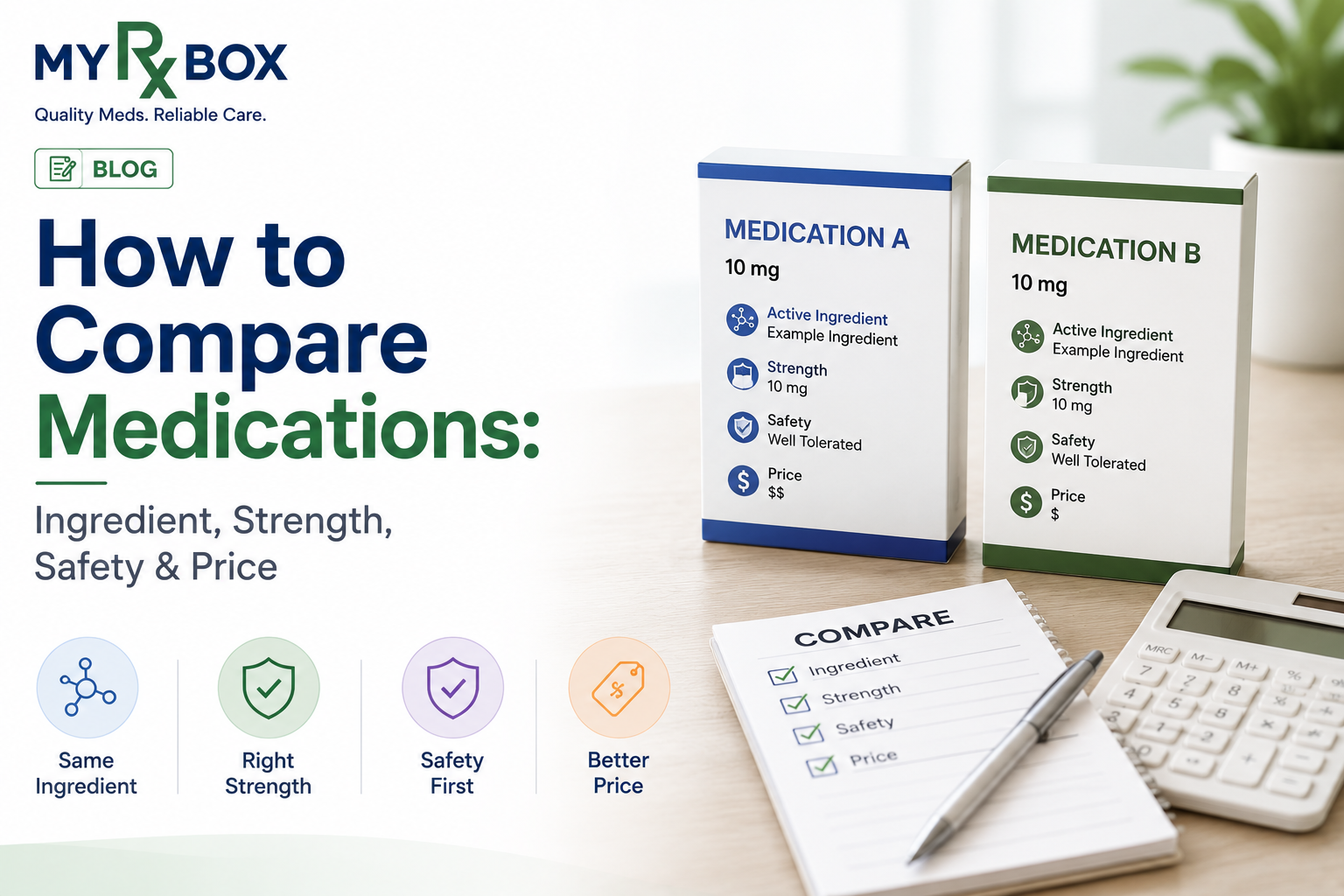
Searching “Medicine A vs Medicine B” sounds simple. But a useful medication comparison requires much more than comparing two names.
Medicines should be evaluated according to their active ingredients, recognized uses, strength, formulation, warnings, interactions and individual patient factors.
1. Identify the Active Ingredients
Two brands can contain the same active ingredient. Conversely, two medicines used for a similar condition may contain entirely different drugs.
Start with the generic ingredient and use the A–Z Medicine Glossary when researching unfamiliar names.
2. Compare What Each Medicine Is Used For
Never assume two medicines are interchangeable just because they belong to the same broad treatment category. Some medicines may have overlapping indications while differing in mechanism, dosing schedule, contraindications, interactions or patient populations.
3. Compare Strength Correctly
20 mg of Medicine A is not automatically equivalent to 20 mg of Medicine B.
Milligrams measure quantity. They do not provide a universal measure of how powerful unrelated drugs are relative to each other.
Read Prescription Strength Explained for more detail.
4. Compare Dosage Form
A medicine may exist as a tablet, capsule, liquid, cream, injection, extended-release tablet or immediate-release tablet. Different formulations can behave differently and are not automatically interchangeable.
5. Compare Route of Administration
Routes can include oral, topical, inhaled, injected, ophthalmic or nasal use. Route can materially change how a medicine is used.
6. Compare Warnings and Contraindications
A medicine suitable for one person may not be suitable for another. Considerations can include allergies, pregnancy, kidney or liver function, heart conditions, age and other medicines.
7. Look for Drug Interactions
Medicines can interact with other prescriptions, OTC medicines, supplements, food or alcohol. Read official medication information and ask a pharmacist or prescriber when you have interaction questions.
8. Compare Side Effects in Context
Do not simply count how many adverse effects appear on two labels. A longer list does not automatically mean one medicine is more dangerous. Frequency, severity, relevance and the patient’s circumstances all matter.
9. Compare Brand and Generic Availability
If two options are both clinically appropriate, approved generic availability may influence affordability. Read Brand vs Generic Medicines.
10. Compare Price After Clinical Relevance
Cost is important, but it should come after establishing that you are comparing clinically relevant options. Once appropriate choices are established with a healthcare professional, use the Medicine Price Index and our Prescription Medicine Price Comparison Guide.
Medication Comparison Table
| Question | Medicine A | Medicine B |
|---|---|---|
| Active ingredient | Check | Check |
| Main use | Check | Check |
| Strength | Check | Check |
| Dosage form | Check | Check |
| Route | Check | Check |
| Major warnings | Check | Check |
| Interactions | Check | Check |
| Generic available | Check | Check |
| Price | Compare when clinically relevant | Compare when clinically relevant |
The Rule to Remember
Instead of asking only “Which drug is stronger?”, ask: How do these medicines differ, and which is appropriate for the specific patient and condition?
Frequently Asked Questions
How do I compare two medicines?
Compare their active ingredients, indications, formulation, route, warnings, interactions, dosing information and price.
Does the same mg mean medicines are equally strong?
No. Milligram values generally cannot be compared directly across different active ingredients.
Can two brands contain the same drug?
Yes. Multiple brands may contain the same active ingredient.
Can I change from one medicine to another myself?
Prescription changes should be discussed with the prescribing healthcare professional.
Medical disclaimer: General educational information only.