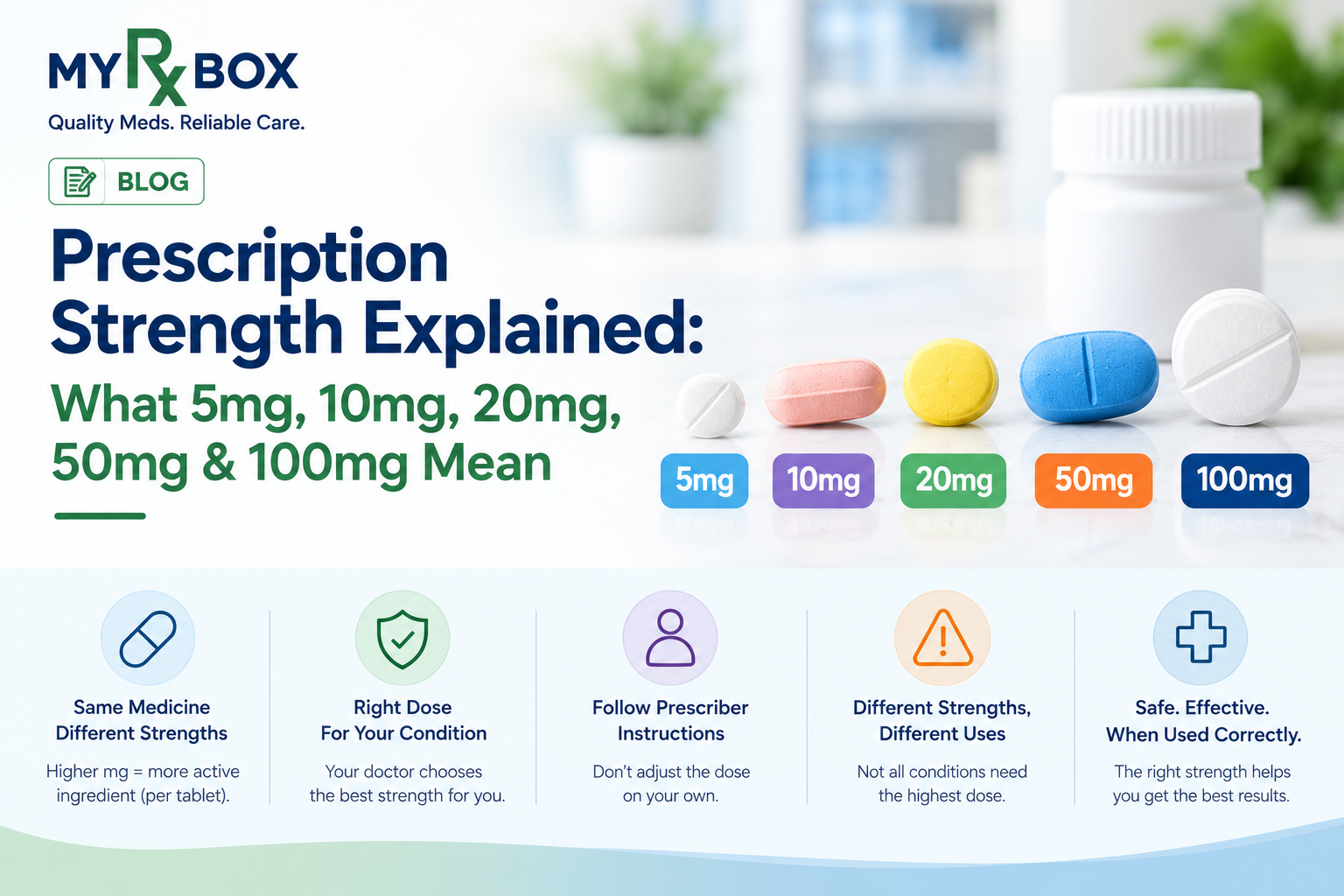
Medicine labels contain numbers everywhere: 5 mg, 20 mg, 50 mg, 100 mg or 500 mg.
Understanding what those numbers mean can make prescription labels easier to read. But there is one crucial rule: a larger number does not automatically mean a better medicine or an appropriate dose.
What Is Medicine Strength?
Strength describes the amount or concentration of active ingredient contained in a particular dosage unit or formulation.
For a tablet labeled ExampleDrug 20 mg, the labeled unit contains 20 mg of that active ingredient.
What Does mg Mean?
mg means milligram. One thousand milligrams equal one gram.
Medicines may also use micrograms, usually written mcg or µg. One milligram equals 1,000 micrograms.
Because these units differ dramatically, read medicine labels carefully.
Strength Is Not the Same as Dose
This distinction matters:
- Strength: the amount or concentration in the product.
- Dose: the amount a patient is instructed to take at a particular time.
Never calculate or change prescription dosing without appropriate clinical guidance.
Higher mg Does Not Mean Better
Suppose Medicine A is 20 mg and Medicine B is 100 mg. You cannot conclude that Medicine B is five times “stronger” if the two products contain different active ingredients.
Each drug has different pharmacology.
Why Does One Medicine Come in Several Strengths?
Different strengths may allow healthcare professionals to individualize treatment according to condition, treatment response, age, other medicines, organ function and clinical guidance.
This is why you should not move from one strength to another on your own.
Check the Active Ingredient First
20 mg Drug A and 20 mg Drug B are not the same simply because the numbers match.
Look up generic medicine names using the MyRxBox Medicine Glossary.
Strength Versus Quantity
Consider a package labeled 20 mg — 30 tablets.
The first number describes the labeled strength. The second tells you how many tablets are supplied.
They are completely different pieces of information.
What About mg/mL?
Liquid medicines may express concentration as something like 10 mg/mL, meaning a specified amount of active ingredient is present per unit volume.
Because liquid dosing can involve measuring devices and calculations, follow the exact prescription or label instructions.
Do Not Split Tablets Automatically
Seeing a higher-strength tablet and thinking “I’ll just split it” can be unsafe. Some tablets have special coatings, use modified-release technology or are not designed to divide evenly.
Ask a pharmacist before altering a dosage form.
How to Read Your Medicine Label
- Medicine name
- Active ingredient
- Strength
- Dosage form
- Directions
- Quantity
- Warnings
- Expiration date
Our Prescription Label Guide explains these fields in more detail.
Frequently Asked Questions
What does 20 mg mean?
It identifies an amount of active ingredient associated with the labeled dosage unit or formulation.
Is 100 mg stronger than 20 mg?
Only within an appropriate comparison of the same active ingredient and formulation. You generally cannot compare milligrams directly between unrelated medicines.
What is the difference between strength and dose?
Strength describes the amount in the product. Dose describes the amount instructed for use.
Is 1 mg the same as 1,000 mcg?
Yes.
Can I split a higher-strength tablet?
Only after confirming that the specific tablet is suitable for splitting and that doing so matches professional instructions.
Medical disclaimer: General educational information only.