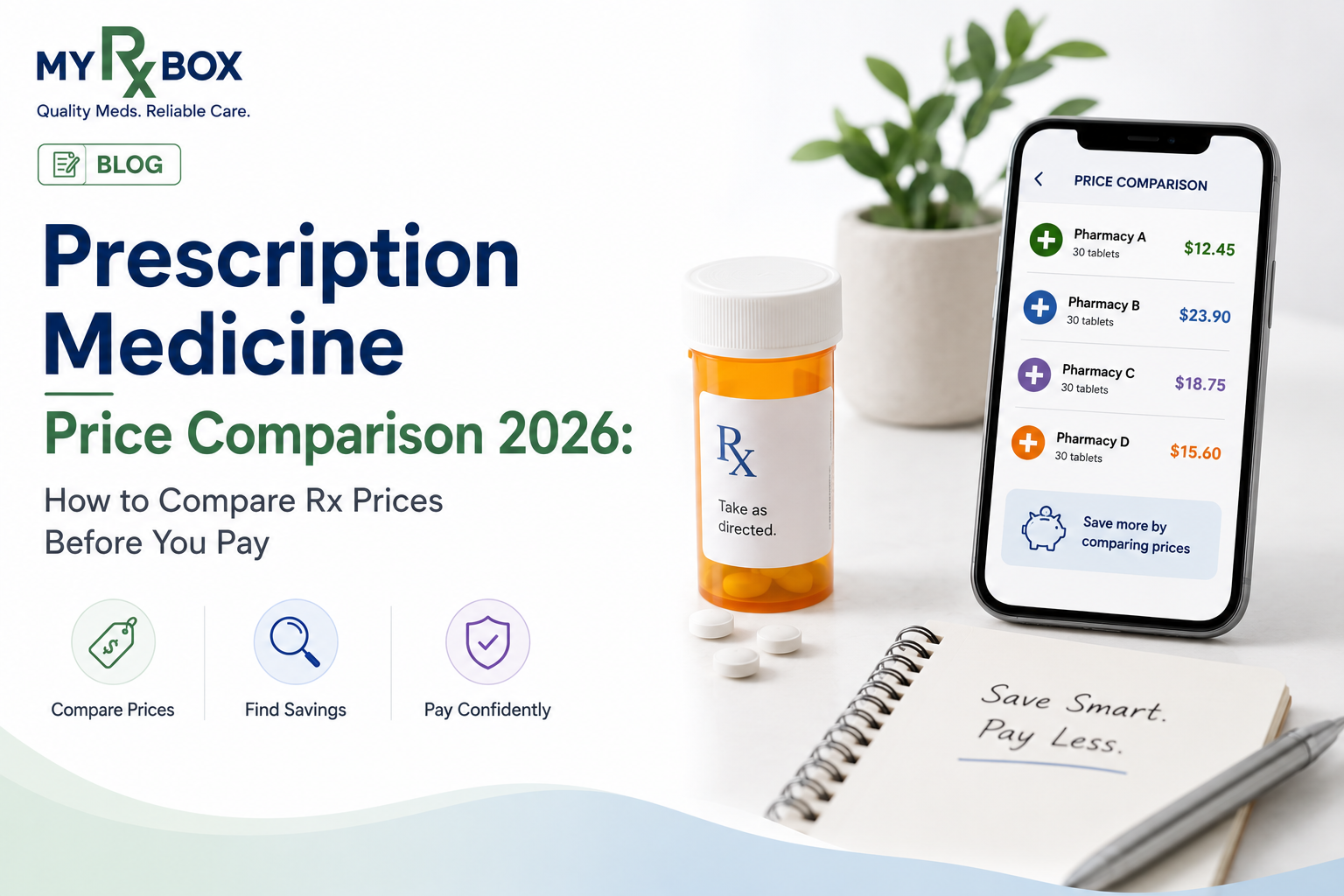
The price of the same prescription medicine can vary depending on the pharmacy, manufacturer, quantity, insurance arrangement and whether a generic version is available.
That is why comparing only the number printed next to a medicine name can give you the wrong answer. A useful prescription medicine price comparison starts by making sure you are comparing the same medicine, same active ingredient, same strength, same dosage form and same quantity.
You can also explore the MyRxBox Medicine Price Index when researching medicine pricing.
Why Can Prescription Medicine Prices Be So Different?
Prescription prices can be influenced by brand-versus-generic status, manufacturer, pharmacy pricing, insurance coverage, quantity, strength, dosage form, location, delivery charges and other fees.
Two listings may look similar while representing different quantities or strengths. For example, comparing 10 tablets with 30 tablets is not meaningful unless you calculate the price per tablet.
1. Check the Active Ingredient
Start with the active ingredient rather than the brand name. The active ingredient is the component responsible for the medicine’s intended pharmacological effect.
A brand-name medicine and an approved generic may contain the same active ingredient even though their names, appearance or packaging differ. FDA-approved generics are required to have the same active ingredient, strength, dosage form and route of administration as their reference drug and to meet applicable bioequivalence requirements.
Look up generic names in the MyRxBox Medicine Glossary.
2. Compare the Same Strength
Never compare two prices until you have checked the strength. Medicine strength may be shown as 5 mg, 10 mg, 20 mg, 50 mg, 100 mg, 500 mg or another unit.
Strength tells you how much active ingredient is present in a particular dosage unit. It does not tell you which strength is appropriate for you. That decision belongs to the prescribing healthcare professional.
If labels confuse you, see How to Read Your Prescription Label.
3. Check the Quantity and Price Per Unit
A lower total price does not always mean a lower real cost. If Pharmacy A charges $20 for 10 tablets and Pharmacy B charges $30 for 30 tablets, Pharmacy B has the lower price per tablet.
Price per unit = total price ÷ number of dosage units.
4. Compare Generic and Brand Options
Approved generic medicines often cost less than their brand-name counterparts. Lower cost does not automatically mean lower quality. Ask your pharmacist or prescriber whether an approved generic is appropriate for your prescription.
For a deeper explanation, read Brand vs Generic Medicines.
5. Compare More Than One Pharmacy
Medicine pricing is not necessarily identical across pharmacies. Compare local pharmacies, licensed online pharmacies, mail-order options, insurance-network pharmacies and legitimate discount pricing when relevant to your situation.
For another comparison route, visit our GoodRx Alternative Guide.
6. Check Cash Price Versus Insurance Price
Depending on your insurance policy, deductible and formulary, the price through insurance may differ from the pharmacy’s cash price. Compare the options available under your own plan rather than assuming one payment route is always cheapest.
7. Include Delivery and Additional Fees
A medicine advertised for one price can cost more after delivery, dispensing, service or consultation fees. Compare the final payable price, not just the headline price.
8. Check Whether the Pharmacy Is Legitimate
Price should never be the only consideration. In the United States, FDA guidance advises consumers to look for pharmacies that require prescriptions for prescription-only medicines, provide contact information, offer access to a licensed pharmacist and are appropriately licensed.
Read How to Check If an Online Pharmacy Is Legit and our broader Online Pharmacy Guide.
Prescription Price Comparison Checklist
| Factor | What to check |
|---|---|
| Active ingredient | Same ingredient |
| Strength | Same strength |
| Dosage form | Same form |
| Quantity | Same quantity or calculate per unit |
| Brand/generic | Identify which product you are comparing |
| Delivery | Include in total cost |
| Other fees | Include in total cost |
| Pharmacy credentials | Verify appropriate licensing |
USA, UK and Australia
Rules surrounding prescription medicines and pharmacies differ by jurisdiction. See our country pages for more context: USA, UK and Australia.
The Bottom Line
The cheapest-looking medication is not necessarily the lowest-cost option. Compare the active ingredient, strength, dosage form, quantity, price per unit, payment route, delivery costs and pharmacy credentials before making a meaningful price comparison.
Start with the MyRxBox Medicine Price Index.
Frequently Asked Questions
Why do prescription medicine prices vary between pharmacies?
Pricing can differ because of manufacturer, generic competition, insurance networks, purchasing arrangements, pharmacy fees, quantity and other commercial factors.
Are generic medicines cheaper?
They often are, although the actual price difference varies by medicine, manufacturer and pharmacy.
How do I compare medication prices correctly?
Compare the exact active ingredient, strength, dosage form and quantity, calculate price per unit and include delivery or service charges.
Is the cheapest online pharmacy automatically the best?
No. Licensing, prescription requirements, medication authenticity, storage and pharmacist access matter alongside price.
Medical disclaimer: This article provides general educational information and is not individualized medical advice. Prescription choice, dosage and treatment decisions should be discussed with an appropriately qualified healthcare professional.