
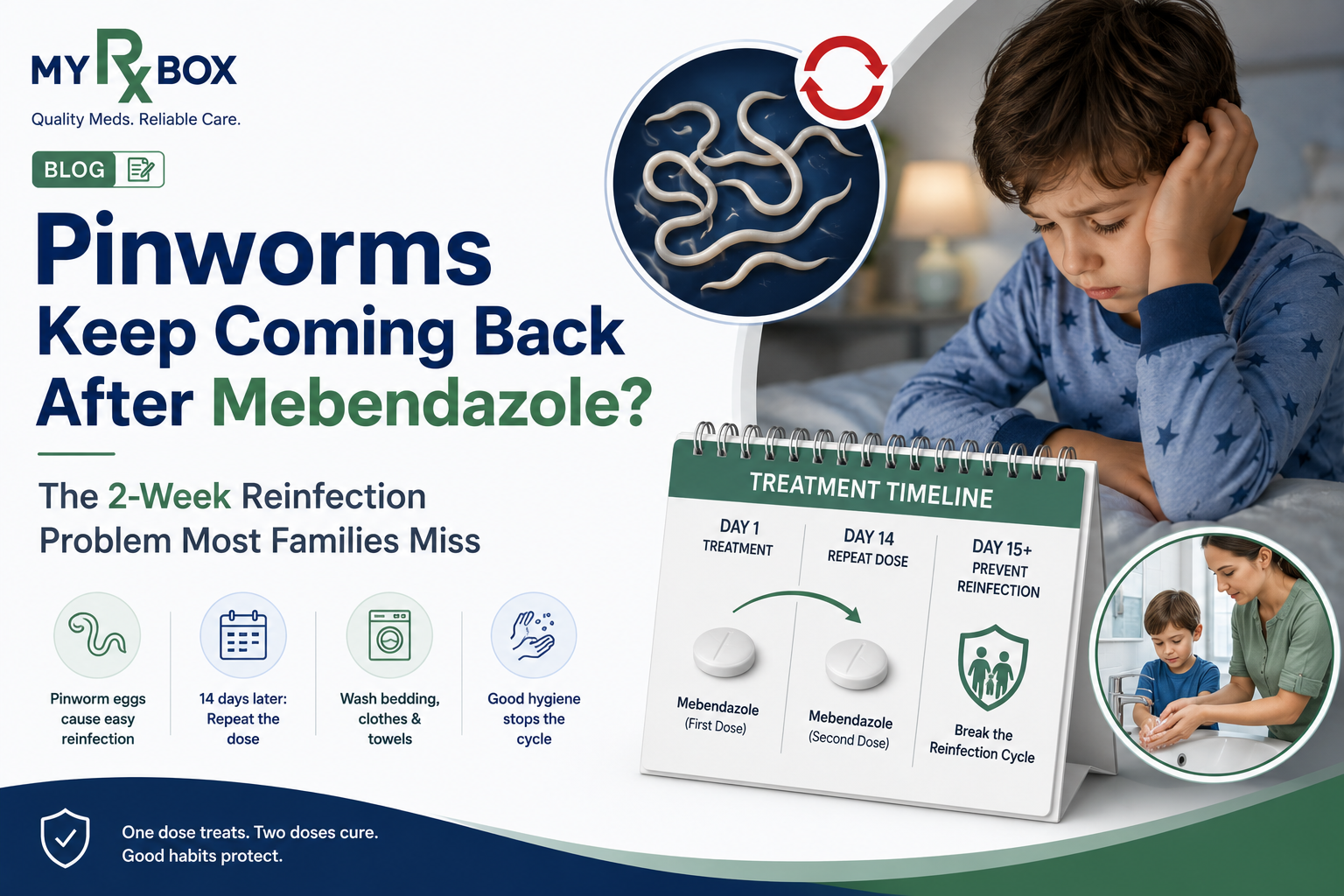
You treat the pinworms.
The itching disappears.
Everyone assumes the problem is over.
Then, a couple of weeks later, the nighttime itching starts again.
For many families this feels like the medicine “didn’t work.”
But there is another explanation that is surprisingly easy to miss:
Mebendazole can kill pinworms, but it does not kill their eggs.
Those microscopic eggs can remain in the environment long enough to start the infection all over again.
CDC says pinworm eggs can survive for 2–3 weeks on objects when they are not properly cleaned. That means bedding, clothing, toys and other frequently touched items can help keep the cycle going even after treatment.
This is one reason pinworm treatment is not only about swallowing a tablet.
It is about breaking an entire reinfection cycle.
If you’re researching the medicine before treatment, the MyRxBox mebendazole guide explains the drug itself, while the Mebex 100 mg mebendazole guide covers the 100 mg formulation in greater detail.
What Exactly Are Pinworms?
Pinworms are tiny parasitic roundworms known scientifically as Enterobius vermicularis.
In the United Kingdom and some other countries, they are usually called threadworms.
CDC describes pinworm as the most common worm infection in the United States. It occurs especially often among preschool and school-age children, household members, caregivers and people living in institutional settings.
The infection is usually not dangerous, but it can be extremely frustrating.
The classic symptom is itching around the anus, particularly at night.
That nighttime pattern happens for a reason.
Female pinworms leave the intestine while an infected person is sleeping and deposit eggs on the skin around the anus.
The itching can then lead to scratching.
Eggs get underneath the fingernails.
Hands touch bedding, pajamas, toys, bathroom surfaces and food.
Eventually the eggs can make their way back into someone’s mouth.
The cycle begins again.
The Fact That Makes Pinworms So Difficult to Eliminate
Pinworm medicine targets the worms.
The eggs are the bigger household problem.
CDC explains that pinworm medications do not kill eggs. Its clinical guidance therefore uses a two-dose treatment approach, with the second dose given two weeks after the first so that worms that hatch after the initial treatment can also be targeted.
This is why someone can take medicine correctly and still see pinworms again.
The infection may not necessarily have survived treatment in adult-worm form.
The person may have swallowed viable eggs after treatment.
This distinction matters because repeatedly changing medicines without addressing reinfection may not solve the real problem.
How Is Mebendazole Used for Pinworms?
Mebendazole is an established human antiparasitic medicine.
In the United States, the current EMVERM prescribing information lists Enterobius vermicularis, or pinworm, among its approved indications for adults and children aged two years and older.
The current U.S. product is a 100 mg chewable tablet.
CDC’s clinical pinworm guidance recommends mebendazole 100 mg orally, followed by another dose two weeks later.
There is an important labeling nuance consumers should know.
The current U.S. EMVERM prescribing information lists one 100 mg tablet once for pinworm and says that if the patient is not cured three weeks after treatment, another course is advised.
CDC’s public-health guidance, by comparison, recommends the second dose at two weeks because the medicines kill worms but not eggs.
Those are two different authoritative instructions, so a patient should follow the directions given by the prescribing healthcare professional and the labeling supplied with the specific product rather than mixing schedules from different sources.
Readers comparing tablet options can also review the MyRxBox mebendazole 100 mg page.
Why Is Mebendazole 100 mg Such a Common Pinworm Search?
For U.S. pinworm treatment, 100 mg is the strength found in the current EMVERM chewable tablet label.
The medicine is also widely recognized internationally for threadworm treatment.
The NHS currently states that mebendazole is used for threadworms, roundworms, whipworms and hookworms. For threadworm infection, NHS guidance describes a single dose, with another dose potentially needed two weeks later if symptoms return.
Availability varies by country.
In the United States, EMVERM is a prescription medicine.
In the United Kingdom, NHS guidance says mebendazole can be purchased from pharmacies for threadworms in adults and children aged two years and older.
That means a search such as “buy mebendazole 100 mg” can have very different regulatory implications depending on where the buyer lives.
MyRxBox readers comparing purchasing options can review the broader mebendazole online guide while checking the prescription rules that apply where they live.
Why Treating Only the Person Who Itches May Not Be Enough
Pinworm infection often occurs in more than one member of the same household.
A person can carry pinworms without obvious symptoms.
That creates a frustrating situation: one child receives treatment, improves, and then becomes exposed again through another household member who never appeared sick.
CDC’s current prevention guidance recommends treating the infected person, their caregivers and household members at the same time to reduce repeat infections.
The NHS similarly advises simultaneous household treatment for people aged two years and older, while recommending professional advice when someone is pregnant, breastfeeding or younger than two.
This is one reason pinworm can feel as if it “keeps coming back.”
Sometimes what looks like one persistent infection is actually ongoing transmission within the household.
The Eggs Can Survive Longer Than Many People Realize
This is probably the strongest reason pinworm becomes a repeat problem.
CDC says pinworm eggs can survive 2–3 weeks on objects.
NHS guidance describes eggs surviving for up to two weeks outside the body.
That means treatment day is not necessarily the end of exposure.
Eggs may still be present on bedding, nightwear, towels and frequently handled objects.
CDC’s April 2026 prevention guidance emphasizes frequent handwashing, morning bathing, keeping fingernails short, changing clothes and bedding, and washing appropriate items in hot water.
CDC recommends water at least 130°F, followed by a hot dryer, for contaminated washable items.
The point isn’t to turn the house into a sterile laboratory.
It is to reduce the chance that surviving eggs return from fingers and household surfaces to someone’s mouth.
Why Morning Showers Matter More Than You Might Expect
Female pinworms lay eggs around the anus primarily at night.
That makes the morning an important time for removing eggs from the skin before they spread through clothing and household contact.
CDC recommends bathing every morning during the period when the household is trying to stop reinfection.
It specifically prefers showers over shared tub baths because bathwater may potentially spread eggs.
Changing underwear in the morning also helps remove material contaminated overnight.
These measures sound simple, but with pinworm they can be as important to preventing recurrence as choosing the medicine.
The Fingernail Connection
Children scratch.
That is exactly what makes pinworm transmission so efficient.
Eggs deposited around the anus can become trapped beneath fingernails after scratching.
A child then bites a nail, sucks a finger or handles food.
The eggs can be swallowed.
Pinworm’s life cycle starts again.
CDC therefore recommends keeping fingernails clean and short and avoiding nail biting during treatment and prevention.
Good handwashing with soap and warm water is considered the most important step for reducing spread.
It is particularly important after using the bathroom, changing diapers, handling contaminated laundry and before preparing or eating food.
How Do You Know It Is Actually Pinworm?
Nighttime anal itching is strongly associated with pinworm infection, but itching alone does not prove the diagnosis.
CDC describes the tape test as the most common diagnostic test.
It sounds almost too simple.
Clear adhesive tape is pressed against the skin around the anus first thing in the morning, ideally before washing, using the toilet or getting dressed.
CDC recommends collecting samples on three consecutive mornings when instructed by a healthcare professional.
The tape can then be examined microscopically for pinworm eggs.
Another clue is seeing small white worms around the anal area several hours after the person falls asleep.
Pinworms may also occasionally be visible on bedding or clothing.
A routine stool test is generally not the best test for pinworm because CDC notes that stool samples often do not contain enough eggs or worms for easy detection.
Are Pinworms Only a Children’s Problem?
No.
Children are affected most frequently, but adults can absolutely become infected.
Parents, siblings, caregivers and other close household contacts can acquire pinworms because transmission occurs so easily.
CDC specifically identifies household members and caregivers as groups at increased risk.
Adults may have nighttime itching, sleep disturbance or no symptoms at all.
That means a household outbreak should not automatically be treated as “the child’s problem.”
The infection can move between family members.
For people comparing broader adult worm-treatment options, the MyRxBox deworming tablets for adults guide provides additional context about different intestinal parasites and medicines.
Can You Get Pinworms From a Dog or Cat?
This is one of the most persistent misconceptions.
CDC’s 2026 prevention guidance says people cannot get human pinworm infection from their pets or transmit their pinworms to pets.
Human pinworm is transmitted between humans.
So repeatedly deworming a dog or cat is not the solution to a human Enterobius vermicularis outbreak.
The focus should instead remain on appropriate human treatment and household hygiene.
Can You Catch Pinworms From a Swimming Pool?
It is extremely unlikely.
CDC says pinworm transmission through swimming pools is unlikely.
Pinworm infection primarily spreads when eggs are swallowed after contamination of hands, food, clothing or objects.
A household or childcare environment with close contact therefore represents a more realistic transmission route than properly maintained swimming water.
This matters because families sometimes spend energy disinfecting the wrong things while overlooking hand hygiene and contaminated bedding.
Mebendazole vs Albendazole vs Pyrantel for Pinworms
Mebendazole is not the only medicine used for pinworm.
CDC lists three commonly used options: mebendazole, albendazole and pyrantel pamoate.
In the United States, pyrantel pamoate is available without a prescription, while CDC identifies mebendazole and albendazole as prescription treatment options.
These medicines do not have identical dosing or regulatory status.
That is why switching between them based only on online comments can create confusion.
MyRxBox’s mebendazole vs ivermectin vs albendazole guide explains how several common antiparasitic drugs differ.
For pinworm specifically, the medicine should be selected according to age, medical circumstances, local availability and professional guidance where needed.
Mebendazole Is Not the Same Treatment for Every Worm
This is another purchasing mistake worth avoiding.
Mebendazole is used against several intestinal worm infections, but the treatment schedule depends on the parasite.
The current U.S. EMVERM label gives one 100 mg tablet for pinworm but uses a different multi-day schedule for whipworm, roundworm and hookworm.
Someone should therefore not take a dosing schedule found in an article about roundworm and apply it to pinworm—or vice versa.
The parasite matters.
The indication matters.
The product instructions matter.
The MyRxBox Mebex 100 mg guide discusses the medicine across its broader antiparasitic uses.
What About Children Younger Than Two?
Extra caution is required.
The current U.S. EMVERM indication covers patients two years of age and older.
CDC says healthcare professionals and parents should weigh the risks and benefits of pinworm medicines in children younger than two years.
NHS guidance similarly advises speaking with a clinician when treatment is needed for a child younger than two.
Parents should not simply split an adult tablet or estimate a dose for an infant or toddler.
Age-specific professional guidance matters.
What About Pregnancy?
This is another situation where someone should not automatically copy a household member’s treatment.
CDC notes that the safety of drugs used for pinworm infection has not been studied adequately in pregnant women and recommends weighing treatment according to the circumstances.
The NHS advises pregnant or breastfeeding people to speak with a pharmacist or doctor because routine household treatment may not be appropriate.
If one family member is pregnant, that does not mean the rest of the household should ignore pinworm.
It means their treatment decisions may need to differ.
One Important Mebendazole Drug Interaction
The current U.S. EMVERM prescribing information contains a significant warning involving metronidazole.
Serious skin reactions, including Stevens-Johnson syndrome/toxic epidermal necrolysis, have been reported when mebendazole and metronidazole were used together.
The U.S. label says concomitant use should be avoided.
Anyone taking prescription medicines should therefore tell their prescriber or pharmacist what else they use before starting mebendazole.
A “common worm tablet” is still a medicine and can have clinically important precautions.
Why Higher Mebendazole Doses Are Not Automatically Better
Online product listings may contain 100 mg tablets, 500 mg tablets and other formulations.
That does not mean someone with pinworm should simply choose the strongest tablet.
For U.S. pinworm treatment, the current licensed EMVERM product is a 100 mg chewable tablet with indication-specific instructions.
Higher-dose or prolonged mebendazole exposure has also been associated with additional adverse effects in prescribing information.
More medicine does not automatically mean better parasite control.
Correct diagnosis and correct indication matter much more than choosing the largest milligram number.
If you are trying to understand how formulations differ, read the MyRxBox mebendazole glossary before comparing specific products.
What Should You Check Before Buying Mebendazole?
Start by confirming that mebendazole is appropriate for the infection you are trying to treat.
Then check the tablet strength, formulation, manufacturer, package labeling, expiration information and local prescription requirements.
For someone specifically prescribed a 100 mg formulation, MyRxBox lists Mebex mebendazole 100 mg tablets and Lupimeb mebendazole 100 mg tablets.
Product availability does not replace medical guidance.
In particular, do not treat unexplained abdominal symptoms as “worms” solely because an antiparasitic medicine can be purchased online.
Different parasitic diseases need different treatments, and some gastrointestinal symptoms have nothing to do with parasites.
Consumers comparing medicine costs can also use the MyRxBox Medicine Price Index and broader online pharmacy guide before ordering medicines online.
Why Pinworms Can Return Even When Everyone Took Medicine
This is the central point worth remembering.
Successful pinworm control has two sides.
The medicine deals with the worms.
Hygiene deals with the eggs and transmission.
If only one side is addressed, reinfection remains possible.
CDC’s April 2026 prevention guidance says repeat infections are common, particularly among household members and children who spend time together.
It recommends maintaining prevention measures for two weeks after the final treatment dose.
So if pinworms return, it does not automatically mean mebendazole “failed.”
Possible explanations include surviving eggs, reinfection from household contacts, incomplete simultaneous treatment or an incorrect original diagnosis.
The Bottom Line
Pinworms are not usually dangerous.
But they are exceptionally good at coming back.
The reason is simple:
The medicine can kill the worms, while the eggs can remain behind.
CDC says those eggs may survive on objects for 2–3 weeks, which helps explain why household outbreaks can repeat after apparently successful treatment.
Mebendazole is an established treatment option for pinworm, including an FDA-labeled use in people aged two years and older.
But taking a tablet is only part of controlling an outbreak.
Household treatment when appropriate, handwashing, morning bathing, clean fingernails, careful laundering and preventing egg transfer are what help break the cycle.
If you are comparing treatment options, read the MyRxBox Mebex 100 mg guide, explore the mebendazole medicine glossary, or browse anti-worm medicines for broader educational information.
Frequently Asked Questions
Does mebendazole kill pinworm eggs?
No. CDC specifically explains that pinworm medicines kill worms but do not kill the eggs. This is why preventing reinfection is an important part of treatment.
Why do pinworms come back after mebendazole?
Viable eggs can remain on hands, bedding, clothing and household objects and can be swallowed again. CDC says eggs may survive 2–3 weeks on objects.
What strength of mebendazole is used for pinworms?
Current U.S. EMVERM labeling uses a 100 mg chewable tablet for pinworm. Treatment instructions can vary by country and guidance source, so follow the directions supplied with your medicine and clinician or pharmacist advice.
Does CDC recommend repeating mebendazole?
CDC’s pinworm guidance lists mebendazole 100 mg followed by a repeat dose two weeks later. The current U.S. EMVERM label instead lists one 100 mg tablet once and advises another course if the patient is not cured after three weeks. Follow the instructions applicable to your specific prescribed or supplied product.
Should the whole family be treated?
CDC recommends simultaneous treatment of the infected person, caregivers and household members to help prevent repeated infection. Individual circumstances such as age and pregnancy can change what treatment is appropriate.
Can adults get pinworms?
Yes. Although pinworm is particularly common among children, household members and caregivers can also become infected.
Can pets spread human pinworms?
CDC says no. People do not get human pinworm infection from pets and do not pass human pinworms to pets.
What is the best test for pinworms?
CDC identifies the morning tape test as the most common diagnostic approach. Samples are typically collected before bathing, using the bathroom or getting dressed.
Is mebendazole available without a prescription?
Availability varies. In the United States, EMVERM is prescription-only. NHS guidance says mebendazole can be purchased from pharmacies in the UK for threadworm treatment in adults and children aged two and older.
Is mebendazole the same as albendazole?
No. Both are antiparasitic medicines, but they are separate drugs with different formulations and dosing instructions. CDC lists both as options for pinworm treatment.
Medical Disclaimer: This article is intended for general educational information and does not replace diagnosis, prescribing advice or treatment from a qualified healthcare professional. Treatment decisions can differ according to age, pregnancy, medical history, medicines already being taken and local drug-label requirements.