
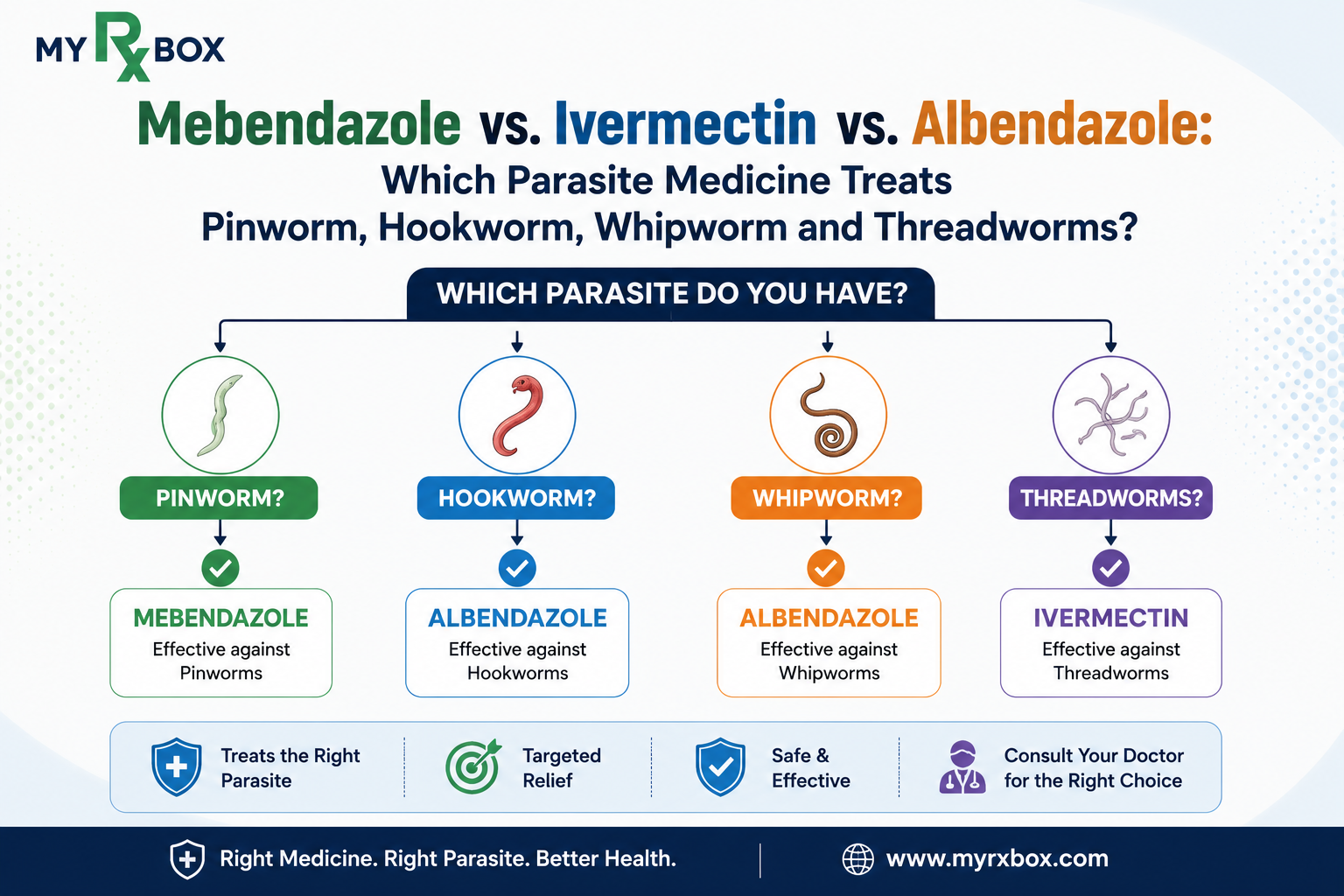
The Parasite-Medicine Question More People Are Asking
Searches for ivermectin and mebendazole, mebendazole vs. albendazole, pinworm treatment, hookworm, whipworm and threadworms are rising.
These medicines often appear together online because they all have roles in parasite treatment. However, they do not treat every parasite in the same way.
Mebendazole may be prescribed for several common intestinal worms. Albendazole has a related but not identical range of medical uses. Ivermectin is often selected for parasites such as Strongyloides and the worms responsible for onchocerciasis, rather than as the first choice for every ordinary intestinal worm infection.
Praziquantel is another antiparasitic medicine, but it is mainly used against certain tapeworms and flukes. It is not interchangeable with mebendazole, albendazole or ivermectin.
The correct medicine depends on:
- The parasite involved
- The patient’s symptoms
- Stool or tape-test results
- Age and body weight
- Pregnancy or breastfeeding
- Liver health
- Other medicines being taken
- Local treatment guidance
- Previous exposure and travel history
A medicine may work well against one worm and perform poorly against another. This is why choosing a deworming tablet by popularity, price or online comments can lead to failed treatment.
This guide explains the differences between mebendazole, ivermectin and albendazole, including which infections they may treat, their side effects and what to check before ordering antiparasitic medicine online.
Quick Comparison: Mebendazole, Ivermectin and Albendazole
| Medicine | Drug family | Commonly linked infections | Important point |
|---|---|---|---|
| Mebendazole | Benzimidazole anthelmintic | Pinworm, whipworm, roundworm and hookworm | Often used for common intestinal worm infections |
| Albendazole | Benzimidazole anthelmintic | Pinworm, roundworm, hookworm and several tissue or intestinal parasites | Has a broader role in some systemic parasite infections |
| Ivermectin | Macrocyclic lactone antiparasitic | Strongyloidiasis, onchocerciasis and selected other parasites | Not a general replacement for mebendazole |
| Praziquantel | Anthelmintic | Certain tapeworms and flukes | Used for different parasite groups |
| Pyrantel pamoate | Depolarising neuromuscular blocker | Pinworm and selected roundworm infections | Available without prescription in some countries |
The table is a broad overview, not a personal treatment plan. The CDC publishes separate guidance for pinworm infection and soil-transmitted helminths, showing that the recommended medicine and treatment period differ by parasite.
What Is Mebendazole?
Mebendazole is an antiparasitic medicine used to treat infections caused by several intestinal worms.
It belongs to the benzimidazole family. These medicines interfere with processes worms need to survive, including their ability to take up glucose. As the parasite loses its energy supply, it becomes unable to survive.
Mebendazole is associated with the treatment of:
- Pinworm
- Whipworm
- Common roundworm
- Hookworm
- Certain mixed intestinal worm infections
The U.S. prescribing information lists mebendazole for infections caused by pinworm, whipworm, common roundworm and two major hookworm species. Readers can see the official indications on the DailyMed mebendazole label.
Mebendazole may be supplied as:
- A chewable tablet
- A swallowable tablet
- An oral liquid
- A single-dose preparation
- A short multi-day course
The form, strength and treatment schedule differ by country and infection.
People researching deworming products can also read the MyRxBox guide to deworming tablets for adults. The guide discusses medicine groups, common worm infections and points patients should raise with a healthcare professional.
What Is Ivermectin Used For?
Ivermectin is a human antiparasitic medicine with approved uses against selected parasites.
Oral ivermectin is widely associated with the treatment of:
- Strongyloidiasis
- Onchocerciasis
- Selected filarial worm infections under medical supervision
Other ivermectin formulations may be used for conditions involving lice or rosacea. The formulation matters: an oral tablet, topical lotion and topical cream are not interchangeable.
Ivermectin acts on parasite nerve and muscle activity. In susceptible parasites, this can cause paralysis and death.
However, ivermectin is not a universal worm tablet. It is not automatically the right medicine for:
- Pinworm
- Every case of hookworm
- Every case of whipworm
- Tapeworm
- Giardia
- Unexplained diarrhoea
- A presumed “parasite cleanse”
The CDC’s treatment table for soil-transmitted worms includes ivermectin for selected infections but uses different medicines and schedules depending on whether the infection involves roundworm, whipworm or hookworm.
Readers comparing available ivermectin strengths can review the MyRxBox ivermectin tablets page or browse the ivermectin product category.
A product page cannot confirm that ivermectin is the right medicine for a visitor. Diagnosis and dose selection require medical input.
What Is Albendazole?
Albendazole is another benzimidazole antiparasitic medicine.
Because albendazole and mebendazole belong to the same medicine family, people often assume they are identical. They have similarities, but their approved uses, absorption, dosing schedules and availability differ.
Albendazole may be used for infections involving:
- Pinworm
- Roundworm
- Hookworm
- Whipworm
- Certain tapeworm infections
- Hydatid disease
- Neurocysticercosis
- Other selected parasitic conditions
Some uses require a single dose. Others require several days or a much longer medically supervised course.
Longer albendazole treatment can require blood tests because the medicine may affect the liver or blood-cell counts. Treatment of parasites in body tissues or the nervous system may also cause inflammatory reactions as organisms die.
MyRxBox lists Albendazole 400 mg Zentel tablets for visitors researching albendazole products. The correct schedule depends on the diagnosed parasite and should not be selected from the tablet strength alone.
Mebendazole vs. Albendazole: What Is the Difference?
Mebendazole and albendazole are closely related drugs. Both interfere with parasite microtubules and energy use, but they are not exact substitutes in every situation.
Mebendazole
Mebendazole is commonly associated with intestinal worms. Only a small portion of an ordinary oral dose may enter systemic circulation, which can make it useful when the target parasite is located in the intestinal tract.
It is often discussed in connection with:
- Pinworm
- Hookworm
- Whipworm
- Roundworm
Albendazole
Albendazole is converted in the body into an active metabolite called albendazole sulfoxide. This systemic exposure gives albendazole an important role in some parasites affecting tissues outside the digestive tract.
It may be chosen for:
- Selected intestinal worms
- Hydatid disease
- Neurocysticercosis
- Certain larval parasite infections
- Some infections where tissue penetration is important
Is one stronger?
“Stronger” is not the best way to compare them.
A medicine can be more suitable for one organism but less suitable for another. The best option depends on the parasite, infection location and treatment evidence.
For pinworm, the CDC lists mebendazole, albendazole and pyrantel pamoate as treatment options. For soil-transmitted worms, schedules differ between roundworm, whipworm and hookworm.
The right comparison is therefore not simply mebendazole vs. albendazole. It is:
Which medicine has the right evidence and schedule for the diagnosed parasite?
Ivermectin and Mebendazole: Can They Be Taken Together?
Searches for ivermectin and mebendazole or ivermectin mebendazole often come from people considering a combined parasite treatment.
The medicines have different mechanisms and parasite coverage, but that does not mean combining them is automatically useful.
A clinician may use more than one antiparasitic drug in selected circumstances, such as:
- A confirmed mixed infection
- A parasite requiring combination treatment
- A specialist-managed tropical infection
- A public-health treatment programme
- A case where the first treatment failed
For an ordinary suspected pinworm infection, taking two prescription antiparasitic drugs without a diagnosis may add risk without improving the outcome.
Possible concerns include:
- More gastrointestinal side effects
- Liver stress
- Drug interactions
- Incorrect treatment timing
- Failure to treat household contacts
- Missed diagnosis of another condition
- Unnecessary exposure to prescription drugs
Someone who still has symptoms after a deworming treatment should not immediately add ivermectin or mebendazole. Reinfection, an incorrect diagnosis or treatment of the wrong parasite may be responsible.
What Is Pinworm?
Pinworm infection is caused by a small, thin, white roundworm called Enterobius vermicularis.
Pinworm is especially common among school-age children, but adults can also become infected. It often spreads between household members.
The main symptom is itching around the anus, particularly at night. Female worms travel to the skin around the anus to lay eggs, which can trigger itching and disturbed sleep.
Common pinworm symptoms
Pinworm symptoms may include:
- Night-time anal itching
- Restless sleep
- Irritability
- Scratching around the anus
- Small white worms around the anus
- Small worms in stool or underwear
- Abdominal discomfort
- Reduced concentration caused by poor sleep
Some people have no symptoms.
The CDC notes that pinworm treatment commonly requires a second dose two weeks after the first because the medicines kill worms but do not reliably kill their eggs. Household members and caregivers may need treatment at the same time. Read the CDC pinworm overview for the current public-health guidance.
Pinworm Treatment: Why Hygiene Matters as Much as Medicine
Pinworm eggs can remain on hands, fingernails, bedding, towels, nightwear, toys and household surfaces.
A person can swallow the eggs after touching a contaminated surface and then touching the mouth. Scratching the affected area may also move eggs under the fingernails, allowing the cycle to continue.
Medicine alone may not stop repeat infection.
Important household steps include:
- Wash hands with soap and warm water after using the toilet.
- Wash hands before preparing or eating food.
- Keep fingernails short and clean.
- Avoid biting nails.
- Avoid scratching the skin around the anus.
- Shower in the morning.
- Change underwear every morning.
- Wash sleepwear, towels and bedding frequently.
- Avoid shaking contaminated laundry.
- Clean frequently touched bathroom and bedroom surfaces.
- Follow the full treatment plan for household members when advised.
The CDC states that handwashing is the most important way to reduce pinworm spread. It also advises washing affected clothing and bedding in hot water and using a hot dryer. See the official CDC pinworm prevention page.
What Is Hookworm?
Hookworms are intestinal roundworms that attach to the lining of the small intestine and feed on blood.
Human hookworm infections are commonly associated with Ancylostoma duodenale and Necator americanus.
People may become infected when larvae in contaminated soil penetrate bare skin. Walking barefoot in an affected area is a recognised exposure route.
Possible hookworm symptoms include:
- Itchy rash where larvae entered the skin
- Abdominal pain
- Diarrhoea
- Reduced appetite
- Tiredness
- Iron-deficiency anaemia
- Weakness
- Pale skin
- Poor growth in children
Light infections may cause few symptoms. Heavier infections can lead to substantial blood loss and nutritional problems.
The CDC’s treatment guidance includes albendazole, mebendazole and pyrantel pamoate as options for hookworm, with schedules that differ from those used for pinworm.
This is why someone should not assume that a one-time pinworm treatment will also clear hookworm.
What Is Whipworm?
Whipworm infection is caused by Trichuris trichiura.
The parasite gets its name from its whip-like shape. The thin front portion embeds in the lining of the large intestine.
People can become infected after swallowing eggs from soil or food contaminated with human faeces.
Mild whipworm infections may cause no obvious symptoms. Heavier infections can cause:
- Frequent bowel movements
- Abdominal pain
- Diarrhoea
- Stool containing mucus or blood
- Anaemia
- Weight loss
- Poor growth in children
- Rectal prolapse in severe childhood cases
Whipworm can be harder to treat than some other common intestinal worms. The treatment schedule may require several days rather than a single tablet.
CDC guidance lists multi-day regimens for mebendazole and albendazole in whipworm treatment, with ivermectin also appearing as an option under specified conditions.
Patients should follow current local guidance because approval status and recommended combinations may vary.
Are Threadworms and Pinworms the Same?
In many countries, particularly the United Kingdom, threadworm is the everyday name used for pinworm infection.
The terms often describe the same parasite: Enterobius vermicularis.
Therefore:
- Pinworm symptoms and threadworm symptoms are usually the same.
- Pinworm treatment and threadworm treatment generally refer to the same infection.
- Household hygiene is central to reducing reinfection.
- A second treatment may be needed after two weeks.
The word “threadworm” can sometimes be used differently in specialist parasite discussions, so a laboratory diagnosis is still valuable when symptoms are unusual or persistent.
Mebendazole 500 mg Dosage for Adults: How Many Days?
The rising phrase “mebendazole 500 mg dosage for adults how many days” cannot be answered safely with one schedule for every patient.
Treatment length depends on the parasite.
For example:
- Some threadworm or pinworm products may be given as a one-time treatment, with another dose later if required.
- Hookworm, whipworm or roundworm treatment may involve doses taken over several days.
- Other parasitic conditions may need a different schedule selected by a specialist.
The NHS notes that mebendazole treatment length changes according to the worm infection. It describes one-off treatment for threadworm and a multi-day schedule for hookworm, whipworm or roundworm. Read the current NHS instructions for taking mebendazole.
The printed strength on a tablet does not tell a patient:
- Whether the diagnosis is correct
- Whether one tablet is enough
- Whether treatment should be repeated
- Whether household contacts need treatment
- Whether the product is suitable for a child
- Whether liver monitoring is required
- Whether pregnancy changes the decision
Use the schedule provided by a doctor, pharmacist or approved product leaflet. Do not extend a course or repeat it frequently without medical advice.
Side Effects of Mebendazole
Many people tolerate short courses of mebendazole, but side effects can occur.
Possible mebendazole side effects include:
- Abdominal discomfort
- Stomach pain
- Diarrhoea
- Gas
- Nausea
- Vomiting
- Headache
- Dizziness
Rare but more serious reactions may include:
- Severe skin reactions
- Allergic reactions
- Liver inflammation
- Changes in blood-cell counts
- Seizures in susceptible individuals
Risk may rise with high doses, prolonged treatment or interacting medicines.
Anyone experiencing facial swelling, breathing difficulty, blistering skin, yellowing of the eyes, unusually dark urine, fever with a severe rash or other major symptoms should seek urgent medical care.
Side Effects of Ivermectin
Possible side effects of oral ivermectin include:
- Dizziness
- Nausea
- Diarrhoea
- Abdominal discomfort
- Weakness
- Headache
- Skin rash
- Itching
Some symptoms following treatment may be related to the body’s inflammatory response to dying parasites rather than a direct drug effect.
Serious reactions are uncommon but may include:
- Low blood pressure
- Severe skin reactions
- Liver injury
- Confusion
- Problems with coordination
- Seizures
- Severe allergic reactions
Taking veterinary ivermectin is particularly risky. Animal formulations may have very different concentrations and may contain ingredients not tested for human use.
Only use a human medicine supplied for the diagnosed condition and taken according to professional advice.
What About “Ivermectina” and “Albendazol”?
Ivermectina is the Spanish, Portuguese or Italian form of the word ivermectin in many online searches.
Albendazol is the spelling used in several languages for albendazole.
The active drug may be the same, but packaging, instructions, regulatory approval and tablet strengths may vary by country.
Before purchasing a medicine sold under a foreign-language label, check:
- The active ingredient
- Strength per tablet or millilitre
- Intended species
- Manufacturer
- Expiry date
- Storage conditions
- Patient leaflet
- Prescription status
- Destination-country rules
Never assume that a product intended for animals is acceptable for human use because the active ingredient has a familiar name.
Is Mebendazole Used for Giardia?
Giardia is a microscopic protozoan parasite, not an intestinal worm.
It causes giardiasis, an infection that may lead to:
- Diarrhoea
- Greasy or foul-smelling stools
- Gas
- Bloating
- Abdominal cramps
- Nausea
- Weight loss
- Fatigue
Mebendazole is not usually regarded as the standard first-choice treatment for giardiasis.
The term “antiparasitic” covers many drug families. A medicine designed for nematode worms may not be suitable for a protozoan parasite.
A person with prolonged diarrhoea should seek testing rather than taking several worm medicines. Giardia, Cryptosporidium, Cyclospora, bacterial infections and noninfectious bowel conditions may cause overlapping symptoms.
What Is Praziquantel Used For?
Praziquantel is an antiparasitic medicine mainly used for selected tapeworm and fluke infections.
It may be linked with treatment of:
- Schistosomiasis
- Certain liver flukes
- Intestinal flukes
- Selected tapeworm infections
Praziquantel affects calcium movement within susceptible parasites, leading to paralysis and damage.
It is not an ordinary replacement for mebendazole in pinworm treatment.
People researching this medicine can view the MyRxBox Biltree Praziquantel 600 mg page. Diagnosis is particularly important before praziquantel treatment because certain tapeworm infections may involve larvae in body tissues, including the brain.
The CDC advises caution when praziquantel or albendazole is used in a person who may have cysticercosis because inflammatory neurological reactions can occur.
Ivermectin for Cancer and Mebendazole for Cancer: What Does the Evidence Say?
Searches for ivermectin for cancer and mebendazole cancer have increased, but neither medicine should be presented as an established cancer cure.
Laboratory studies may test existing medicines against cancer cells. Animal studies may also report biological effects. These findings can help researchers decide whether a drug deserves formal human trials.
They do not prove that taking the medicine treats cancer in people.
Important differences exist between:
- A cell-culture experiment
- An animal study
- An early safety trial
- A randomised clinical trial
- Regulatory approval for cancer treatment
- A personal story posted online
Mebendazole is approved for specific worm infections, not as a standard cancer treatment. Ivermectin is approved for selected parasitic infections, not as a general cancer treatment.
People undergoing cancer care should not replace surgery, radiation, chemotherapy, immunotherapy, targeted therapy or hormonal treatment with self-directed antiparasitic drugs.
High-dose or prolonged use may cause:
- Liver injury
- Blood-cell changes
- Neurological effects
- Interactions with cancer medicines
- Delayed evidence-based care
- Confusing laboratory results
- Greater treatment costs without proven benefit
Someone interested in a drug-repurposing study should ask an oncologist about registered clinical trials. Use of an unapproved medicine should occur only through a properly supervised trial or an individual medical decision made by a qualified cancer specialist.
Mebendazole Price: What Changes the Cost?
Mebendazole price can vary greatly between countries and pharmacies.
Cost may depend on:
- Brand or generic status
- Tablet strength
- Number of tablets
- Chewable or liquid formulation
- Prescription fees
- Pharmacy dispensing charges
- Shipping
- Insurance coverage
- Product availability
When comparing mebendazole for sale online, check the total cost rather than the headline tablet price.
A fair price comparison should state:
- Active ingredient
- Strength
- Package quantity
- Price per dose
- Manufacturer
- Shipping cost
- Prescription requirements
- Date checked
Do not purchase solely because a seller uses phrases such as “cheap mebendazole” or “lowest price.” Medicine authenticity and proper storage matter more than a small price difference.
How to Buy Antiparasitic Medicine Online More Safely
Online medicine listings range from regulated pharmacy services to anonymous sellers.
Before placing an order, check the following.
Confirm the diagnosis
Different parasites need different treatments. A stool test, tape test, blood test or medical examination may be required.
Check the active ingredient
Do not rely only on a brand name. Read the generic name and strength.
Confirm human use
Never purchase a veterinary product for personal use.
Review prescription rules
Mebendazole, albendazole, ivermectin and praziquantel may require prescriptions depending on the country and intended use.
Check the seller’s identity
Look for a business name, physical address, working support channel and pharmacy details.
Read the warnings
A credible page should discuss contraindications, pregnancy, side effects and interactions—not only product benefits.
Check import rules
A seller’s willingness to ship does not confirm that personal import is legal in the customer’s country.
Avoid broad cure claims
Do not trust pages claiming that one antiparasitic tablet treats all worms, cancer, viruses and chronic illness.
MyRxBox visitors researching parasite medicines can begin with:
- Deworming tablets for adults
- Ivermectin tablets
- Ivermectin product category
- Albendazole 400 mg Zentel
- Biltree Praziquantel 600 mg
Product availability, prescription requirements, prices and shipping eligibility may vary.
When Should You Get Tested for Worms?
Medical testing may be useful when symptoms are persistent, severe or difficult to identify.
Seek medical advice for:
- Worms or segments visible in stool
- Persistent night-time anal itching
- Ongoing diarrhoea
- Blood in the stool
- Unexplained weight loss
- Anaemia
- Severe abdominal pain
- Fever
- Recent international travel
- Barefoot exposure to contaminated soil
- Eosinophilia on a blood test
- Symptoms following untreated water exposure
- Repeated infection after treatment
- Symptoms during pregnancy
- Symptoms in a young child
- A weakened immune system
Possible tests include:
- Pinworm tape test
- Stool ova and parasite examination
- Stool molecular tests
- Blood count
- Iron studies
- Antibody tests for selected parasites
- Imaging for tissue infections
One negative stool test does not always exclude infection. Some parasites are shed intermittently, and several samples may be required.
Frequently Asked Questions
Is mebendazole the same as ivermectin?
No. They are different antiparasitic drugs with different mechanisms and preferred uses.
Is mebendazole the same as albendazole?
No. They belong to the same benzimidazole medicine family but differ in metabolism, absorption and clinical uses.
Which is better: mebendazole or albendazole?
The better option depends on the parasite. Both may be used for common intestinal worms, while albendazole has additional roles in some tissue infections.
Does ivermectin treat pinworm?
Ivermectin is not normally listed as the main routine treatment for uncomplicated pinworm. CDC guidance lists mebendazole, albendazole and pyrantel pamoate.
Does mebendazole treat hookworm?
Mebendazole is one treatment option for hookworm infection. The schedule differs from ordinary pinworm treatment.
Does mebendazole treat whipworm?
Mebendazole may be used for whipworm. Multi-day treatment is commonly described in clinical guidance.
Are threadworms and pinworms the same?
In common UK usage, threadworm usually means pinworm.
Can adults get pinworm?
Yes. Pinworm is common in children but can spread to parents, caregivers and other household members.
Why is a second pinworm dose sometimes needed?
The medicines kill worms but do not reliably kill eggs. A later dose targets worms that hatch after the first treatment.
Can I take ivermectin and mebendazole together?
Do not combine them without medical advice. A combination may be appropriate only for selected diagnosed infections.
Is 500 mg mebendazole taken for one day or several days?
It depends on the parasite, product and local guidance. Do not select a schedule from the strength alone.
Can mebendazole treat cancer?
Mebendazole is not an approved standard cancer treatment. Laboratory research does not prove that self-treatment improves cancer outcomes.
Can ivermectin treat cancer?
Ivermectin is not an approved general cancer therapy. Patients should not substitute it for oncology treatment.
Does deworming medicine prevent future infection?
No. A person can become infected again after successful treatment. Hygiene, sanitation, safe food and clean water remain important.
Final Takeaway
Mebendazole, ivermectin and albendazole are valuable antiparasitic medicines, but they should not be treated as interchangeable products.
Mebendazole is commonly used against intestinal worms such as pinworm, whipworm, roundworm and hookworm. Albendazole treats several similar infections and also has important roles in selected tissue parasite conditions. Ivermectin is strongly associated with parasites such as Strongyloides and the organism responsible for onchocerciasis.
The most useful question is not:
Which parasite medicine is strongest?
It is:
Which parasite has been diagnosed, and which medicine has the right evidence for that organism?
For suspected pinworm, household treatment and hygiene can be as important as the medicine. For persistent diarrhoea, anaemia, weight loss, travel-related illness or failed treatment, medical testing is safer than repeating random deworming tablets.
People comparing antiparasitic products online should confirm the active ingredient, human-use status, prescription requirements, manufacturer, package size, total cost and destination-country rules before ordering.
Medical and Purchasing Disclaimer
This article provides general health and product information. It does not diagnose a parasitic infection, select a medicine or provide a personal dosing plan.
Mebendazole, ivermectin, albendazole and praziquantel may require a prescription. Their correct use depends on the diagnosed organism, age, weight, medical history, pregnancy status, liver function and other medicines.
Do not take veterinary antiparasitic products. Do not combine antiparasitic medicines without professional advice. Seek urgent care for severe abdominal pain, fainting, seizures, breathing difficulty, a serious rash, confusion, jaundice or other rapidly worsening symptoms.