Updated: September 2026
Quick Answer
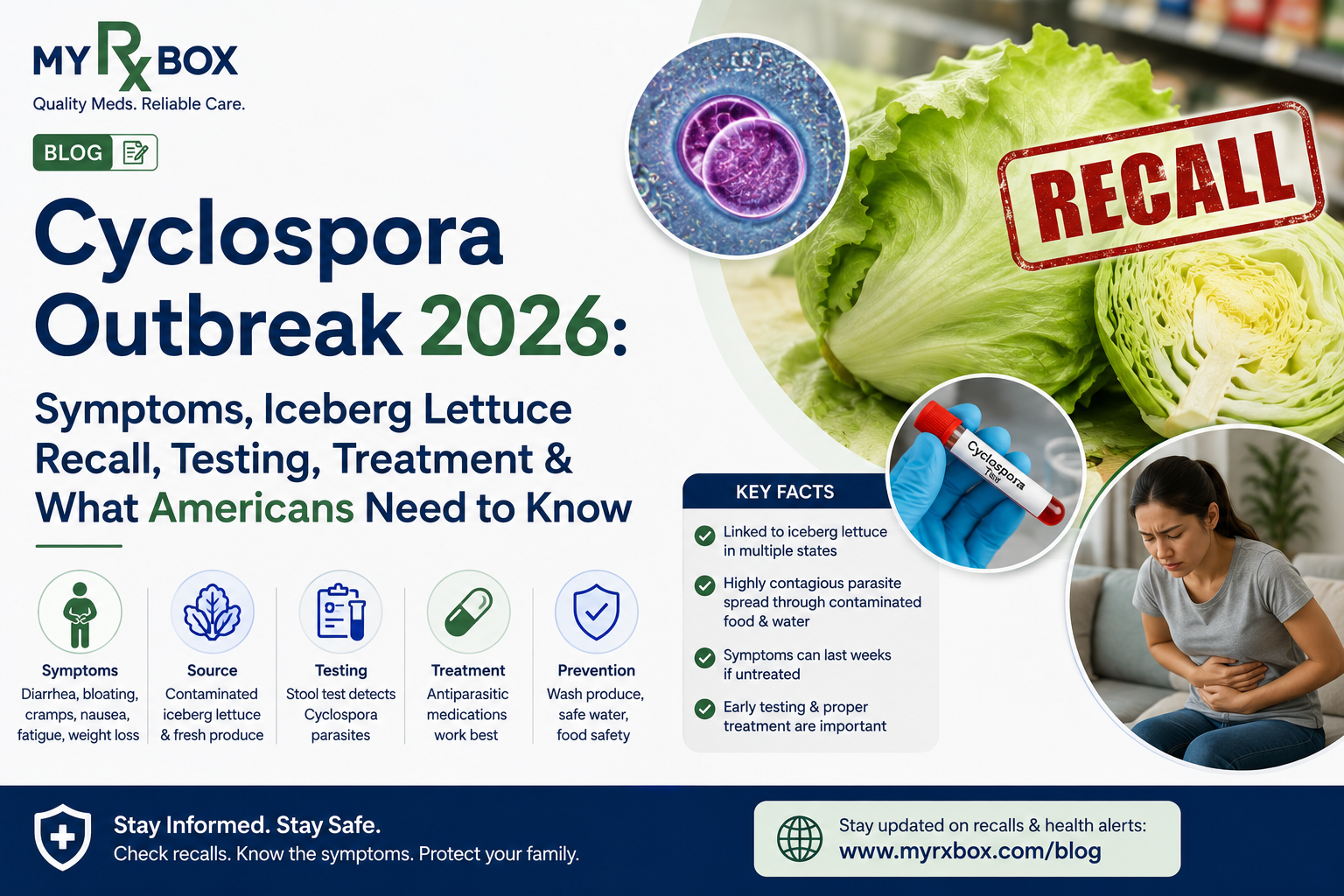
A major multistate Cyclospora outbreak linked to iceberg lettuce has affected thousands of people in the United States in 2026. In the latest federal case-count update, the outbreak included 9,481 illnesses, 398 hospitalizations and 2 deaths across 17 states. The U.S. Food and Drug Administration said on August 27, 2026, that the investigation remained ongoing, although the recalled iceberg lettuce connected with this outbreak should no longer be available in stores or restaurants.
Cyclospora infection, called cytosporiasis, most commonly causes prolonged watery diarrhea, abdominal cramps, bloating, nausea, fatigue, appetite loss and weight loss. Symptoms generally begin about one week after infection but can appear anywhere from roughly two days to more than two weeks later.
Most importantly, people should not assume that every “deworming” or antiparasitic medicine treats Cyclospora. The Centers for Disease Control and Prevention lists trimethoprim-sulfamethoxazole (TMP-SMX) as the treatment of choice for cyclosporiasis. CDC does not list ivermectin as its recommended treatment for Cyclospora.
What Is Happening With the 2026 Cyclospora Outbreak?
Cyclospora has become one of the most closely watched foodborne illness stories of the 2026 summer season.
Federal health officials connected a large cluster of infections to iceberg lettuce sourced from central Mexico. FDA traceback information identified Taylor Farms de Mexico as the supplier associated with the implicated shredded iceberg lettuce.
Taylor Farms initiated a recall on July 17, 2026, involving iceberg lettuce sourced from central Mexico. The recall included certain Marketside iceberg salad and shredded lettuce products sold through Walmart as well as products distributed to food-service customers.
By August 13, federal officials reported:
| 2026 outbreak statistic | Federal update |
|---|---|
| Reported illnesses | 9,481 |
| Hospitalizations | 398 |
| Deaths | 2 |
| States with outbreak-linked cases | 17 |
| Recall issued | Yes |
| Investigation | Ongoing |
FDA’s August 27 update stated that the agency was continuing its investigation and working with U.S. and Mexican officials, including inspections and sampling involving iceberg lettuce growers in Mexico. FDA also said it remained confident that the recalled iceberg lettuce associated with this specific outbreak was off the market.
Readers following this and other emerging health issues can also explore our viral health concerns section.
What Is Cyclospora?
Cyclospora cayetanensis is a microscopic parasite that infects the human small intestine. The intestinal illness it causes is called cytosporiasis.
Unlike many illnesses people casually describe as “stomach flu,” cyclosporiasis is a parasitic infection.
People become infected when they consume food or water contaminated with infectious Cyclospora organisms. In the United States, previous outbreaks have repeatedly been associated with fresh produce.
That is why our broader parasite and skin problems resource separates different parasitic conditions instead of treating every parasite as though it requires the same medicine.
This distinction matters.
Different parasites respond to different treatments. A medicine used for one worm or parasite should never automatically be assumed to work against another.
You can compare that principle in our educational guide to mebendazole vs ivermectin vs albendazole and our general overview of deworming tablets for adults.
Neither resource should be used to self-diagnose Cyclospora.
How Does Cyclospora Spread?
Cyclospora primarily spreads through contaminated food or water.
An unusual characteristic of this parasite helps explain why casual person-to-person transmission is considered unlikely.
Cyclospora organisms passed in the stool of an infected person are not immediately infectious. CDC explains that they generally need at least one to two weeks in the environment to mature sufficiently to infect another person.
This means that being near a person who has cyclosporiasis is not comparable to being exposed to someone with a typical respiratory virus.
The major concern is food or water contaminated somewhere along the production, processing or handling chain.
Fresh produce can present a particular challenge because many vegetables and fruits are eaten raw.
Which Lettuce Was Recalled in 2026?
On July 17, 2026, Taylor Farms de Mexico voluntarily removed iceberg lettuce sourced from central Mexico from the U.S. market.
Among the retail products identified by FDA were certain Marketside products sold through Walmart, including iceberg salad and shredded lettuce packages with specified July-August 2026 best-by dates. The recall also extended to food-service products.
FDA says the best-by dates for the recalled products have now passed and the affected products should no longer be available for sale.
That is an important detail.
The public-health recommendation in September 2026 is not that Americans should avoid every package of iceberg lettuce indefinitely.
Instead, consumers should follow current CDC and FDA food-safety alerts and pay attention to specific products when a recall is active.
What Are the Symptoms of Cyclospora?
The most recognizable symptom is watery diarrhea, often with frequent bowel movements.
CDC lists other common symptoms including:
- loss of appetite;
- unintentional weight loss;
- abdominal cramping;
- stomach pain;
- bloating;
- increased gas;
- nausea; and
- fatigue.
Less common symptoms can include vomiting, headache, body aches, a low-grade fever and other flu-like symptoms.
One characteristic that can make Cyclospora especially frustrating is that symptoms may appear to improve and then return again.
Untreated illness can continue for days, weeks or even a month or longer.
People with weakened immune systems or other health problems can experience more prolonged or severe illness.
How Long After Eating Contaminated Food Do Symptoms Start?
Symptoms usually begin approximately one week after infection.
However, CDC says the incubation period can range from around two days to two weeks or longer.
That delay can make identifying a source difficult.
Someone who develops severe diarrhea today may need to think about foods eaten during the previous one to two weeks rather than only what they consumed yesterday.
That is also one reason outbreak investigations can continue to grow even after a contaminated product has been recalled.
Public-health investigators need time to identify illnesses, obtain laboratory results, interview patients and determine whether individual cases belong to a particular outbreak.
When Should You Contact a Healthcare Professional?
Contact a healthcare professional if you develop persistent diarrhea, particularly after possible exposure to food involved in a Cyclospora outbreak.
FDA specifically advises people with possible cyclosporiasis symptoms to contact a healthcare provider, especially when they ate implicated shredded iceberg lettuce during the two weeks before becoming sick.
Seek medical attention more urgently if diarrhea is accompanied by signs of significant dehydration or serious illness.
Potential dehydration warning signs can include very limited urination, severe weakness, dizziness, inability to keep fluids down or worsening symptoms.
Children, older adults, pregnant people, immunocompromised patients and people with significant underlying illness may need more individualized medical guidance.
How Is Cyclospora Diagnosed?
You cannot reliably diagnose Cyclospora infection simply by looking at symptoms.
Many gastrointestinal infections can cause diarrhea, abdominal cramping, nausea and fatigue.
Healthcare professionals typically diagnose cyclosporiasis using stool testing.
There is another complication: Cyclospora can be difficult to detect.
CDC notes that standard laboratory testing does not necessarily include testing specifically for Cyclospora. The parasite may also be present intermittently or in relatively low numbers in a stool sample.
For that reason, a healthcare professional may specifically request testing for Cyclospora, and in some situations multiple stool samples collected on different days may be necessary.
This is important for anyone who remains symptomatic after receiving an initial negative stool result.
A single negative result does not automatically rule out Cyclospora when the clinical and exposure history remains suspicious.
What Is the Recommended Treatment for Cyclospora?
According to CDC, the treatment of choice for cyclosporiasis is trimethoprim-sulfamethoxazole, commonly abbreviated TMP-SMX.
This is a prescription medication and treatment decisions should be made by an appropriate healthcare professional.
Most otherwise healthy people can eventually recover even without treatment, but untreated illness may be prolonged and symptoms can relapse.
Hydration is also important because extended diarrhea can cause substantial fluid loss.
People receiving any prescription should read the instructions carefully. Our guide to reading a prescription label explains common label information, but individual directions from a prescriber or pharmacist always take priority.
Does Ivermectin Treat Cyclospora?
This is one of the most important questions to answer clearly because people searching for parasite treatments frequently encounter ivermectin online.
CDC does not list ivermectin as the recommended treatment for cyclosporiasis.
CDC identifies TMP-SMX as the treatment of choice.
Ivermectin is an antiparasitic medicine with legitimate medical uses for certain other parasitic infections, but “antiparasitic” does not mean that it treats every parasite.
For example, ivermectin has an established role in treating certain infections such as strongyloidiasis, which is a completely different disease. Readers interested in understanding that distinction can see our separate ivermectin and strongyloidiasis guide or educational ivermectin glossary.
Those pages should not be interpreted as evidence that ivermectin treats Cyclospora.
Do not substitute ivermectin for the treatment recommended for confirmed cyclosporiasis without medical guidance.
What About Mebendazole or Albendazole?
The same principle applies to other antiparasitic medicines.
Mebendazole and albendazole are drugs used for particular parasitic worm infections.
They should not automatically be used for Cyclospora simply because all of these illnesses involve parasites.
Readers dealing with recurrent pinworm infections, for example, should use condition-specific information such as our guide on why pinworms can keep coming back rather than applying pinworm treatment recommendations to an unrelated intestinal infection.
Our medicine glossary also explains individual drug names separately because drug classes, approved uses, warnings and dosing requirements differ.
The key lesson is straightforward:
Treat the diagnosed organism—not the word “parasite.”
Does Nitazoxanide Treat Cyclospora?
Nitazoxanide is another antiparasitic drug people may encounter during online searches.
However, CDC continues to identify TMP-SMX as the treatment of choice for cyclosporiasis.
People who cannot take TMP-SMX, including some patients with sulfonamide-related allergies, should speak directly with their healthcare provider about alternatives rather than selecting another antiparasitic drug themselves.
This is especially important when symptoms are severe, prolonged or recurrent.
Can Washing Lettuce Remove Cyclospora?
Washing fresh produce remains an important food-safety practice, but it is not a perfect defense against Cyclospora.
FDA states that rinsing produce can reduce contamination but may not reliably eliminate the parasite.
Cyclospora is also resistant to standard chlorine-based sanitizers.
Consumers should not wash fruits or vegetables with soap or bleach.
Instead, FDA recommends:
- washing hands before and after preparing fresh produce;
- rinsing fruits and vegetables thoroughly under clean running water;
- scrubbing firm produce with a clean produce brush;
- discarding damaged or bruised areas;
- avoiding cross-contamination from cutting boards, utensils and counters;
- refrigerating cut produce promptly; and
- following federal recall announcements.
CDC additionally notes that cooking produce to at least 158°F (70°C) can kill Cyclospora, although this obviously is not practical for every salad or raw vegetable dish.
Can You Get Cyclospora From Another Person?
Direct person-to-person transmission is considered unlikely.
CDC explains that the parasite passed in a bowel movement must mature in the environment before it becomes infectious, a process believed to require at least one to two weeks under favorable conditions.
Therefore, the major route of infection is consuming contaminated food or water rather than ordinary contact with somebody experiencing diarrhea.
Normal hygiene remains important, of course, particularly handwashing after using the bathroom and before food preparation.
Can Cyclospora Come Back After You Feel Better?
Yes.
One of the notable features of cyclosporiasis is that symptoms can relapse.
A person may believe the infection has resolved because diarrhea or stomach discomfort improves, only for symptoms to return later.
CDC says untreated illness can continue from a few days to a month or longer, and symptoms may disappear and return one or more times.
Persistent or recurring symptoms are therefore a reason to contact a healthcare professional rather than repeatedly self-treating with over-the-counter gastrointestinal products or unrelated antiparasitic medicines.
Is Every U.S. Cyclospora Case Connected to the Lettuce Outbreak?
No.
This distinction is important when reporting outbreak numbers.
CDC has stated that it is investigating other Cyclospora illnesses and outbreaks nationally that are unrelated to the iceberg lettuce outbreak.
Therefore, national cyclosporiasis activity should not automatically be attributed to one restaurant, retailer, grower or lettuce supplier.
Public-health agencies use laboratory results, patient interviews, traceback investigations and epidemiological data to determine which cases can reasonably be grouped together.
This is also why outbreak totals can change as investigations progress.
Should You Throw Away Iceberg Lettuce Now?
According to FDA’s August 27 update, the specific recalled products linked with this outbreak should no longer be available in stores or restaurants because their best-by dates have passed.
FDA said it remained confident that recalled iceberg lettuce associated with this particular outbreak was off the market.
Consumers should therefore check the latest official FDA and CDC alerts rather than rely on old social-media screenshots or assume that every current package of iceberg lettuce is recalled.
Food recalls change quickly.
Always verify the product name, lot information, best-by date and current government notice before deciding whether a product is affected.
Cyclospora vs Common Worm Infections: Why Correct Diagnosis Matters
The word “parasite” includes many very different organisms.
Cyclospora is not the same thing as:
- pinworm;
- roundworm;
- hookworm;
- Strongyloides;
- tapeworm; or
- other common intestinal parasites.
Consequently, there is no universal “parasite tablet” that treats all of them.
Our worm infection information section and adult deworming guide cover medicines associated with other worm infections, but these should never replace condition-specific medical advice for suspected cyclosporiasis.
The correct sequence is:
symptoms → exposure history → appropriate testing → diagnosis → organism-specific treatment.
Not:
symptoms → internet search → random antiparasitic medicine.
What Should You Do If You Think You Were Exposed?
If you ate potentially implicated food but currently feel well, monitor for gastrointestinal symptoms and follow current CDC and FDA outbreak advice.
If you develop persistent watery diarrhea or other compatible symptoms:
- Contact a healthcare professional.
- Explain any possible exposure to recalled or implicated food.
- Tell them when you ate the food and when symptoms began.
- Ask whether specific testing for Cyclospora is appropriate.
- Maintain adequate fluid intake unless a clinician has told you to restrict fluids.
- Do not start leftover antibiotics or antiparasitic medicines on your own.
- Seek prompt medical attention for severe dehydration or rapidly worsening illness.
Consumers looking up unfamiliar medicines can use our medicine glossary as educational background, while our broader medicines section covers additional medication-related information.
Neither replaces professional diagnosis or prescribing.
Frequently Asked Questions
What is the number-one Cyclospora symptom?
Watery diarrhea is the most common symptom reported by CDC. It may occur frequently and can continue or recur over an extended period.
How quickly does Cyclospora make you sick?
Symptoms usually begin about one week after exposure, although the range can be approximately two days to more than two weeks.
What kills Cyclospora?
For an established infection in a patient, CDC identifies TMP-SMX as the treatment of choice. For food, CDC/FDA note that cooking to at least 158°F (70°C) kills the parasite.
Does ivermectin kill Cyclospora?
CDC does not recommend ivermectin as the treatment of choice for cyclosporiasis. Its recommended treatment is TMP-SMX. People should not self-substitute another antiparasitic medicine.
Can Cyclospora symptoms disappear and return?
Yes. CDC reports that symptoms can improve and subsequently relapse.
Is Cyclospora contagious?
Ordinary direct person-to-person transmission is considered unlikely because the organism needs time in the environment to become infectious. Food and water contamination are the primary concerns.
Is the 2026 lettuce recall still active?
The recalled products’ best-by dates have passed, and FDA says they should no longer be available in stores or restaurants. However, the federal outbreak investigation remained ongoing as of the FDA update dated August 27, 2026.
The Bottom Line
The 2026 Cyclospora outbreak is a reminder that foodborne parasites do not always produce immediate symptoms and cannot all be treated with the same medication.
Federal investigators linked a major multistate outbreak to iceberg lettuce sourced from central Mexico. In the latest reported case-count update, 9,481 illnesses, 398 hospitalizations and two deaths were associated with the outbreak across 17 states. FDA’s August 27 update said the investigation remained ongoing, although affected recalled products should now be off the market.
If prolonged watery diarrhea develops—particularly after a known foodborne exposure—contact a healthcare professional and ask whether specific Cyclospora testing is appropriate.
Most importantly, do not assume that ivermectin, mebendazole, albendazole or another antiparasitic drug is interchangeable with the treatment for Cyclospora.
CDC identifies trimethoprim-sulfamethoxazole (TMP-SMX) as the treatment of choice for cyclosporiasis.
Accurate diagnosis and organism-specific treatment are more important than simply choosing a medicine labeled “antiparasitic.”
Official U.S. Government Sources
CDC — 2026 Cyclospora Outbreak Linked to Iceberg Lettuce
CDC outbreak investigation
FDA — Investigation of Multistate Outbreak of Cyclospora Illnesses: Iceberg Lettuce
FDA outbreak investigation and updates
FDA — Taylor Fresh Foods Iceberg Lettuce Recall
FDA recall announcement
CDC — About Cyclosporiasis
CDC Cyclospora overview, diagnosis and treatment
CDC — Symptoms of Cyclosporiasis
CDC symptoms guidance
CDC — Clinical Care of Cyclosporiasis
CDC clinical treatment guidance
CDC — Preventing Cyclosporiasis
CDC prevention guidance
FDA — Cyclospora Food Safety Information
FDA Cyclospora consumer guidance
Medical disclaimer: This article provides general educational information and is not a diagnosis, prescription or substitute for individualized medical care. People with persistent or severe diarrhea, possible dehydration, underlying medical conditions, pregnancy, immune suppression or other concerns should contact an appropriate healthcare professional.