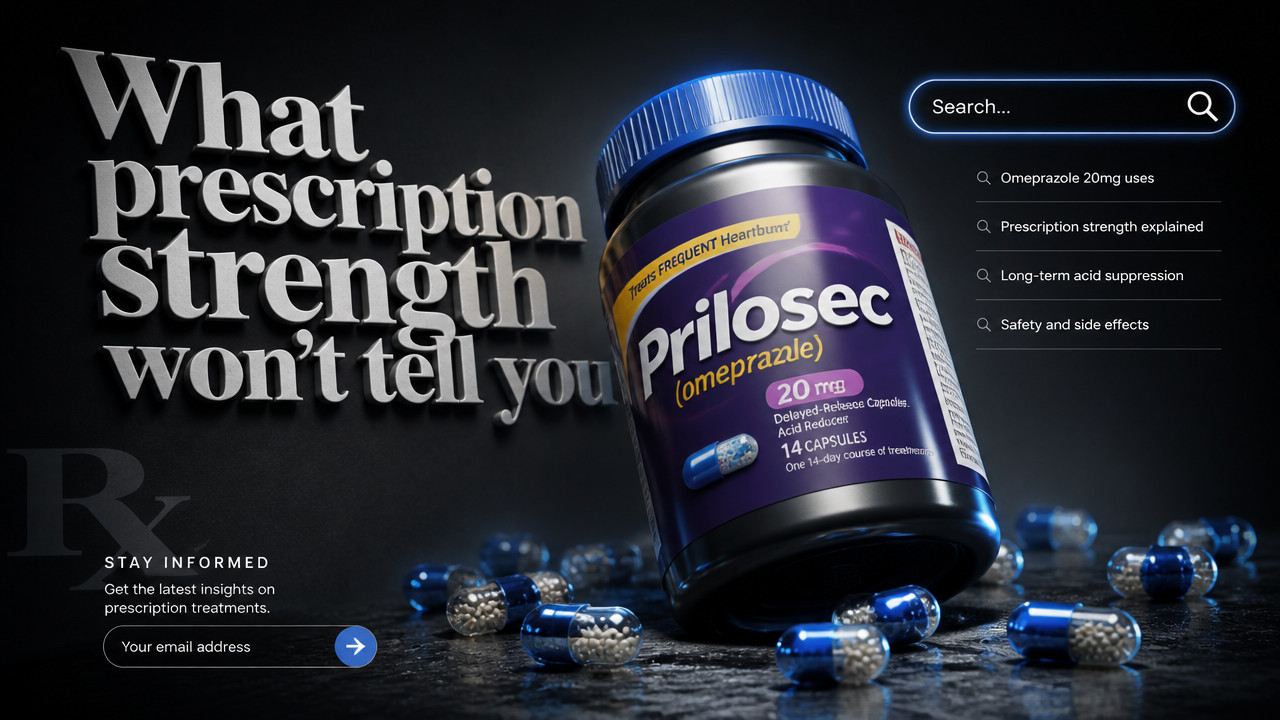
Prilosec prescription strength comes in two doses: 20mg (the standard daily strength for most GERD cases) and 40mg (used for severe erosive esophagitis or Zollinger-Ellison syndrome). While 20mg omeprazole is available over-the-counter in the USA, prescription versions are often prescribed for longer durations, higher doses, or insurance coverage purposes. In 2026, approximately 49.8 million omeprazole prescriptions were written in the United States alone, making it one of the most dispensed medications nationwide.
Quick Answer: What Strength Is Prescription Prilosec?
Prescription Prilosec (omeprazole) is available in two distinct strengths: 20mg and 40mg. The 20mg strength matches what is sold over-the-counter, but prescription versions allow for longer treatment durations and insurance billing. The 40mg strength remains prescription-only and is reserved for more serious acid-related conditions.
According to Clincalc, approximately 49,784,461 prescriptions were written for omeprazole in 2024, making it one of the most commonly prescribed medications in the United States. This volume reflects how routinely doctors rely on this proton pump inhibitor for acid suppression therapy.
The key difference lies not just in milligrams, but in how patients access and pay for each version:
| Version | Strength | Availability | Typical Duration | Insurance Coverage |
|---|---|---|---|---|
| OTC Prilosec | 20mg | Pharmacy shelves, no Rx | 14 days max (label) | Not covered |
| Rx Prilosec 20mg | 20mg | Prescription only | 4-8+ weeks | Usually covered |
| Rx Prilosec 40mg | 40mg | Prescription only | 4-12+ weeks | Usually covered |
Many patients are surprised to learn that prescription 20mg and OTC 20mg contain identical active ingredients. The real difference comes down to labeling, duration of therapy, and whether insurance helps offset the cost.
20mg vs 40mg: When Doctors Prescribe Higher Strength
Doctors reach for Prilosec 40mg when standard doses simply are not getting the job done. The 20mg dose works well for typical heartburn and mild GERD, but certain conditions demand stronger acid suppression to heal tissue damage or control excessive acid production.
Clinical guidelines support 40mg dosing for specific diagnoses where the esophagus or stomach lining needs more aggressive protection. This higher strength delivers roughly double the acid-blocking power, creating conditions where damaged tissue can actually regenerate.

Here are five specific conditions where doctors commonly prescribe the 40mg strength:
- Erosive esophagitis healing of actual erosions in the esophageal lining requires higher doses for 8-12 weeks
- Zollinger-Ellison syndrome this rare condition causes tumors that pump out excess acid, often requiring 60-120mg daily
- Severe GERD with complications including strictures or Barrett’s esophagus changes
- H. pylori eradication therapy combination treatment regimens often use higher PPI doses alongside antibiotics
- Refractory acid reflux when symptoms persist despite 20mg therapy after 4-8 weeks
For patients with these conditions, the jump from 20mg to 40mg is not about taking “more medicine” casually. It represents a calculated clinical decision based on diagnosis, disease severity, and healing goals. Understanding these distinctions helps patients advocate appropriately when reviewing how to read your prescription label with their healthcare provider.
How Prescription Omeprazole Dosing Schedules Work
Getting the dose right is only half the equation. The omeprazole dosing schedule matters just as much as the pill strength itself. Most patients take their medication once daily, but certain conditions call for twice-daily dosing to maintain consistent acid suppression around the clock.
Standard prescription omeprazole dosage protocols follow established timelines based on what is being treated. Acute healing phases often require more intensive regimens, while maintenance therapy can sometimes step down to lower doses.
Here is how dosing schedules typically break down by condition:
| Condition | Usual Dose | Frequency | Duration |
|---|---|---|---|
| Uncomplicated GERD | 20mg | Once daily | 4-8 weeks |
| Erosive Esophagitis | 40mg | Once daily | 8-12 weeks |
| Zollinger-Ellison | 60-120mg | Twice daily | Ongoing |
| H. pylori Treatment | 40mg | Twice daily | 10-14 days |
| Maintenance (healed) | 20mg | Once daily | Ongoing |
Patients often wonder why duration varies so dramatically. The answer lies in what the medication needs to accomplish. Relieving symptoms happens relatively quickly often within days. But actually healing eroded tissue takes weeks of consistent acid suppression. Patients seeking clarity on medication naming conventions can reference our medicine name decoder for additional context.
Why Timing Before Meals Maximizes Acid Suppression
The mechanism matters. Proton pump inhibitors work by deactivating the acid pumps in your stomach lining but those pumps need to be actively working for the drug to bind effectively. This creates a counterintuitive timing requirement.
Take omeprazole 30-60 minutes before your first meal of the day. This window ensures the medication reaches peak blood levels right when you are eating and your proton pumps are most active. Food triggers acid production, which triggers pump activation, which allows the medication to bind and shut them down.
Patients who dose after breakfast, or with breakfast, often see reduced effectiveness. The pumps have already done their work. Taking the medication at night before bed similarly misses the window. Morning dosing,空腹 that is, on an empty stomach before eating delivers consistent results.
Insurance Coverage: Why Doctors Write Rx for OTC-Strength Prilosec
This scenario plays out constantly: a patient buys OTC Prilosec 20mg for $25, then later gets a prescription for the exact same strength from their doctor. Why the duplicate? The answer comes down to money.
Prescription versions of 20mg omeprazole open the insurance reimbursement pathway. For patients with prescription drug coverage, paying a $10 copay makes more sense than paying full retail price for OTC versions. The math works even better for those filling 90-day supplies through mail-order pharmacies.
Long-term users particularly benefit. Someone managing chronic GERD might need ongoing PPI therapy for years. At OTC prices, that compounds into substantial out-of-pocket costs. Prescription coverage transforms that expense into manageable copays. Patients comparing costs across options can check our medicine price index for current pricing data.
The process is not always seamless. Some insurers require prior authorization for prescription PPIs, especially if OTC versions exist. Your doctor may need to document why prescription-strength access matters typically citing duration needs, coordination with other medications, or specific diagnosis codes that support medical necessity.
Generic Omeprazole vs Brand Prilosec: Prescription Equivalence
Generic versions contain the same active ingredient, meet the same FDA bioequivalence standards, and deliver the same therapeutic effect. The Rx Prilosec strength you are prescribed applies equally to brand-name and generic versions.
Where generics differ dramatically is price. Patients can typically save 70-90% by choosing generic omeprazole over brand Prilosec. Those savings multiply for long-term users filling regular prescriptions.
Here is how pricing typically compares across options:
| Medication | Strength | Typical Cash Price (30 days) | Insurance Copay (common) |
|---|---|---|---|
| Brand Prilosec | 20mg | $180-220 | Higher tier copay |
| Generic omeprazole | 20mg | $15-40 | Generic tier copay |
| Brand Prilosec | 40mg | $250-300 | Higher tier copay |
| Generic omeprazole | 40mg | $25-60 | Generic tier copay |
Prices vary by pharmacy, region, and coverage, so patients should compare prescription medication prices before filling. Most pharmacists automatically substitute generic unless specifically instructed otherwise.
How to Access Prescription-Strength Omeprazole Through myRxBox
Prescription omeprazole requires a valid prescription from a licensed healthcare provider. myRxBox facilitates access to both 20mg and 40mg strengths for patients with appropriate prescriptions, offering competitive pricing and worldwide delivery.
The ordering process is straightforward:
- Step 1: Obtain a valid prescription from your healthcare provider specifying omeprazole strength and quantity
- Step 2: Create an account and upload your prescription documentation through the secure portal
- Step 3: Select your medication strength and quantity, then complete checkout
- Step 4: Receive order confirmation with tracking information for international delivery
myRxBox sources medications from trusted pharmaceutical suppliers, and patients can learn more about understanding your prescription requirements before placing their first order.
International customers should verify import regulations for their country before ordering. Prescription requirements vary by jurisdiction, and patients bear responsibility for compliance with local laws governing prescription medication import.
Key Takeaways: Prescription Prilosec Strength Selection
- Two prescription strengths exist 20mg for standard cases, 40mg for severe conditions requiring stronger acid suppression
- OTC and Rx 20mg are chemically identical the difference lies in labeling, duration, and insurance coverage
- 40mg remains prescription-only reserved for erosive esophagitis, Zollinger-Ellison syndrome, and refractory GERD
- Timing matters critically take omeprazole 30-60 minutes before breakfast for maximum effectiveness
- Insurance coverage often favors prescription versions even when dispensing the same strength available OTC
- Generic omeprazole offers substantial savings typically 70-90% less than brand Prilosec at equivalent strengths
For current pricing across strengths and brands, patients can reference current medication pricing data before filling their prescription.
FAQ: Prescription Prilosec Strength Questions
Is prescription Prilosec stronger than OTC Prilosec?
Not necessarily. Prescription Prilosec 20mg contains the same active ingredient and strength as OTC Prilosec 20mg. The prescription version enables longer treatment durations, insurance billing, and clinical supervision. Only the 40mg strength, which is prescription-only, is actually stronger than standard OTC options.
Can I take two 20mg OTC pills to equal prescription 40mg?
This approach is not recommended without doctor supervision. While the math suggests two 20mg pills would equal 40mg, self-dosing bypasses clinical evaluation. Double-dosing increases costs compared to actual prescription 40mg, and masks underlying conditions that warrant proper diagnosis. Patients should consult their doctor about appropriate dosing and learn how to verify prescription details when receiving new medications.
How long can I stay on prescription omeprazole?
Duration varies by condition. Typical GERD treatment spans 4-8 weeks, while maintenance therapy for chronic conditions may continue indefinitely under medical supervision. Long-term PPI use requires monitoring for potential nutrient absorption issues, bone density changes, and other considerations your doctor will discuss.
Does 40mg Prilosec work twice as well as 20mg?
No the relationship is not linear. Pharmacologically, 40mg provides more complete acid suppression, but not double the effect. The higher dose matters for healing damaged tissue or controlling pathologically excessive acid production. For symptom control alone, many patients see no additional benefit from doubling strength.
What happens if I miss a dose of prescription omeprazole?
Take it as soon as you remember, unless it is near your next scheduled dose. In that case, skip the missed dose do not double up. Consistent daily dosing maintains steady acid suppression. Occasional missed doses will not derail treatment, but chronic inconsistency reduces overall effectiveness.
Can I get prescription omeprazole without insurance?
Yes generic omeprazole remains affordable without coverage. Cash prices for generic omeprazole 20mg typically run $15-40 for a month supply. The 40mg strength costs slightly more but remains accessible. myRxBox offers competitive pricing for patients paying out-of-pocket.
Is prescription Prilosec the same as prescription Nexium?
No different active ingredients with similar effects. Prilosec contains omeprazole; Nexium contains esomeprazole. Both are proton pump inhibitors used for acid-related conditions, but they are distinct molecules with slightly different pharmacokinetic profiles. Prescribers choose based on patient response, insurance formularies, and specific clinical scenarios.
Will my doctor prescribe 40mg if 20mg is not working?
Possibly after proper evaluation. Dose escalation to 40mg requires clinical justification. Your doctor will assess whether persistent symptoms reflect inadequate dosing, incorrect diagnosis, or other factors. Simply doubling strength without investigation could mask underlying issues needing different interventions.
Can children take prescription-strength omeprazole?
Yes pediatric dosing exists for specific conditions. Children with GERD or erosive esophagitis may receive weight-based omeprazole prescriptions. Pediatric formulations and dosing schedules differ from adult protocols. Parents should work closely with pediatric gastroenterologists for appropriate management.