
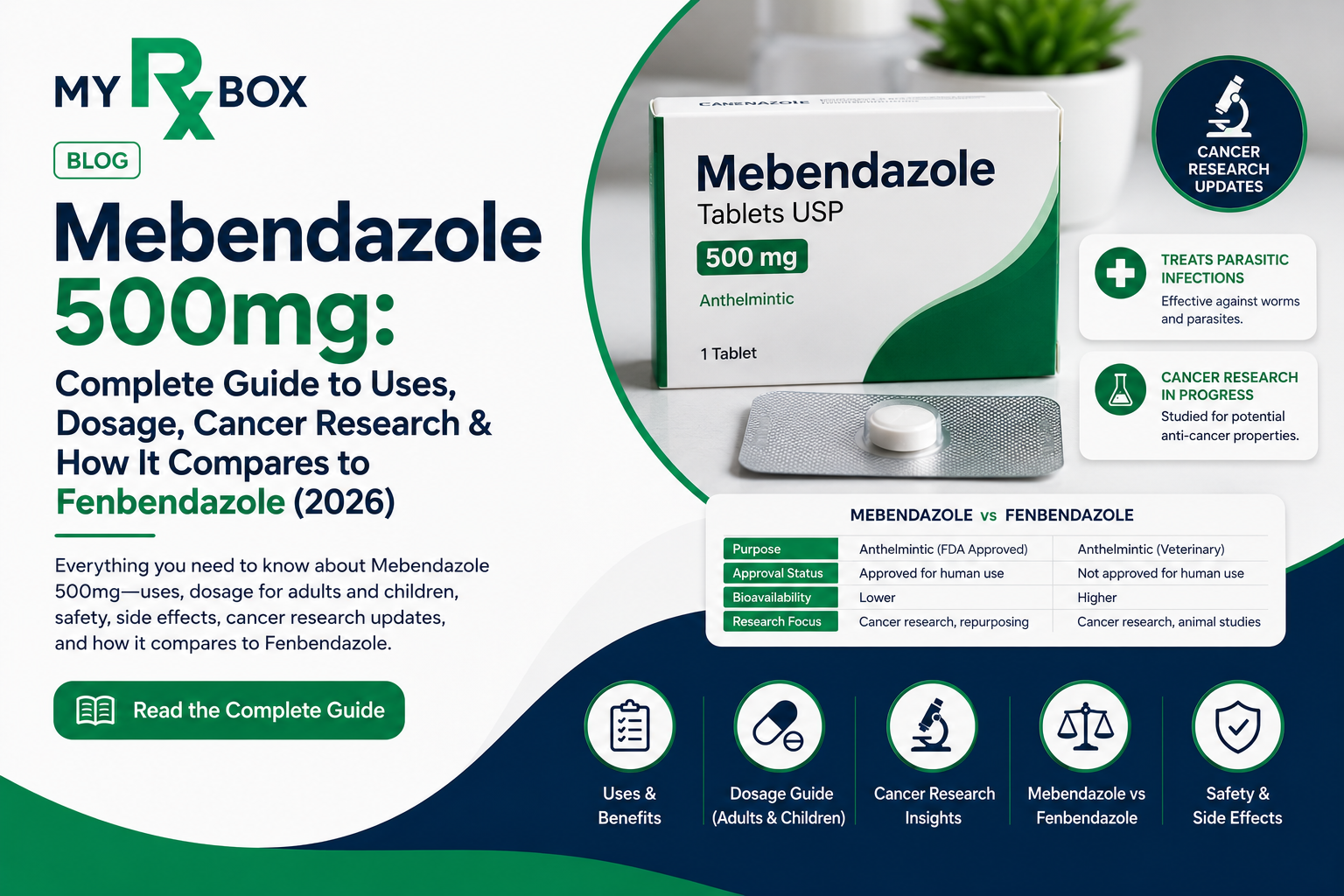
Mebendazole is one of the most widely prescribed antiparasitic drugs in the world for human use — and it’s also quietly becoming one of the most interesting drugs in oncology research. Unlike its chemical cousin fenbendazole (primarily a veterinary drug popularized by the Joe Tippens story), mebendazole was always designed and approved for humans, giving it a more established safety record and a head start in serious clinical cancer research.
This article covers everything you need to know about mebendazole 500mg: its approved uses for intestinal parasites, the dosing differences between 100mg and 500mg forms, and a thorough review of the 2026 state of cancer research — including the Phase II clinical trial results that have caught the attention of mainstream oncologists.
⚠️ Medical Disclaimer Mebendazole is a prescription medication in many countries. Off-label use should be discussed with a licensed physician. This article is for educational purposes only.
What Is Mebendazole?
Mebendazole is a benzimidazole anthelmintic (antiparasitic) drug that has been on the WHO Model List of Essential Medicines since 1977. It works by binding to beta-tubulin — the same molecular target as fenbendazole and most other benzimidazoles — preventing the formation of microtubules essential for parasite cell division and metabolism. In intestinal worms, this results in gradual starvation and death of the parasite, which is then expelled naturally.
Mebendazole is manufactured under several brand names including Vermox (Janssen), Emverm (Amneal Pharmaceuticals), and numerous generics. It is available as 100mg chewable tablets and 500mg tablets depending on the formulation and intended use.
FDA-Approved Uses of Mebendazole
Mebendazole is FDA-approved for treating the following intestinal worm infections:
- Enterobiasis (pinworm / threadworm, Enterobius vermicularis): One of the most common parasitic infections globally, especially in children
- Trichuriasis (whipworm, Trichuris trichiura): Infects an estimated 460 million people worldwide
- Ascariasis (roundworm, Ascaris lumbricoides): Most common human worm infection globally — over 800 million infected
- Hookworm infections (Ancylostoma duodenale and Necator americanus): Cause significant anemia and malnutrition in endemic regions
- Mixed infections: Mebendazole is broad-spectrum and effective against multiple parasites simultaneously
It is the first-line treatment for many of these infections according to the US Centers for Disease Control and Prevention (CDC) and WHO guidelines.
Mebendazole 100mg vs 500mg: When Each Dose Is Used
The 100mg and 500mg dosing schedules serve distinct purposes and should not be interchanged without medical guidance:
| Indication | Dose | Schedule | Notes |
|---|---|---|---|
| Pinworm (enterobiasis) | 100mg (single dose) | One time; repeat after 2 weeks | Entire household should be treated; re-infection is common |
| Roundworm / whipworm / hookworm | 100mg twice daily × 3 days OR 500mg single dose | 3-day or 1-day protocol | 500mg single dose equivalent efficacy to 3-day 100mg for many infections |
| Mixed polyparasitism | 500mg single dose | One time (often repeated at 2–4 weeks) | Preferred in mass drug administration programs |
| Off-label (cancer adjunct) | 100–200mg three times daily OR 500mg once/twice daily | Continuous daily dosing | Research protocols vary; physician supervision required |
The 500mg single-dose format has become particularly important in global public health because it simplifies mass deworming programs. The WHO and organizations like the Bill & Melinda Gates Foundation have supported large-scale mebendazole distribution using the 500mg formulation for this reason.
Mebendazole in Cancer Research: What the Clinical Trials Show
Here is where mebendazole becomes significantly more interesting than most antiparasitic drugs. Unlike fenbendazole — which has abundant preclinical data but no completed human clinical trials — mebendazole has actual Phase I and Phase II clinical trial data in humans.
Glioblastoma (Brain Cancer)
The most advanced mebendazole cancer research is in glioblastoma multiforme (GBM), one of the deadliest and most treatment-resistant brain cancers. A 2011 study published in Clinical Cancer Research demonstrated mebendazole’s ability to inhibit glioblastoma tumor growth in mouse models. This was followed by a Phase I trial (NCT01729260) at Johns Hopkins that established safety and tolerability in GBM patients.
A subsequent randomized Phase II trial (NCT01837862) examined mebendazole as a maintenance therapy in newly diagnosed GBM patients alongside standard temozolomide chemotherapy. Results published in 2023 in Neuro-Oncology showed encouraging trends in progression-free survival in the mebendazole arm, though the trial was not powered to reach statistical significance in overall survival. The full trial data is catalogued at ClinicalTrials.gov.
Colorectal Cancer
A Phase II trial conducted at the National University Cancer Institute Singapore examined mebendazole in patients with metastatic colorectal cancer who had failed standard chemotherapy. The trial reported disease stabilization in a subset of patients and an acceptable safety profile. Mebendazole was generally well-tolerated at doses used in these trials (200mg three times daily), with the most common side effects being abdominal discomfort and transient liver enzyme elevation.
Adrenocortical Carcinoma (ACC)
Several case reports and a small case series have documented prolonged disease stabilization in patients with advanced adrenocortical carcinoma — a rare and highly treatment-resistant cancer — treated with mebendazole. This has led to increased interest in benzimidazole drugs specifically for ACC.
The Mechanisms Behind Mebendazole’s Anti-Cancer Activity
The cancer-relevant mechanisms of mebendazole mirror those of fenbendazole — which makes sense given their near-identical chemical structures and molecular targets:
- Beta-tubulin binding → mitotic disruption: Cancer cells divide rapidly and depend on intact microtubule function; mebendazole disrupts this similarly to vincristine and taxanes
- VEGF pathway inhibition: Mebendazole appears to inhibit angiogenesis (formation of new blood vessels that tumors require) — a target of several approved cancer drugs
- BCL-2 inhibition: BCL-2 is an anti-apoptotic protein that many cancer cells overexpress to avoid programmed cell death; mebendazole inhibits BCL-2
- Glucose metabolism disruption: Similar to fenbendazole, interferes with cancer cell glycolytic metabolism
- CDK inhibition: Inhibits cyclin-dependent kinases involved in cell cycle progression
Mebendazole vs Fenbendazole: A Direct Comparison
| Factor | Mebendazole | Fenbendazole |
|---|---|---|
| Approved for humans? | Yes — FDA, WHO, EMA approved | No — veterinary use only |
| Human clinical trial data in cancer? | Yes — Phase I and Phase II completed | No completed trials |
| Standard antiparasitic dose | 100mg × 3 days OR 500mg single dose | N/A (not approved for humans) |
| Cancer protocol dose | 100–200mg 3× daily (continuous) | 222mg 3 days on / 4 days off |
| Safety record | Extensive — decades of human data | Limited — primarily animal data |
| Bioavailability | Low (~2–5%) — improved by fat | Low — improved by fat |
| Chemical similarity | Benzimidazole (closest to fenbendazole) | Benzimidazole (closest to mebendazole) |
| Cost | Low — generic widely available | Low — generic widely available |
Bioavailability: The Fat Absorption Principle
Like fenbendazole, mebendazole has notoriously poor oral bioavailability — only about 2–5% of the oral dose reaches systemic circulation when taken without food. This is a well-established pharmacokinetic property of benzimidazoles. The practical implication for any use of mebendazole beyond simple gut-resident parasite treatment (where low bioavailability is actually fine, since the drug just needs to be present in the intestine) is:
- Always take mebendazole with a meal containing fat
- Avocado, cheese, eggs, olive oil, or any fatty food can increase absorption 5–10-fold
- For cancer adjunct protocols where systemic levels matter, fat co-ingestion is essential
- Some practitioners recommend taking it with grapefruit juice, which inhibits CYP3A4 and may further increase plasma levels
Frequently Asked Questions
Is mebendazole 500mg a single dose or a daily dose?
For standard antiparasitic use, 500mg is typically a single-dose treatment for roundworm, whipworm, or hookworm infections. For off-label cancer adjunct protocols, the dosing is entirely different — typically 100–200mg taken two or three times daily continuously. These are very different regimens and should not be confused.
Should I choose mebendazole or fenbendazole for off-label cancer use?
Mebendazole has the stronger scientific argument for off-label human use: it was designed for humans, has decades of human safety data, and is the only benzimidazole with completed Phase II cancer trials in humans. Fenbendazole has a larger community of users and more patient testimonials, but less formal clinical evidence. This decision should involve an oncologist familiar with the emerging benzimidazole research.
What are the main side effects of mebendazole?
At standard antiparasitic doses, mebendazole is very well tolerated with occasional abdominal pain, nausea, and diarrhea. At higher, continuous doses used in cancer protocols, transient liver enzyme elevation is more common. Hepatic monitoring via LFTs is recommended for anyone taking mebendazole continuously over weeks or months.
Can I take mebendazole if I am on chemotherapy?
Not without discussing it with your oncologist first. Mebendazole is metabolized by the liver and can interact with chemotherapy agents. Interestingly, several cancer researchers have studied mebendazole specifically in combination with chemotherapy (as a potential sensitizer), but these combinations require medical supervision and monitoring.
Mebendazole 500mg — Pharmaceutical Grade, In Stock
myRxbox carries mebendazole 500mg from verified manufacturers. Discreet worldwide shipping.