
Hydroxychloroquine (HCQ) has had one of the most turbulent reputations in modern medicine. A drug quietly used for decades to treat autoimmune diseases and malaria became one of the most controversial pharmaceutical topics of the early 2020s — and emerged from that controversy with its legitimate clinical indications largely intact, and a new generation of patients curious about its uses.
This guide focuses on what hydroxychloroquine is actually approved and prescribed for in 2026, how the 200mg and 400mg dosages differ in their applications, the genuine safety profile, and what patients considering this drug should know.
⚠️ Medical Disclaimer Hydroxychloroquine is a prescription medication. This article is for educational purposes only. Do not start, stop, or modify HCQ without guidance from a licensed physician. HCQ has potentially serious cardiac and ophthalmologic effects that require monitoring.
What Is Hydroxychloroquine?
Hydroxychloroquine is an antimalarial and anti-inflammatory drug derived from chloroquine, which has been used since the 1940s. The hydroxyl group added to chloroquine’s structure makes HCQ significantly less toxic and better tolerated while preserving its therapeutic properties. It is marketed under the brand name Plaquenil and several generic versions.
HCQ’s mechanism involves multiple pathways: it interferes with lysosomal acidification in cells (affecting antigen processing and immune activation), has anti-inflammatory properties by blocking toll-like receptor signaling, and at the cellular level acts as an alkalinizing agent. This multi-pronged mechanism explains why it’s useful across several distinct conditions.
FDA-Approved Uses of Hydroxychloroquine
- Systemic Lupus Erythematosus (SLE / Lupus): HCQ is a cornerstone treatment for lupus, significantly reducing disease flares, organ damage, and mortality. Most lupus patients are on HCQ as a baseline medication
- Rheumatoid Arthritis (RA): Used as a disease-modifying antirheumatic drug (DMARD), usually in combination with other RA treatments
- Malaria Prevention and Treatment: Effective against Plasmodium vivax and P. malariae in regions without chloroquine resistance; used for both prophylaxis and acute treatment
- Discoid Lupus Erythematosus: A skin-limited form of lupus where HCQ helps control rash and photosensitivity
According to the FDA’s official drug information page, HCQ has been continuously approved for these indications and remains a standard-of-care medication in rheumatology and infectious disease.
HCQ 200mg vs 400mg: When Each Dose Is Used
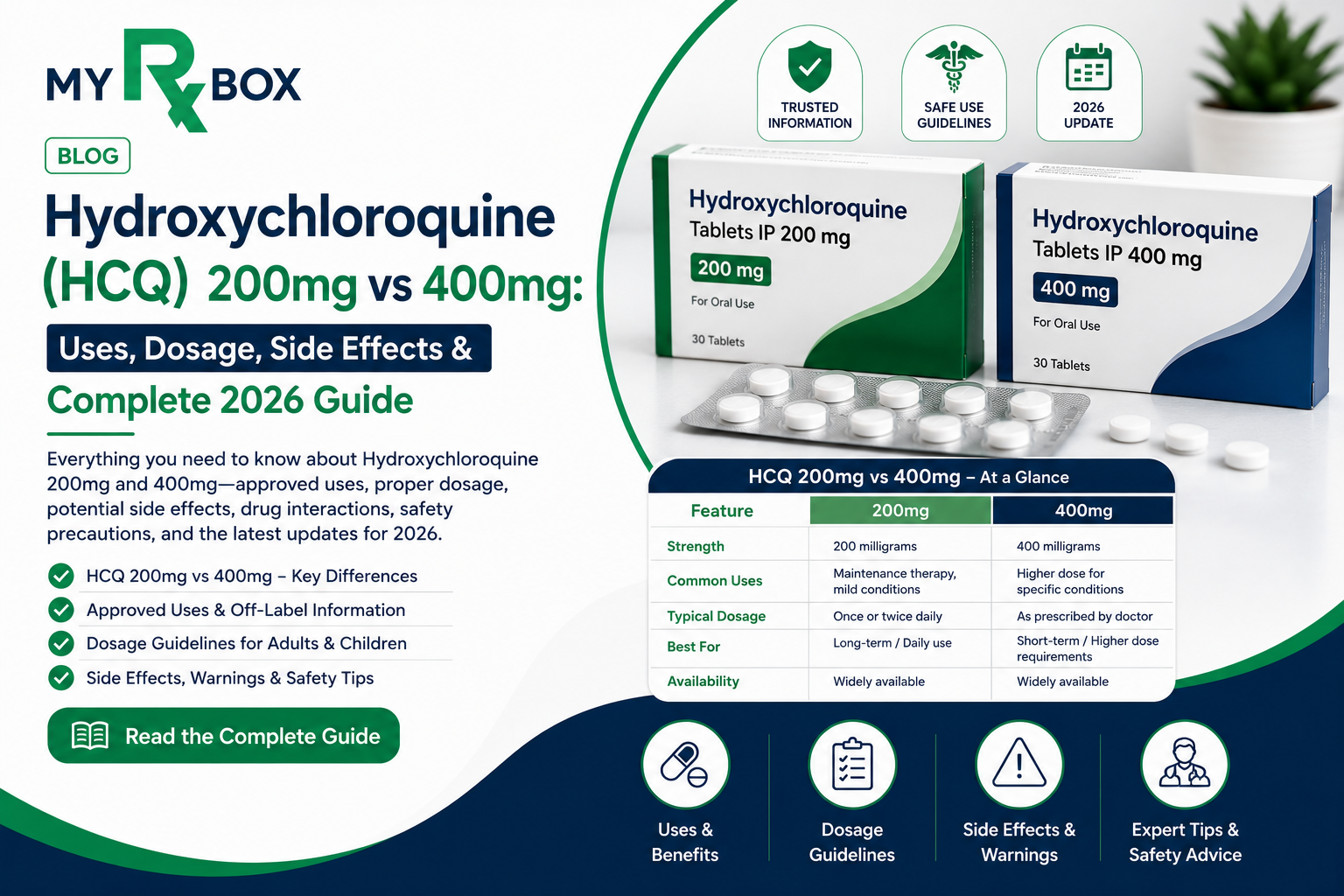
The 200mg and 400mg doses serve different purposes and patient populations. Understanding which dose is appropriate requires knowing both the condition being treated and the patient’s weight, kidney function, and overall health status.
| Indication | Typical Dose | Frequency | Duration |
|---|---|---|---|
| Systemic Lupus (maintenance) | 200–400mg/day | Once daily or split twice daily | Indefinite (long-term) |
| Rheumatoid Arthritis | 200–400mg/day | Once or twice daily with food | Long-term; reassessed annually |
| Malaria prophylaxis | 400mg once weekly | Weekly | Start 2 weeks before travel; continue 4 weeks after |
| Acute malaria treatment | 800mg initial, then 400mg at 6h, 24h, 48h | Loading dose protocol | 3-day treatment course |
| Discoid Lupus | 200mg/day (often adequate) | Once daily | Long-term based on response |
The Weight-Based Dosing Principle
A critical advancement in HCQ prescribing, driven by retinal toxicity research, is the shift to weight-based maximum dosing. Current guidelines from the American Academy of Ophthalmology (AAO) and the American College of Rheumatology recommend:
- Maximum daily dose: 5 mg/kg of actual body weight
- For a 60kg person: maximum 300mg/day
- For an 80kg person: maximum 400mg/day
- The old flat 400mg/day recommendation is now considered potentially excessive for lighter patients
- 200mg/day is now the preferred starting dose in many rheumatology practices, especially for smaller patients
💡 Why 400mg Was Once the Default — and Why 200mg Is GrowingHistorically, 400mg was the standard daily dose for autoimmune diseases because it was effective and appeared well-tolerated in short-term studies. Long-term retinal toxicity data — which only becomes apparent after 5–7 years of use — changed the calculus. The lower 200mg dose carries significantly less risk of retinopathy while maintaining meaningful clinical efficacy for most autoimmune indications.
Retinal Toxicity: The Most Important Long-Term Risk
The most serious long-term adverse effect of hydroxychloroquine is damage to the retina (the photosensitive layer at the back of the eye), a condition called HCQ retinopathy. This risk is dose-dependent, duration-dependent, and partly genetic (certain gene variants increase susceptibility).
Key facts on retinal toxicity risk:
- Risk is low in the first 5 years of use at appropriate doses (<1%)
- After 10 years of use at 5mg/kg/day, risk rises to approximately 2–4%
- At doses exceeding 5mg/kg/day, 10-year risk can exceed 10%
- Retinopathy can progress even after HCQ is stopped, making early detection critical
- Annual ophthalmology screening is mandatory for all long-term HCQ users — typically starting at year 5, or year 1 in high-risk patients
The AAO published updated screening guidelines in 2016 (reaffirmed 2022) recommending baseline eye examination within the first year of HCQ use, with annual screening after 5 years (or earlier for high-risk individuals).
Cardiac Considerations: QT Prolongation
HCQ can prolong the QT interval — a measure of cardiac electrical activity. This becomes clinically significant in patients who are simultaneously taking other QT-prolonging drugs (certain antibiotics, antifungals, antidepressants, and antiarrhythmics). The risk of a serious cardiac arrhythmia from HCQ alone, at standard doses, is low in patients without pre-existing cardiac conditions.
A baseline ECG before starting HCQ is recommended for patients over 60 or those with known cardiac disease. The American Heart Association provides guidance on QT-prolonging drug combinations for clinicians.
How Long Does HCQ Take to Work?
This is one of the most important things lupus and RA patients need to understand about HCQ: it is a slow-acting drug. Unlike NSAIDs or steroids that produce effects within hours to days, HCQ builds up in tissues gradually. For autoimmune disease, patients typically need:
- 3 to 6 months to notice a meaningful reduction in disease activity
- Up to 12 months for full therapeutic effect in lupus
- Benefit often only becomes fully apparent when the drug is stopped and disease worsens
Stopping HCQ abruptly — which some patients do because they don’t feel an immediate effect — can trigger significant lupus flares. Rheumatologists typically stress that HCQ is a maintenance drug, not a symptomatic reliever.
HCQ and Off-Label Use: What the Evidence Shows in 2026
Beyond its approved uses, HCQ has been investigated for a range of off-label applications. The most relevant include:
- Sjögren’s Syndrome: Widely used off-label; supported by observational data and clinical practice guidelines
- Antiphospholipid Syndrome: Used adjunctively; may reduce thrombotic risk
- Dermatomyositis/Polymyositis: Some evidence supporting skin manifestation control
- Cancer adjunct (investigational): HCQ’s ability to inhibit autophagy (a cellular recycling mechanism many cancer cells exploit for survival) has made it of interest in oncology, particularly in combination with chemotherapy. Several clinical trials examining HCQ as an autophagy inhibitor in pancreatic, colorectal, and brain cancers have been conducted or are ongoing via ClinicalTrials.gov
Frequently Asked Questions
Should I take HCQ 200mg or 400mg?
Your doctor will determine the appropriate dose based on your weight, condition, and health status. Current guidelines favor 5mg/kg/day as the maximum, which for most adults means 200–400mg daily. Many rheumatologists now prefer starting at 200mg and adjusting upward only if needed — a more conservative approach that significantly reduces retinal toxicity risk over decades of use.
Do I need eye exams while taking HCQ?
Yes — this is non-negotiable for long-term use. The American Academy of Ophthalmology recommends a baseline eye exam within the first year of use and annual screening beginning at year 5 (or earlier for high-risk patients). Multifocal ERG and spectral-domain OCT are the preferred screening tools — more sensitive than standard visual field testing alone.
Can HCQ be stopped suddenly?
For autoimmune conditions, stopping HCQ suddenly can trigger significant disease flares — particularly in lupus. Any decision to discontinue should be made with your rheumatologist. Tapering is preferred over abrupt discontinuation in most contexts.
Hydroxychloroquine 200mg & 400mg — In Stock
myRxbox carries pharmaceutical-grade HCQ in both dosages. Worldwide shipping.