
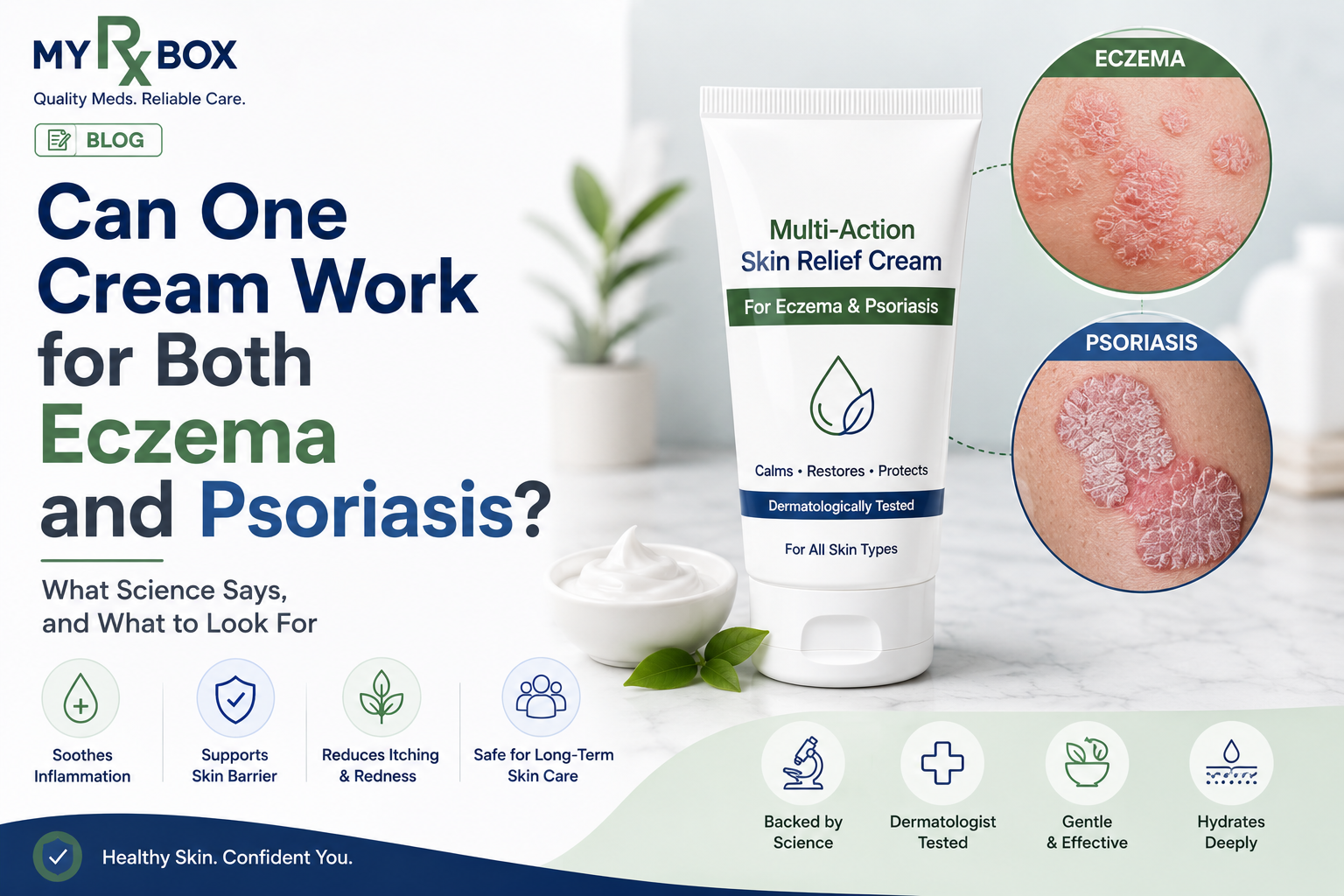
Can One Cream Work for Both Eczema and Psoriasis?
You have dry, itchy, flaky skin.
You search for a cream.
Then the confusing part begins.
One product says eczema cream.
Another says psoriasis cream.
Some moisturizers claim to help dry skin generally.
And certain medicines—especially topical corticosteroids—can be used in treatment plans for both eczema and psoriasis.
So does the label really matter?
Yes.
Eczema and psoriasis may look similar, but they are different inflammatory skin conditions, and the product that makes sense for one rash may not be the right choice for another.
The American Academy of Dermatology says moisturizers are an important part of eczema care, while psoriasis treatment can involve moisturizers, topical corticosteroids, vitamin D analogues, salicylic acid, coal tar and other medicines depending on severity and location.
That means the smartest buying question is not:
“Which cream is strongest?”
It is:
“What is causing my skin problem, and what kind of cream fits that problem?”
If you are still unsure which condition you may have, start with the MyRxBox guide Eczema vs Psoriasis: Symptoms, Creams and Key Differences before comparing individual creams.
Why Eczema and Psoriasis Are So Easy to Confuse
Both conditions can produce:
- Dry skin
- Itching
- Inflammation
- Scaling
- Cracking
- Recurrent flare-ups
But the typical pattern can differ.
Eczema, particularly atopic dermatitis, is strongly associated with itching and a disrupted skin barrier.
Psoriasis more often produces well-defined, thicker, raised plaques with scale.
Psoriasis also has another clue that eczema usually does not: it can affect the nails and joints.
If you already know you are dealing with eczema, MyRxBox has a dedicated guide to choosing an eczema cream.
If psoriasis has been diagnosed instead, see the separate MyRxBox psoriasis cream guide.
Can the Same Cream Really Be Used for Both?
Sometimes treatment categories overlap.
But that does not mean every eczema cream should be used for psoriasis or every psoriasis cream should be used for eczema.
One major example is topical corticosteroids.
Dermatologists commonly use topical corticosteroids to reduce inflammation and itching in eczema. The American Academy of Dermatology also describes topical corticosteroids as the most commonly prescribed topical treatment for psoriasis.
However, corticosteroids come in different strengths.
Where the cream is applied also matters.
A product appropriate for thick psoriasis plaques on an elbow may not be appropriate for thinner facial skin.
AAD warns that stronger topical steroids used incorrectly on thin skin can cause problems such as skin thinning and stretch marks.
So the fact that one ingredient category can be used for both conditions does not mean the same product should automatically be applied everywhere.
What Should You Look for in an Eczema Cream?
For eczema-prone skin, moisture retention and skin-barrier support are especially important.
AAD currently recommends moisturizer for everyone with atopic dermatitis and says keeping the skin well moisturized can help prevent cracking, itching and worsening rash.
When choosing a basic moisturizer, dermatologists frequently recommend a thick fragrance-free cream or ointment rather than a thin lotion.
AAD specifically advises people with atopic dermatitis to use fragrance-free products and notes that “unscented” is not necessarily the same thing as fragrance-free.
If you are comparing a specific product, you can review the current MyRxBox Eczema Cream product listing for its current ingredient information, pack details, directions and availability.
Before buying, check whether the product is:
- A moisturizer
- A cosmetic
- An OTC medicine
- A prescription medicine
- A combination product
Those classifications matter because they determine what the product can reasonably be expected to do.
Why Fragrance-Free Matters for Eczema-Prone Skin
A cream can smell pleasant and still be a bad match for sensitive skin.
AAD recommends fragrance-free skin-care products for people with atopic dermatitis because fragrance can trigger flare-ups in some people.
This is particularly important when buying creams online, where phrases such as:
- Natural
- Herbal
- Botanical
- Luxury
- Aromatherapy
- Essential-oil enriched
can sound appealing.
“Natural” does not automatically mean less irritating.
Plant extracts, essential oils and fragrance ingredients can still trigger reactions in susceptible skin.
When trying a new cosmetic or moisturizer, AAD recommends testing new skin-care products before broader use.
When Is the Best Time to Apply an Eczema Moisturizer?
Timing can matter almost as much as product choice.
AAD recommends moisturizing after bathing while the skin still contains moisture.
A thick cream or ointment applied to slightly damp skin can help reduce water loss and support the damaged skin barrier.
A simple routine can be:
Use lukewarm water rather than very hot water.
Avoid harsh cleansers.
Pat rather than aggressively rub the skin dry.
Then apply an appropriate moisturizer.
For more product-selection guidance, see Best Eczema Cream: How to Choose One for Itchy, Irritated Skin.
What Should You Look for in a Psoriasis Cream?
Psoriasis is different because reducing dryness is only one part of treatment.
Psoriasis involves accelerated skin-cell turnover and inflammation.
Depending on the type and severity, topical treatment may include:
- Moisturizers
- Corticosteroids
- Vitamin D analogues
- Salicylic acid
- Coal tar
- Retinoids
- Other prescription topical medicines
AAD’s psoriasis guideline recommends topical corticosteroids for plaque psoriasis in appropriate areas and also identifies agents such as vitamin D analogues, salicylic acid, coal tar and emollients as treatment options.
For people specifically shopping for psoriasis skin care, MyRxBox has a Psoriasis Cream product page where the current product details can be checked before purchase.
You can also read Best Psoriasis Cream: What to Look for Before Choosing One for broader treatment-selection information.
Moisturizer Still Matters in Psoriasis
Even though psoriasis is not simply “dry skin,” moisturizing can still help.
AAD says moisturizers can benefit anyone with psoriasis because psoriasis commonly produces dryness and scale.
Heavy creams, ointments and oils may be more useful than lightweight lotions for very dry psoriasis-prone skin.
Moisturizing can help:
- Reduce dryness
- Soften scale
- Reduce cracking
- Make skin feel more comfortable
That does not mean moisturizer treats the underlying immune process.
Instead, it is often used as part of a broader skin-care or treatment plan.
Why Some Psoriasis Creams Contain Salicylic Acid
Salicylic acid is commonly used as a scale-softening ingredient.
AAD notes that salicylic acid can help loosen and remove psoriasis scale.
This can make it useful for thick or scaly areas.
However, an ingredient designed to break down thick psoriasis scale may not be the ideal choice for every patch of highly sensitive or inflamed eczema.
That is another reason the two product categories should not automatically be treated as interchangeable.
What About Hydrocortisone?
Hydrocortisone is one of the best examples of overlap.
Mild hydrocortisone products are available without a prescription in many places.
AAD says mild hydrocortisone may work for a few small psoriasis patches and that topical corticosteroids also have an established role in eczema treatment.
But stronger is not always better.
Steroid strength, body location and treatment duration matter.
Using a strong corticosteroid for too long or on an inappropriate area can increase the risk of unwanted effects.
Anyone needing repeated steroid treatment should consider professional guidance rather than continuously increasing strength on their own.
Cream vs Ointment: Which Is Better?
People often use “cream” to describe almost every topical treatment.
Technically, creams and ointments behave differently.
Ointments usually contain more oil and form a stronger barrier over the skin.
Creams are generally less greasy and can be easier to use during the day.
AAD notes that ointments can be particularly soothing for cracked psoriasis and frequently recommends thick creams or ointments for eczema-prone skin.
So when buying, don’t look only at the active ingredient.
Also consider the vehicle.
For very dry, cracked skin, an ointment may feel better.
For hair-bearing areas or daytime use, a lighter formulation may be more practical.
Can You Use Eczema Cream on Psoriasis?
A basic fragrance-free moisturizer marketed for eczema may sometimes still help relieve dryness in someone with psoriasis.
That is different from saying it will treat psoriasis itself.
If the “eczema cream” contains medication, the answer becomes more complicated.
Different active ingredients, strengths and formulations can have very different uses.
Therefore, check the ingredient list and product classification rather than relying only on the words printed on the front of the package.
If you are deciding between the two conditions, review MyRxBox’s complete eczema vs psoriasis comparison first.
Can You Use Psoriasis Cream on Eczema?
Again, it depends on what is actually inside the cream.
A simple moisturizer may be usable on many types of dry skin.
A medicated psoriasis cream containing an ingredient intended to remove thick scale or alter skin-cell turnover may not be appropriate for irritated eczema.
The phrase “psoriasis cream” alone does not tell you enough.
Always check:
- Active ingredients
- Intended use
- Directions
- Warnings
- Body areas where it can be applied
- Recommended age
- Whether the product requires professional supervision
The Face Is Different From the Elbows and Knees
This is one of the most important cream-buying mistakes to avoid.
Skin thickness varies dramatically across the body.
Elbows and knees have relatively thick skin.
Facial skin is thinner.
Body folds are also more sensitive.
AAD cautions that strong topical corticosteroids used on thin skin can cause unwanted effects such as thinning and stretch marks.
So don’t assume that a cream used successfully on a thick elbow plaque belongs on the eyelids, face or groin.
The location of the rash matters almost as much as the diagnosis.
Why Psoriasis With Joint Pain Needs More Than a Cream
Sometimes the most important clue isn’t on the skin.
Psoriasis can be associated with psoriatic arthritis.
AAD advises people with psoriasis to tell a dermatologist if they develop symptoms such as:
- Swollen joints
- Morning stiffness
- A noticeably swollen finger or toe
- Heel pain
- Nail pitting
- Lower-back pain
Early diagnosis and treatment can help reduce joint damage.
A topical cream may improve a skin plaque.
It cannot address inflammatory arthritis inside a joint.
So someone with psoriasis plus persistent joint symptoms should not simply keep buying stronger creams.
When Eczema Needs More Than Moisturizer
The same principle applies to eczema.
Moisturizer is a foundation of skin-barrier care, but moderate or severe eczema may require medication.
AAD’s current treatment guidance includes topical corticosteroids, topical calcineurin inhibitors, crisaborole, roflumilast and other treatments depending on the patient and severity.
If the skin becomes increasingly painful, swollen, crusted or infected-looking, a moisturizer alone may not be enough.
Some eczema can become secondarily infected because scratching damages the skin barrier.
The “Natural Cream” Trap
A common online-shopping mistake is assuming that a natural product is automatically the safest choice.
Skin does not recognize marketing categories.
It reacts to ingredients.
Someone may tolerate petroleum jelly perfectly but react strongly to an essential oil.
Another person may tolerate botanical extracts without a problem.
The key is not whether a product sounds natural.
The key is whether the ingredients are suitable for the individual’s skin.
People with very reactive eczema should be particularly cautious with fragrance.
Do Expensive Creams Work Better?
Not necessarily.
Price does not automatically predict effectiveness.
An expensive moisturizer may have elegant packaging, botanical extracts or a premium texture.
A simple fragrance-free cream or ointment may still provide excellent moisture retention.
AAD’s eczema recommendations focus on properties such as moisturizer consistency and fragrance avoidance—not luxury pricing.
For psoriasis, the correct active treatment matters more than whether the jar looks premium.
Before purchasing anything, compare what the product actually contains.
How to Compare the Two MyRxBox Cream Listings
If you are considering MyRxBox products, start by opening both listings rather than buying solely from the product name.
Review the MyRxBox Eczema Cream listing and compare it with the MyRxBox Psoriasis Cream listing.
Pay attention to:
- Ingredients
- Formulation
- Intended use
- Directions
- Pack size
- Warnings
- Current availability
Then compare that information with the condition you are actually trying to manage.
If the diagnosis itself is uncertain, do not let the name of an online cream become your diagnosis.
Eczema Cream Buying Checklist
Before choosing an eczema cream, ask:
Is the product fragrance-free?
Is it designed for dry or sensitive skin?
Is it a moisturizer or medicated treatment?
Does it contain an ingredient I have reacted to before?
Is it appropriate for the body area involved?
Is professional guidance needed?
For a longer buying guide, read How to Choose an Eczema Cream That Soothes Itchy, Irritated Skin.
Psoriasis Cream Buying Checklist
Before buying psoriasis cream, ask:
Do I actually have psoriasis?
Is the product primarily a moisturizer or an active treatment?
Does it contain an ingredient for scale, inflammation or both?
Where on the body will I use it?
Are the plaques mild and localized or widespread?
Do I have nail changes or joint symptoms?
For more detail, see MyRxBox’s Best Psoriasis Cream Guide.
Where to Browse More Skin-Care Products
If you want to compare additional topical products rather than only eczema and psoriasis options, browse the MyRxBox Skin Care product category.
For educational skin-condition articles, visit the MyRxBox Skin Care section.
Readers interested in other conditions involving itching, rashes or parasites can also explore the Parasite and Skin Problems section.
So Which Cream Should You Buy?
There is no universal answer.
If you have dry, intensely itchy, sensitive skin associated with eczema, barrier-supporting moisturization is usually a major part of care.
If you have thick, well-defined psoriasis plaques, treatment may require more than a moisturizer and can involve specific topical medicines targeted at inflammation, scaling or abnormal skin-cell turnover.
And if you do not know which condition you have?
That is the most important information to establish before buying multiple medicated products.
Use the Eczema vs Psoriasis comparison guide as a starting point, but remember that photographs and online descriptions cannot always distinguish inflammatory skin conditions reliably.
The Bottom Line
Eczema and psoriasis can look similar enough to create confusion in the skin-care aisle.
Both can itch.
Both can scale.
Both can crack.
And both can benefit from good moisturization.
But they are not the same disease.
A moisturizer may overlap between the two.
Certain anti-inflammatory medicines may also be used for both.
But product strength, active ingredients, location and diagnosis all matter.
Instead of asking:
“What is the strongest cream I can buy?”
ask:
“Is this product actually appropriate for the condition and the part of my body I am treating?”
If eczema is your main concern, compare the MyRxBox Eczema Cream with the site’s eczema cream buying guide.
If psoriasis is the concern, review the MyRxBox Psoriasis Cream alongside the psoriasis cream guide.
And if you are still unsure which condition is causing the rash, return to the complete eczema vs psoriasis guide before deciding what to purchase.
Frequently Asked Questions
Can one moisturizer be used for both eczema and psoriasis?
Sometimes, yes. A basic moisturizer may help relieve dryness in both conditions. However, medicated products should not automatically be treated as interchangeable.
What type of moisturizer is usually recommended for eczema?
AAD recommends thick, fragrance-free creams or ointments for many people with atopic dermatitis and advises moisturizing regularly, particularly after bathing.
Are moisturizers useful for psoriasis?
Yes. AAD says moisturizers can benefit anyone with psoriasis by helping reduce dryness and supporting skin comfort.
Can steroid creams be used for eczema and psoriasis?
Topical corticosteroids are used in treatment plans for both conditions. However, strength, duration and body location matter, so they should be used according to appropriate directions.
Is psoriasis cream good for eczema?
Not automatically. Some ingredients may overlap, while others may be specifically intended for psoriasis scale or skin-cell turnover. Check the active ingredients before using one condition’s medicated product for another.
Is eczema cream good for psoriasis?
A moisturizer marketed for eczema may still help dry psoriasis skin, but it should not automatically be expected to treat psoriasis inflammation or plaques.
Should I choose a cream or ointment?
Ointments are generally heavier and can be useful for very dry or cracked skin. Creams are usually less greasy. The best choice depends on the condition, severity, body area and personal preference.
When should someone with psoriasis see a doctor rather than just buying cream?
Seek professional evaluation if psoriasis is extensive, persistent, difficult to control or accompanied by swollen joints, morning stiffness, heel pain, nail changes or swollen fingers or toes.
Where can I compare eczema and psoriasis products?
You can review the MyRxBox Eczema Cream, MyRxBox Psoriasis Cream and the wider Skin Care collection.
Medical Disclaimer: This article is for general educational purposes. Eczema, psoriasis, fungal infections, contact dermatitis and other skin diseases can sometimes look similar. A cream appropriate for one condition may not be appropriate for another. Seek professional medical advice for persistent, severe, infected, widespread or uncertain skin symptoms and before using prescription medicines.