
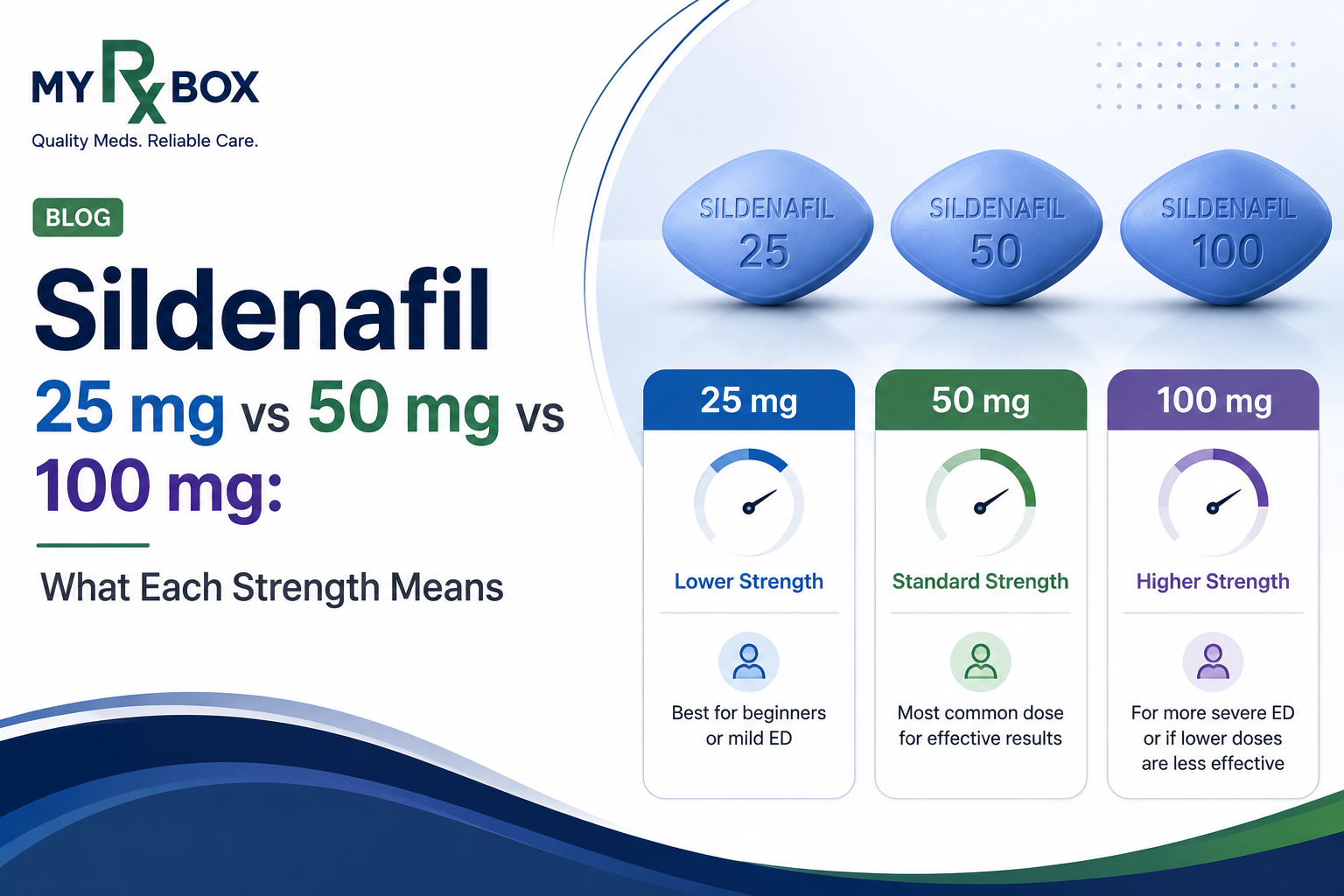
Sildenafil 25 mg vs 50 mg vs 100 mg: What is the difference?
When comparing sildenafil 25 mg vs 50 mg vs 100 mg, the most important thing to understand is that a higher number does not automatically mean a better treatment.
All three strengths contain the same active ingredient: sildenafil. The difference is the amount of sildenafil in each tablet.
For erectile dysfunction, official Viagra prescribing information lists tablets containing 25 mg, 50 mg and 100 mg of sildenafil. For most patients, 50 mg is the recommended dose, taken as needed approximately one hour before sexual activity. Depending on effectiveness and tolerability, a healthcare professional may reduce the dose to 25 mg or increase it to a maximum recommended dose of 100 mg. The maximum recommended dosing frequency is once per day.
That means choosing between sildenafil 25 mg, 50 mg and 100 mg should be based on medical suitability and response, not simply on which tablet is strongest.
Quick comparison: Sildenafil 25 mg vs 50 mg vs 100 mg
| Sildenafil strength | How it may be used | Key consideration |
|---|---|---|
| 25 mg | A lower strength that may be selected for certain patients | May be considered when a lower dose is medically appropriate |
| 50 mg | Recommended dose for most patients according to Viagra prescribing information | Often used as the initial reference dose |
| 100 mg | Maximum recommended single dose for erectile dysfunction | May be considered if a lower dose is insufficient and well tolerated |
The FDA prescribing information specifically states that dose adjustment should be based on effectiveness and tolerability.
How does sildenafil work?
Sildenafil belongs to a group of medicines called phosphodiesterase type 5 inhibitors, commonly shortened to PDE5 inhibitors.
It helps relax blood vessels and improve blood flow to the penis during sexual stimulation, making it easier for some people with erectile dysfunction to achieve and maintain an erection.
Sildenafil does not cause an automatic erection and does not increase sexual desire. Sexual stimulation is still required for the medicine to work.
This distinction matters because increasing the sildenafil strength does not eliminate the need for sexual stimulation and does not necessarily correct every possible cause of erectile dysfunction.
Sildenafil 50 mg: Why is it commonly discussed as the usual dose?
For most patients using Viagra for erectile dysfunction, official prescribing information recommends 50 mg as needed approximately one hour before sexual activity. The medicine may be taken between 30 minutes and four hours before sexual activity.
This is why sildenafil 50 mg appears so frequently in discussions about sildenafil starting doses.
However, 50 mg should not be interpreted as the correct dose for every individual. A healthcare professional may recommend another strength after considering factors such as:
- age;
- liver function;
- kidney function;
- cardiovascular health;
- blood pressure;
- other prescription medicines;
- previous response to sildenafil; and
- side effects.
The correct dose is therefore an individual clinical decision rather than a one-size-fits-all choice.
When might sildenafil 25 mg be considered?
Sildenafil 25 mg is the lowest of the three standard Viagra tablet strengths.
Official prescribing information says a 25 mg starting dose may be considered in certain circumstances, including in some people over 65, people with hepatic impairment, people with severe renal impairment, and patients taking particular medicines that can increase sildenafil exposure.
A lower dose may also be selected when a patient experiences unwanted effects at a higher strength.
That does not mean 25 mg is inherently ineffective. The aim of treatment is to find a dose that provides an appropriate response while limiting unnecessary adverse effects.
Sildenafil 25 mg may be relevant when:
- a prescriber decides a lower starting dose is appropriate;
- certain medicines could interact with sildenafil;
- age or health conditions affect how the medicine is processed;
- a higher dose causes troublesome side effects; or
- a patient responds adequately to the lower strength.
A person should not reduce, increase or combine tablets without following their prescriber’s instructions.
Is sildenafil 100 mg stronger than 50 mg?
Yes, a 100 mg tablet contains twice as much sildenafil as a 50 mg tablet.
But the more useful question is: Does 100 mg provide a better balance of benefit and side effects for that particular patient?
Not necessarily.
Official prescribing information allows the dose to be increased to a maximum recommended dose of 100 mg based on effectiveness and tolerability.
A higher dose may increase sildenafil exposure, but it can also increase the likelihood or intensity of adverse effects. This is why someone who has an unsatisfactory experience with 50 mg should not automatically move to 100 mg without medical guidance.
Several factors can affect how sildenafil works, including timing, food, underlying medical conditions, other medicines and whether adequate sexual stimulation occurred.
Is sildenafil 100 mg the maximum dose?
For Viagra used for erectile dysfunction, 100 mg is the maximum recommended dose listed in the FDA prescribing information, and the maximum recommended dosing frequency is once per day.
This point is especially important because online shoppers may encounter products advertised as sildenafil 150 mg or sildenafil 200 mg.
A larger number on an online product listing should not be interpreted as evidence that the product is more appropriate, more effective or safer.
Anyone considering a sildenafil strength beyond the standard approved dosing information should discuss the situation with a qualified healthcare professional rather than self-escalating the dose.
Sildenafil 150 mg and 200 mg: Why extra caution is needed
Searches for sildenafil 150 mg and sildenafil 200 mg are common online, but they should be approached cautiously.
The standard Viagra strengths listed in official FDA prescribing information are 25 mg, 50 mg and 100 mg, with 100 mg described as the maximum recommended dose for erectile dysfunction.
Therefore, a website advertising higher-strength sildenafil should not be treated as proof that such a dose is appropriate for an individual.
Extra caution is also appropriate when buying medicines online because imported or unapproved medicines may not have been evaluated to the same standards for safety, quality and efficacy. Australia’s TGA specifically warns that imported therapeutic products may be counterfeit or may contain ingredients or amounts that differ from what is claimed.
Does body weight determine sildenafil dosage?
Sildenafil dosing is not simply calculated according to body weight in adults using it for erectile dysfunction.
A larger person does not automatically require 100 mg, and a smaller person does not automatically require 25 mg.
Instead, a clinician considers the wider medical picture, including treatment response, tolerability, health conditions and interacting medicines.
This is another reason why selecting the “strongest” tablet based only on the milligram number is inappropriate.
Age, liver and kidney function can affect dose selection
The body must process and eliminate sildenafil after it is taken. Certain health factors can increase sildenafil exposure.
FDA prescribing information advises considering a 25 mg starting dose in people over 65 years of age, patients with hepatic impairment and patients with severe renal impairment.
This does not mean every older adult or every person with kidney or liver disease will receive the same dose.
It means these factors are relevant when a clinician decides which strength offers an appropriate balance between expected benefit and risk.
Sildenafil interactions that can affect safety
One of the most important parts of any sildenafil discussion is medication interaction.
Sildenafil and nitrates
Sildenafil must not be combined with nitrates or nitric oxide donors used for conditions such as angina because the combination can cause a dangerous drop in blood pressure.
Examples include medicines containing:
- nitroglycerin;
- glyceryl trinitrate;
- isosorbide mononitrate; and
- isosorbide dinitrate.
Recreational nitrites can present similar concerns.
Sildenafil and alpha blockers
Sildenafil can also lower blood pressure when combined with alpha-blocking medicines. The FDA prescribing information recommends particular caution and specifies a 25 mg sildenafil starting dose in certain patients using alpha blockers.
Other interacting medicines
Some medicines can increase sildenafil concentrations in the body. These include certain strong CYP3A4 inhibitors. This is another situation in which a healthcare professional may consider dose adjustment.
Always provide a doctor or pharmacist with a complete list of prescription medicines, over-the-counter products and supplements before using sildenafil.
Sildenafil side effects: Does dose matter?
Common adverse reactions reported with Viagra include:
- headache;
- flushing;
- indigestion;
- nasal congestion;
- dizziness;
- nausea; and
- temporary visual disturbances.
Higher sildenafil exposure can increase the possibility of some adverse reactions, which is why the objective is not to use the largest dose possible.
Instead, treatment aims to use a medically appropriate strength that provides sufficient benefit with acceptable tolerability.
If side effects are severe, persistent or concerning, contact a healthcare professional rather than changing the dose independently.
When does sildenafil require urgent medical attention?
Although many sildenafil side effects are mild, some symptoms require urgent assessment.
Seek urgent medical care if you experience:
- an erection lasting four hours or longer;
- sudden vision loss or a major change in vision;
- sudden decrease or loss of hearing;
- fainting or severe dizziness;
- symptoms of a severe allergic reaction; or
- chest pain or other serious cardiovascular symptoms.
Official prescribing information specifically instructs patients to seek emergency treatment for an erection lasting longer than four hours and prompt medical attention for sudden vision or hearing loss.
If emergency treatment is required, tell the healthcare team that sildenafil was taken and when it was taken.
Never combine sildenafil strengths without instructions
Someone who has 25 mg, 50 mg or 100 mg tablets available should not mix tablets or take additional doses because the first tablet “didn’t work quickly enough.”
The FDA prescribing information states that the maximum recommended dosing frequency for Viagra is once per day.
Taking additional tablets without medical instructions can increase sildenafil exposure and the risk of adverse effects.
The same principle applies to combining sildenafil with other erectile dysfunction medicines.
If the prescribed treatment appears ineffective, the safer approach is to discuss the result with the prescriber.
Sildenafil vs Viagra: Are they the same?
Viagra is a brand name, while sildenafil is the active pharmaceutical ingredient.
Other legitimate medicines may also contain sildenafil as their active ingredient.
This distinction is useful when comparing products because consumers should check the active ingredient and strength, rather than relying only on the brand name or tablet appearance.
For example, a product labelled sildenafil 50 mg and Viagra 50 mg may contain the same amount of sildenafil, but the manufacturer, regulatory approval, excipients, packaging and lawful availability can differ.
Never assume that every product advertised online as a “Viagra alternative” has been approved or quality-checked by the regulator in your country.
Comparing Cenforce, Caverta, Penegra and Kamagra strengths
Online searches frequently combine sildenafil strength terms with brand names such as:
- Cenforce 25 mg;
- Cenforce 50 mg;
- Cenforce 100 mg;
- Caverta 25 mg;
- Caverta 50 mg;
- Caverta 100 mg;
- Penegra 50 mg;
- Penegra 100 mg;
- Kamagra 50 mg; and
- Kamagra 100 mg.
When comparing any sildenafil-containing product, the milligram strength is only one part of the decision.
A consumer should also establish:
- the active ingredient;
- the stated strength;
- the manufacturer;
- whether the product is authorised in their country;
- whether a prescription is required;
- whether the pharmacy or supplier is appropriately licensed; and
- whether their clinician has approved that medicine and strength.
A brand being available from an international seller does not automatically mean it is approved or legally supplied in the buyer’s country.
Sildenafil prescription rules in the United States
Sildenafil used for erectile dysfunction is a prescription medicine in the United States. Its use should therefore involve appropriate medical assessment and lawful dispensing.
Prescription requirements are important because erectile dysfunction can sometimes occur alongside cardiovascular disease, diabetes, medication effects or other health conditions requiring evaluation.
A legitimate pathway should also allow the patient’s medication history and potential contraindications to be checked before treatment.
Sildenafil prescription rules in Australia
Sildenafil for erectile dysfunction is also a prescription medicine in Australia. Healthdirect states that patients need a prescription for erectile dysfunction medicines and should be assessed by a healthcare professional who can determine the appropriate medicine and dose.
Australians considering medicines supplied from overseas also need to understand the Personal Importation Scheme.
The TGA states that when a medicine is prescription-only in Australia, a valid Australian prescription or written authority must be held at the time of importation. Other quantity and eligibility conditions also apply.
Consumers should verify the current rules before ordering because overseas availability does not automatically equal lawful Australian supply.
How to assess an online sildenafil product page
Whether researching sildenafil 25 mg, 50 mg or 100 mg, avoid judging an online medicine solely by price or promotional claims.
A responsible product page should make important information easy to identify, including:
- active ingredient;
- tablet strength;
- dosage form;
- manufacturer;
- pack information;
- prescription requirements;
- safety information; and
- appropriate customer-support or pharmacy details.
Be cautious with websites that describe prescription medicines as “guaranteed,” “completely safe,” “side-effect free” or suitable for everyone.
Medical treatment cannot responsibly be guaranteed in that way.
How to choose between sildenafil 25 mg, 50 mg and 100 mg
The practical answer is simple:
Do not choose sildenafil strength by looking for the biggest number.
For most patients, official Viagra prescribing information recommends 50 mg as needed, while allowing adjustment down to 25 mg or up to a maximum of 100 mg depending on effectiveness and tolerability.
A prescriber may consider factors such as:
- how well the previous dose worked;
- whether side effects occurred;
- age;
- liver and kidney function;
- cardiovascular status;
- blood pressure; and
- interacting medicines.
The best dose is therefore the lowest medically appropriate strength that provides the desired treatment response with acceptable tolerability, as determined with professional guidance.
Frequently Asked Questions
Is sildenafil 25 mg enough?
For some patients, it may be. Sildenafil 25 mg is an established tablet strength, and official prescribing information allows the dose to be decreased to 25 mg based on effectiveness and tolerability. It may also be selected as a starting dose in certain patients.
Is sildenafil 50 mg a normal starting dose?
For most patients using Viagra for erectile dysfunction, the FDA prescribing information recommends 50 mg as needed approximately one hour before sexual activity. Individual prescribing decisions may differ.
Is 100 mg sildenafil better than 50 mg?
Not automatically. A 100 mg tablet contains more sildenafil, but treatment success depends on response and tolerability. The dose may be increased to 100 mg when medically appropriate, but 100 mg is the maximum recommended Viagra dose for erectile dysfunction.
Can I take two 50 mg sildenafil tablets instead of one 100 mg tablet?
Do not change or combine tablets unless your prescriber specifically instructs you to do so. Sildenafil dosing should follow the prescription, and the maximum recommended Viagra dosing frequency is once daily.
Can I take sildenafil every day?
The appropriate schedule depends on the prescription and medical circumstances. For Viagra used as needed for erectile dysfunction, official prescribing information states that the maximum recommended dosing frequency is once per day.
Does sildenafil work without sexual stimulation?
No. Sildenafil helps support the erection process, but sexual stimulation is still required. It does not automatically produce an erection or increase sexual desire.
Can sildenafil be taken with nitrates?
No. Sildenafil should not be used with nitrates or nitric oxide donors because the combination can cause a dangerous fall in blood pressure.
What happens if sildenafil does not work the first time?
Do not automatically increase the dose. Timing, food, stimulation, medical conditions, interactions and other factors can influence the experience. Discuss an inadequate response with a healthcare professional before changing the strength.
Final Thoughts: Which Sildenafil Strength Is Best?
When comparing sildenafil 25 mg vs 50 mg vs 100 mg, there is no single strength that is “best” for everyone.
Sildenafil 25 mg provides a lower-dose option and may be appropriate in certain patients.
Sildenafil 50 mg is the recommended dose for most patients in official Viagra prescribing information.
Sildenafil 100 mg is the maximum recommended dose and may be considered when a lower strength does not provide adequate benefit and the medicine is well tolerated.
The right choice depends on medical history, other medicines, treatment response and side effects—not on selecting the largest milligram number.
Anyone experiencing persistent erectile dysfunction should consider discussing it with a healthcare professional because ED can have physical, psychological or medication-related causes and may sometimes warrant a broader health assessment.