
There is a number in the cardiology literature that almost no one outside cardiology knows, and it is one of the most useful pieces of information a man can have about his own body.
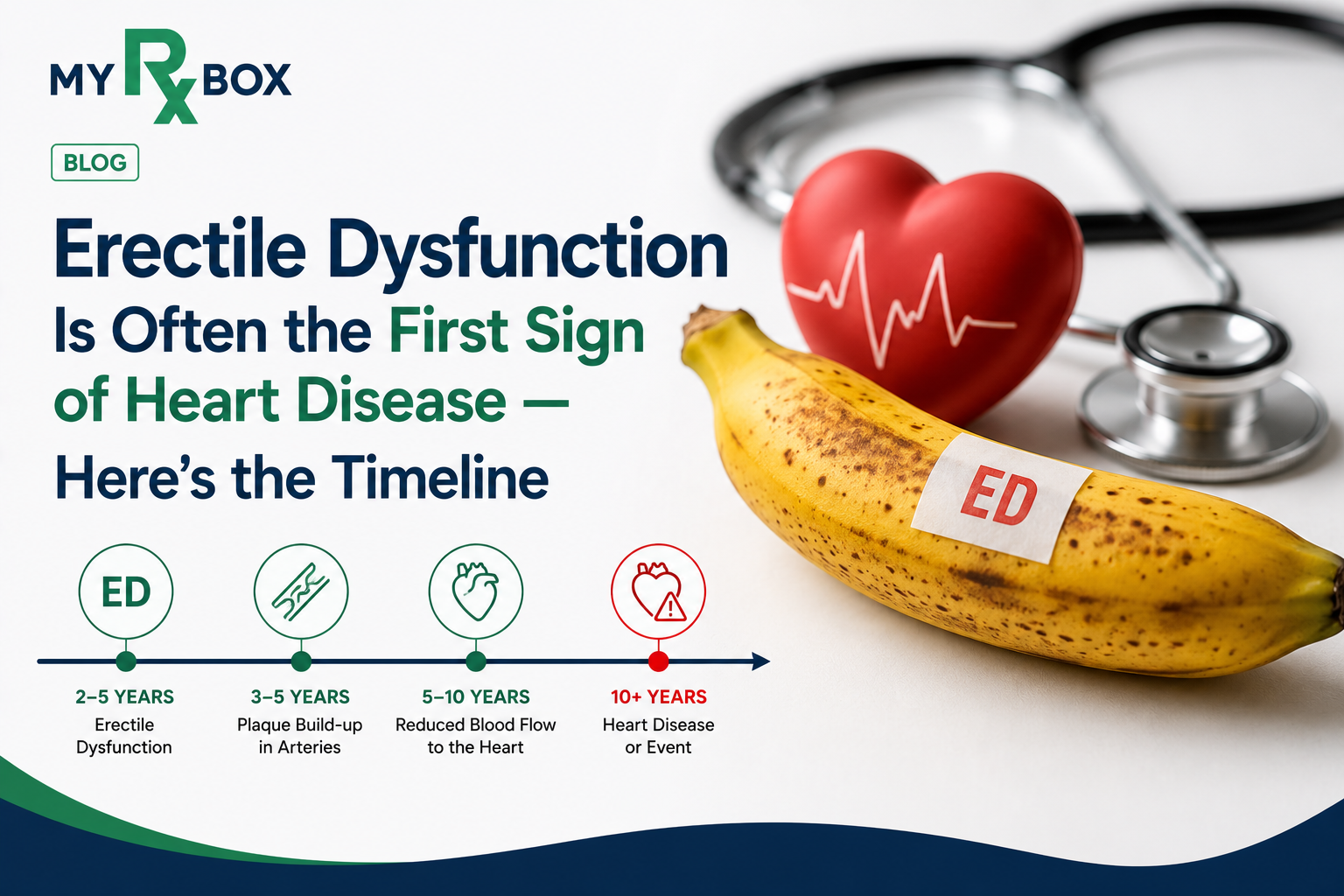
Erectile dysfunction of vascular origin precedes a cardiac event by an average of three to five years.
Not occasionally. On average. It’s a consistent finding across multiple cohorts, and it means that for a large number of men, the first symptom of coronary artery disease is not chest pain, breathlessness or a collapse at work. It’s a bedroom problem that they find humiliating, tell nobody about, and try to solve privately.
That gap — three to five years — is an extraordinary amount of warning. It is enough time to change the outcome entirely. And most of it gets spent looking for a pill rather than a diagnosis.
This article explains why the connection exists, how strong the evidence actually is, how to tell vascular ED from the other causes, what to ask for, and what genuinely improves it.
An erection is a vascular event
This is the piece that reframes everything else.
An erection is achieved by blood flow. Sexual stimulation triggers the release of nitric oxide from nerve endings and, critically, from the endothelium — the single-cell layer lining every blood vessel in the body. Nitric oxide activates guanylate cyclase, which produces cyclic GMP, which relaxes the smooth muscle in the walls of the penile arteries and the trabecular tissue of the corpora cavernosa. Those arteries dilate, blood floods in, the expanding tissue compresses the veins against the surrounding tunica albuginea, outflow is restricted, and pressure is maintained.
The whole sequence depends on healthy endothelium and healthy arteries. It is a functional test of the vascular system that happens to be performed regularly and reported by the patient.
Endothelial dysfunction — the failure of that lining to produce adequate nitric oxide and dilate on demand — is also the earliest measurable stage of atherosclerosis. It precedes plaque. It precedes any narrowing visible on a scan. It is the beginning of the disease that produces heart attacks and strokes.
So vascular ED and early coronary disease are not two conditions that happen to be associated. They are frequently the same pathological process, showing up in two places, at different times.
Why it shows up in the penis first
This is known as the artery size hypothesis, and it’s elegantly simple.
The same degree of endothelial dysfunction and plaque burden produces a proportionally greater reduction in flow through a narrow vessel than a wide one. So the smallest arteries become symptomatic first.
Approximate diameters:
- Penile (cavernosal) arteries: 1–2mm
- Coronary arteries: 3–4mm
- Internal carotid: 5–7mm
- Femoral: 6–8mm
A plaque burden that reduces the cavernosal artery enough to impair erection will not yet meaningfully restrict a coronary artery. Give it a few more years of the same process and it will.
This predicts the observed clinical sequence exactly: erectile dysfunction first, then angina and myocardial infarction, then — often — claudication and peripheral arterial disease later still. That’s the order it tends to happen in, and the artery size hypothesis explains why.
What the evidence actually shows
It’s worth being precise here, because this is an area where both overstatement and dismissal are common.
Montorsi and colleagues conducted the work that established the timeline. In a cohort of men admitted with acute chest pain and angiographically proven coronary disease, roughly half reported erectile dysfunction predating their cardiac symptoms, with a mean interval of about three years. Subsequent work extended the typical range to three to five.
Large meta-analyses pooling prospective cohort studies have found men with ED carry meaningfully elevated risk of subsequent cardiovascular events — in the region of a 44% increase in total cardiovascular events, around 62% for myocardial infarction, and roughly 25% for all-cause mortality compared with men without ED. Effect sizes differ between analyses depending on inclusion criteria and adjustment, but the direction and rough magnitude are consistent.
The Princeton Consensus Panel, now in its fourth iteration, formalised this into clinical guidance: ED in a man with no known cardiac disease should be treated as a marker warranting cardiovascular risk assessment. This is mainstream cardiology, not a fringe position.
The relative risk is highest in younger men. This is counterintuitive and important. ED becomes more common with age, so in a 75-year-old it carries less discriminating information. In a man of 40 to 50, ED is statistically unusual and therefore a much stronger signal that something vascular is developing early. Some analyses put the relative risk elevation in men under 60 at several times that seen in older men.
ED is now formally recognised as an independent risk marker in several cardiovascular prevention guidelines — meaning it adds predictive information beyond the conventional factors of smoking, blood pressure, lipids and diabetes.
But not all ED is vascular
Overclaiming here would be its own kind of dishonesty. A significant proportion of erectile dysfunction has nothing to do with arteries, and telling every man with ED that he’s heading for a heart attack is both wrong and cruel.
Psychogenic ED — performance anxiety, relationship difficulty, depression, stress, pornography-related conditioning in some accounts. Common, particularly in younger men.
Medication-induced. A long list, covered below.
Neurological. Multiple sclerosis, Parkinson’s, spinal cord injury, diabetic neuropathy, and damage from pelvic surgery — radical prostatectomy in particular.
Hormonal. Hypogonadism, hyperprolactinaemia, thyroid disease in both directions.
Post-surgical or post-radiotherapy for prostate or bladder cancer.
Peyronie’s disease, where fibrous plaque causes curvature and pain.
How to tell them apart
There are reasonably reliable discriminators, and they’re worth knowing before you see anyone.
Points toward psychogenic:
- Sudden onset, often traceable to a specific event or period
- Situational — fine alone or with one partner, not another
- Morning and night-time erections preserved
- Younger age
- Normal function returns in low-pressure situations
Points toward organic, and specifically vascular:
- Gradual onset over months to years
- Present in all circumstances
- Loss or marked reduction of morning and spontaneous night-time erections
- Progressive worsening
- Presence of cardiovascular risk factors
That morning erection question is the highest-yield single discriminator, and it’s the one most men are never asked. Nocturnal erections occur several times per night during REM sleep and require no psychological input at all. If the plumbing works while you’re asleep, the plumbing works.
If your ED came on gradually, is present in every situation, and your morning erections have faded — that is the vascular pattern, and the rest of this article is aimed squarely at you.
What to ask for
If the pattern fits, the correct next step is not a prescription. It’s a workup, and it’s cheap, quick and mostly available through any GP.
Blood pressure. The commonest treatable cardiovascular risk factor and frequently silent.
Fasting lipid profile. Total cholesterol, LDL, HDL, triglycerides.
HbA1c or fasting glucose. Diabetes is one of the strongest causes of ED, it damages both vessels and nerves, and a very large number of men are undiagnosed. ED is a recognised presenting feature of type 2 diabetes.
Morning total testosterone, ideally before 11am on at least two occasions if low, since levels vary diurnally. Low testosterone causes reduced libido more characteristically than reduced erectile capability, but the two coexist.
Thyroid function, if there are other suggestive features.
Waist circumference and BMI. Visceral adiposity drives both endothelial dysfunction and reduced testosterone via aromatisation.
A formal cardiovascular risk score — QRISK3 in the UK, ASCVD in the US. Present the ED as part of the history, because it should influence how the result is acted on.
Ask directly about sleep apnoea. Snoring, witnessed apnoeas, daytime sleepiness. Untreated obstructive sleep apnoea is strongly associated with both ED and cardiovascular disease and is very commonly missed.
A man who walks into an appointment and says “I’ve had gradually worsening ED for a year, my morning erections have gone, and I understand that can be an early vascular sign — can we check my blood pressure, lipids and HbA1c” will get a substantially better consultation than one who asks for a prescription.
The safety issue that makes this urgent
There is a specific, lethal drug interaction at the centre of this topic and it follows directly from everything above.
PDE5 inhibitors — sildenafil, tadalafil, vardenafil — must be taken by anyone using nitrates.
That includes glyceryl trinitrate in any form (spray, sublingual tablet, patch), isosorbide mononitrate and dinitrate, nicorandil, and recreational alkyl nitrites — “poppers.”
The mechanism is straightforward. Nitrates donate nitric oxide, driving up cyclic GMP. PDE5 inhibitors block the enzyme that breaks cyclic GMP down. Combined, cGMP accumulates without brake, producing profound systemic vasodilation and catastrophic hypotension. People have died from this combination.
Now hold that alongside the central point of this article: the men most likely to have vascular ED are precisely the men most likely to be prescribed nitrates for angina, because both conditions arise from the same disease. The population that most wants these drugs overlaps heavily with the population for whom they are most dangerous.
There are other real contraindications and cautions — alpha-blockers requiring dose separation, significant hypotension, recent stroke or myocardial infarction, unstable angina, severe hepatic impairment, certain retinal conditions including retinitis pigmentosa, and a history of non-arteritic anterior ischaemic optic neuropathy.
And there is a question that has nothing to do with drug interactions: is your heart able to tolerate the exertion of sex at all? The Princeton Consensus exists partly to answer this, stratifying men into low, intermediate and high cardiac risk, with the intermediate and high groups needing exercise testing or cardiology input before resuming sexual activity. Sex is comparable to moderate exercise — roughly climbing two flights of stairs briskly. For a man with significant untreated coronary disease, that is a genuine stress.
This is why these medicines require a prescriber. Not as a formality — the assessment is short, but it’s the part that catches the thing that kills people.
What actually improves vascular ED
Here is the genuinely encouraging part, and it’s underreported because nobody profits from it.
Vascular ED is, in its earlier stages, substantially reversible. Endothelial function responds to intervention.
Exercise has the strongest evidence of any intervention. Multiple randomised trials and meta-analyses show aerobic exercise produces clinically meaningful improvement in erectile function. Roughly 160 minutes per week of moderate aerobic activity over six months is the sort of dose studied. The effect size in some trials approaches that of medication. It also improves every other cardiovascular parameter simultaneously.
Weight loss. Trials of intensive lifestyle intervention in obese men with ED have shown around a third regaining normal erectile function without any drug.
Smoking cessation. Nicotine is an acute vasoconstrictor and smoking is directly toxic to endothelium. Improvement follows cessation, and it’s faster in younger men and shorter-duration smokers.
Mediterranean-pattern diet. Consistently associated with improved erectile function in observational and interventional work, mediated through endothelial function.
Treating sleep apnoea. CPAP improves erectile function in men with significant OSA.
Reducing alcohol. Chronic heavy intake impairs function through hepatic, hormonal and neurological routes.
Controlling blood pressure and blood glucose. Both directly protect endothelium — see blood pressure care and diabetes care for the medicines involved, all of which require a prescriber and monitoring.
The distinction that matters: PDE5 inhibitors treat the symptom. The interventions above treat the disease. A man who takes a tablet and changes nothing has a working erection and an unchanged trajectory toward the cardiac event that the ED was warning him about. That is the failure mode this entire article exists to prevent.
Medications that commonly cause ED
Worth reviewing with a prescriber if the timing fits — but do not stop any of these on your own.
- Thiazide diuretics — among the commonest culprits
- Older beta-blockers — atenolol, propranolol; nebivolol appears substantially better and is sometimes substituted for this reason
- SSRIs and SNRIs — very common, dose-related
- Finasteride and dutasteride — for prostate enlargement or hair loss
- Spironolactone — anti-androgenic
- Some antipsychotics — via raised prolactin
- Opioids — suppress the hypothalamic-pituitary-gonadal axis
- Cimetidine
- Anabolic steroids — suppress endogenous testosterone, often persistently
Stopping antihypertensive or antidepressant medication unsupervised trades a sexual problem for a stroke or a relapse. Substitution within the same class is frequently possible and is a conversation worth having.
When to seek help urgently
- ED accompanied by chest pain, breathlessness on exertion, or exertional jaw, arm or neck discomfort — this needs same-day assessment
- Sudden complete loss of erectile function with pain or curvature
- Priapism — an erection lasting over four hours is a urological emergency and can cause permanent tissue damage
- ED with visual disturbance, headache, or breast tissue development — suggests a pituitary cause
- ED alongside claudication — calf pain on walking that eases with rest, indicating established peripheral arterial disease
Common questions
I’m 30 and I have ED. Is this about my heart? Statistically, less likely — psychogenic causes dominate in younger men. But don’t assume. Early-onset vascular disease exists, particularly with familial hypercholesterolaemia, type 1 diabetes, smoking or heavy anabolic steroid use. The morning erection question is your best first discriminator, and the blood tests are cheap.
My ED improved on medication. Doesn’t that mean it’s fine? No. PDE5 inhibitors work by amplifying a nitric oxide signal that’s still partially present. Responding to them tells you the pathway isn’t completely destroyed. It says nothing about your coronary arteries.
Does testosterone therapy fix vascular ED? Generally no. Testosterone chiefly affects libido. If testosterone is genuinely low and confirmed on repeat morning samples, replacement may help — but it requires proper diagnosis and ongoing monitoring including haematocrit and PSA, and it suppresses fertility. It isn’t a treatment for arterial disease.
Is it just ageing? Prevalence rises with age, but ED is not an inevitable consequence of it. Many men retain function into their eighties. Treating it as unavoidable is how the warning gets discarded.
Can this be reversed? Often, in earlier stages, and substantially. Established atherosclerosis with fibrotic change in the cavernosal tissue responds less. Which is the argument for acting on it now rather than in three years.
The short version
If your erectile dysfunction came on gradually, happens in every situation, and your morning erections have faded, treat it as a vascular symptom until proven otherwise. You have, on average, a three-to-five-year head start on a cardiac event, and that window is long enough to change the ending.
Get your blood pressure, lipids and HbA1c checked. Ask about sleep apnoea. Have your medications reviewed. Start exercising — it has the best evidence of anything here and it treats the underlying disease rather than the symptom.
And if you and a prescriber decide medication is appropriate, that decision has to include the nitrate question, because the men who need that question asked are the same men most likely to want to skip it.
More in our men’s health articles, the men’s health range, and our plain-language guide to male hormones. Questions about anything here — get in touch.
This article is general health information and not individual medical advice. Erectile dysfunction has many causes and warrants proper assessment. PDE5 inhibitors are prescription-only medicines in the UK, US, Australia and most other countries, and are contraindicated with nitrates — a combination that can be fatal. If you have erectile dysfunction, particularly of gradual onset, speak to a doctor about cardiovascular assessment before seeking treatment for the symptom alone.