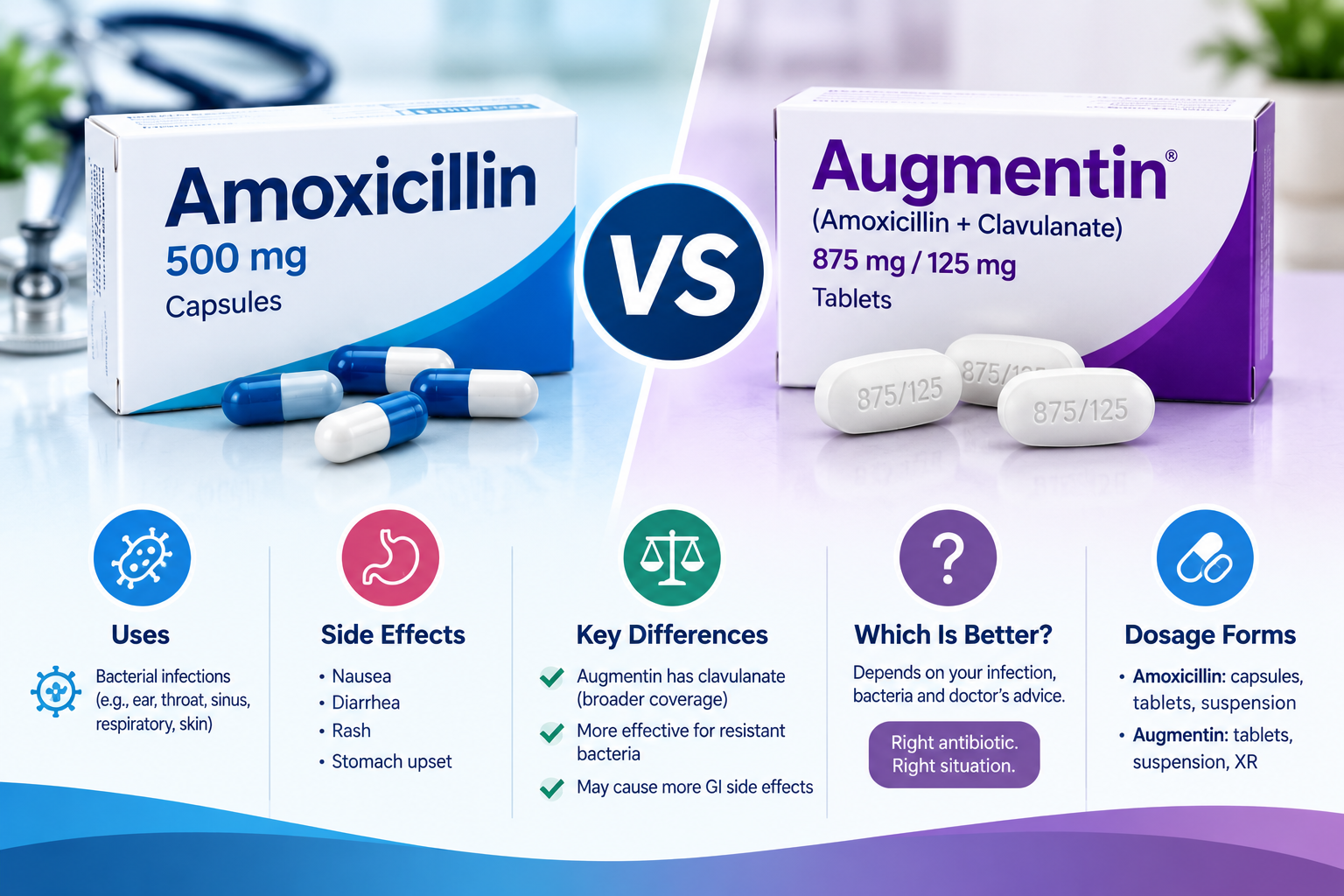
Amoxicillin and Augmentin are two commonly prescribed antibiotics used to treat bacterial infections. Although both medicines contain amoxicillin, they are not identical. The main difference is that Augmentin contains an additional ingredient called clavulanic acid, which helps amoxicillin work against certain bacteria that would otherwise resist its effects.
If you have been prescribed either medication, you may wonder: Is Augmentin stronger than amoxicillin? Do they treat the same infections? Which one has fewer side effects?
Understanding the differences between amoxicillin vs Augmentin can help you have a more informed discussion with your healthcare provider. This guide explains how both antibiotics work, their medical uses, possible side effects, and the factors doctors consider when choosing between them.
What Is Amoxicillin?
Amoxicillin is a penicillin-type antibiotic used to treat infections caused by susceptible bacteria. It works by interfering with bacterial cell wall formation, ultimately killing vulnerable bacteria.
Healthcare providers commonly prescribe amoxicillin for certain bacterial infections, including ear infections, bacterial throat infections, pneumonia, and some skin infections.
It may also be prescribed alongside other medications to treat Helicobacter pylori (H. pylori), a bacterium associated with certain stomach ulcers.
Amoxicillin is available in different forms, including capsules, tablets, chewable tablets, and oral liquid suspensions.
One example is Amoxicillin 250mg (Cipmox) Tablets, which contain amoxicillin as the active ingredient.
However, amoxicillin does not work against every type of bacterium. Some bacteria produce enzymes called beta-lactamases that can break down the antibiotic and prevent it from working effectively.
This is one reason a doctor may prescribe an antibiotic combination such as Augmentin instead.
What Is Augmentin?
Augmentin is the brand name for a combination antibiotic containing two active ingredients:
Amoxicillin: A penicillin-class antibiotic that kills susceptible bacteria by interfering with bacterial cell wall formation.
Clavulanic acid: A beta-lactamase inhibitor that blocks certain enzymes produced by bacteria, helping protect amoxicillin from being broken down.
Together, these ingredients allow Augmentin to treat some bacterial infections that may not respond to amoxicillin alone.
Doctors may prescribe Augmentin for certain bacterial infections involving the ears, sinuses, lungs, skin, and urinary tract.
Augmentin is available in different strengths and formulations, including Augmentin 375mg Tablets and Augmentin 1000mg Duo Tablets.
The appropriate formulation depends on the infection, the patient’s medical history, and the prescribed treatment plan.
Amoxicillin vs Augmentin: Key Differences
Although both medications belong to the penicillin family, their composition and antibacterial coverage differ.
| Feature | Amoxicillin | Augmentin |
|---|---|---|
| Active ingredients | Amoxicillin | Amoxicillin + clavulanic acid |
| Antibiotic class | Penicillin-type antibiotic | Penicillin-type antibiotic plus beta-lactamase inhibitor |
| Antibacterial coverage | Susceptible bacteria | Broader coverage against certain beta-lactamase-producing bacteria |
| Common medical uses | Certain ear, throat, respiratory, and skin infections | Certain ear, sinus, respiratory, skin, and urinary infections |
| Effect on beta-lactamase enzymes | Can be broken down by certain enzymes | Clavulanate blocks some beta-lactamases |
| Common side effects | Diarrhea, nausea, rash | Diarrhea, nausea, vomiting, rash |
| Available forms | Tablets, capsules, chewable tablets, suspension | Tablets, chewable tablets, suspension |
| Prescription required | Yes | Yes |
The main takeaway: Augmentin has broader antibacterial coverage, but broader does not automatically mean better. For infections caused by bacteria that respond to amoxicillin, amoxicillin alone may be the more suitable treatment.
Is Augmentin Stronger Than Amoxicillin?
Augmentin is sometimes described as a stronger version of amoxicillin because it contains clavulanic acid.
However, this description can be misleading.
Augmentin can work against certain bacteria that produce beta-lactamase enzymes, which may make amoxicillin alone ineffective. This gives Augmentin a wider range of antibacterial activity.
Nevertheless, not all bacterial resistance involves beta-lactamase production, and clavulanic acid cannot overcome every resistance mechanism.
For infections involving bacteria that are already susceptible to amoxicillin, adding clavulanic acid may provide no extra clinical benefit.
In fact, using a broader-spectrum antibiotic unnecessarily can expose patients to additional side effects and contribute to antibiotic resistance.
Therefore, the better antibiotic is the one that appropriately treats the diagnosed infection, rather than simply the medicine with broader coverage.
Amoxicillin vs Augmentin for Common Bacterial Infections
The choice between these two antibiotics often depends on the location of the infection, the bacteria suspected, previous antibiotic use, and the patient’s medical history.
1. Ear Infections
Amoxicillin is frequently the first-choice antibiotic for children with acute bacterial middle ear infections when antibiotics are needed.
Doctors may consider Augmentin when a child has recently received amoxicillin, has certain additional symptoms such as purulent conjunctivitis, or has a history of ear infections that did not respond to amoxicillin.
Not every ear infection requires antibiotics. Some mild cases may improve without antibiotic treatment under medical supervision.
2. Sinus Infections
Many sinus infections are caused by viruses rather than bacteria, meaning antibiotics will not help.
When a clinician diagnoses acute bacterial sinusitis and decides antibiotics are appropriate, amoxicillin or amoxicillin-clavulanate may be prescribed.
The choice depends on the patient’s symptoms, risk factors, and the likelihood of resistant bacteria.
3. Throat Infections
Amoxicillin is commonly prescribed for confirmed group A streptococcal throat infections.
Augmentin is generally not necessary for uncomplicated strep throat because amoxicillin alone is effective against the bacteria responsible.
A sore throat should not automatically be treated with antibiotics because most sore throats are viral.
4. Respiratory Infections
Both medications may be used for certain bacterial respiratory infections.
Amoxicillin is a treatment option for some cases of bacterial pneumonia. Augmentin may be considered in other situations when broader antibacterial coverage is appropriate.
The treatment decision depends on the specific diagnosis, severity, and individual health factors.
5. Dental Infections
Amoxicillin is sometimes prescribed for certain dental infections when antibiotics are clinically necessary.
Augmentin may be considered in selected cases when broader coverage is needed.
However, antibiotics alone cannot replace dental treatment such as drainage, root canal treatment, or removal of an infected tooth when those procedures are necessary.
Amoxicillin vs Augmentin: Side Effects
Both antibiotics can cause side effects because they affect bacteria throughout the body, including bacteria naturally present in the digestive system.
Common Side Effects of Amoxicillin
Possible side effects include nausea, diarrhea, vomiting, and skin rash.
Some people may also experience changes in their normal intestinal bacteria, which can contribute to digestive discomfort.
Common Side Effects of Augmentin
Augmentin can cause similar side effects, including diarrhea, nausea, vomiting, stomach discomfort, and rash.
Diarrhea is particularly common with amoxicillin-clavulanate, and some patients may experience more gastrointestinal side effects with this combination than with amoxicillin alone.
Serious Side Effects and Warning Signs
Although uncommon, either medication can cause serious adverse reactions.
Seek immediate medical attention for difficulty breathing, swelling of the face or throat, or symptoms of a severe allergic reaction.
Other warning signs that require prompt medical assessment include severe or bloody diarrhea, blistering skin reactions, persistent severe vomiting, and yellowing of the skin or eyes.
Augmentin has also been associated with liver problems in rare cases.
Always tell your healthcare provider about previous penicillin allergies or serious antibiotic reactions before starting treatment.
Can You Take Amoxicillin and Augmentin Together?
Amoxicillin and Augmentin should not be taken together unless a healthcare professional specifically instructs you to do so.
Augmentin already contains amoxicillin. Taking both medications without medical supervision could result in unnecessary additional amoxicillin exposure and increase the risk of adverse effects.
If you have been prescribed Augmentin after previously taking amoxicillin, ask your doctor or pharmacist when to stop the earlier medication and begin the new one.
Do not combine or switch antibiotics on your own.
Dosage and How to Take These Antibiotics
Amoxicillin and Augmentin are available in different strengths. The correct dose and treatment duration depend on factors such as the type of infection, age, body weight, kidney function, and medical history.
Amoxicillin may be taken with or without food, although taking it with food can help reduce stomach discomfort.
Augmentin is generally taken with food to improve gastrointestinal tolerability.
Both medications should be taken according to the prescribing clinician’s directions.
Take each dose at the prescribed time, and do not change the dosage or stop treatment early without speaking to your healthcare provider.
For children, liquid antibiotic doses often depend on body weight. Parents should use an oral dosing syringe or another properly marked measuring device rather than a household spoon.
Different Augmentin tablet strengths are not always interchangeable because the amount of clavulanate can differ.
Why Antibiotic Resistance Matters
Antibiotic resistance occurs when bacteria develop ways to survive medications that previously killed them or stopped their growth.
Using antibiotics when they are unnecessary increases the risk of resistant infections.
Neither amoxicillin nor Augmentin treats viral illnesses such as the common cold or influenza.
Taking Augmentin simply because it covers more bacteria is not a good reason to choose it over amoxicillin.
Healthcare professionals consider the likely bacteria, local resistance patterns, and clinical evidence before selecting an antibiotic.
Using the most suitable antibiotic for a confirmed or strongly suspected bacterial infection helps protect patients from unnecessary side effects.
Frequently Asked Questions
Is Augmentin better than amoxicillin?
Not always. Augmentin covers certain bacteria that may resist amoxicillin, but amoxicillin alone can be sufficient for many infections. The better choice depends on the diagnosis and the bacteria involved.
Does Augmentin work faster than amoxicillin?
Not necessarily. When the bacteria are susceptible to both medications, Augmentin does not automatically produce faster recovery. The time needed to feel better depends on the infection and individual response.
Is Augmentin the same as amoxicillin?
No. Augmentin contains amoxicillin plus clavulanic acid, while amoxicillin products contain amoxicillin without clavulanate.
Which antibiotic is better for a sinus infection?
Both may be prescribed for acute bacterial sinusitis. Many sinus infections do not need antibiotics at all. A doctor can determine whether treatment is necessary and which antibiotic is appropriate.
Does Augmentin cause more diarrhea than amoxicillin?
It can. Gastrointestinal symptoms, especially diarrhea, are common with Augmentin. However, either antibiotic may cause digestive side effects.
Can I switch from amoxicillin to Augmentin?
Only under medical guidance. A clinician may change treatment if symptoms do not improve, the infection worsens, or test results indicate that another antibiotic is more appropriate.
Can I take Augmentin if I am allergic to amoxicillin?
You should not take Augmentin if you have a confirmed serious allergy to amoxicillin unless an allergy specialist has assessed the situation and given specific instructions. Augmentin contains amoxicillin and may trigger a similar reaction.
Are amoxicillin and Augmentin safe for children?
Both medications are prescribed to children for appropriate bacterial infections. The dose and formulation must be selected by a healthcare professional based on the child’s condition, age, and weight.
Final Thoughts: Amoxicillin or Augmentin?
When comparing amoxicillin vs Augmentin, the most important difference is their antibacterial coverage.
Amoxicillin is an established antibiotic for many common bacterial infections. Augmentin combines amoxicillin with clavulanic acid to provide additional activity against certain bacteria that produce beta-lactamase enzymes.
Neither medication is universally better.
For bacteria susceptible to amoxicillin, amoxicillin alone may be sufficient. In other cases, a clinician may select Augmentin because the suspected bacteria require broader coverage.
The right treatment depends on a medical diagnosis, your health history, and the likely cause of infection.
If you want to learn more about available formulations, MyRxBox provides product information for Cipmox Amoxicillin 250mg and Augmentin 375mg.
Always obtain prescription antibiotics through a licensed pharmacy with a valid prescription and follow your healthcare provider’s instructions.
Medical References
- MedlinePlus – Amoxicillin
- MedlinePlus – Amoxicillin and Clavulanic Acid
- CDC – Outpatient Antibiotic Treatment for Adults
- CDC – Outpatient Antibiotic Treatment for Children
Medical Disclaimer: This article is intended for general educational purposes and is not a substitute for professional medical advice, diagnosis, or treatment. Always consult a licensed healthcare professional before starting, stopping, or changing prescription medication.